

Researchers have mapped the molecular changes that unfold as sunlight causes plastics to leach dissolved organic matter, findings that could reshape understanding of ecosystem health, water quality, and global carbon cycling.
Scientists have found that microplastics drifting through rivers, lakes, and oceans steadily release a wide range of dissolved organic chemicals into the water. These chemicals change over time, with sunlight playing a major role in how they form and break down. The research offers the most detailed molecular-scale look so far at how microplastic-derived dissolved organic matter, known as MPs DOM, develops and changes in natural aquatic environments.
The study, published in New Contaminants, examined four widely used types of plastic and compared the chemicals they release with naturally occurring dissolved organic matter found in rivers. By combining kinetic modeling with fluorescence spectroscopy, high-resolution mass spectrometry, and infrared analysis, the team showed that each plastic produces its own chemical signature. These signatures shift as sunlight alters the surface of the polymers.
“Microplastics do not just pollute aquatic environments as visible particles. They also create an invisible chemical plume that changes as they weather,” said lead author Jiunian Guan of Northeast Normal University. “Our study shows that sunlight is the primary driver of this process, and that the molecules released from plastics are very different from those produced naturally in rivers and soils.”
Sunlight accelerates the release of plastic-associated carbon
To explore this process, the researchers placed microplastics made of polyethylene, polyethylene terephthalate, polylactic acid, and polybutylene adipate co terephthalate in water under both dark conditions and ultraviolet light for periods of up to 96 hours. Exposure to sunlight sharply increased the amount of dissolved organic carbon released by all four plastics. Materials designed to be biodegradable, such as PLA and PBAT, released the highest levels, which the researchers linked to their less stable chemical structures.
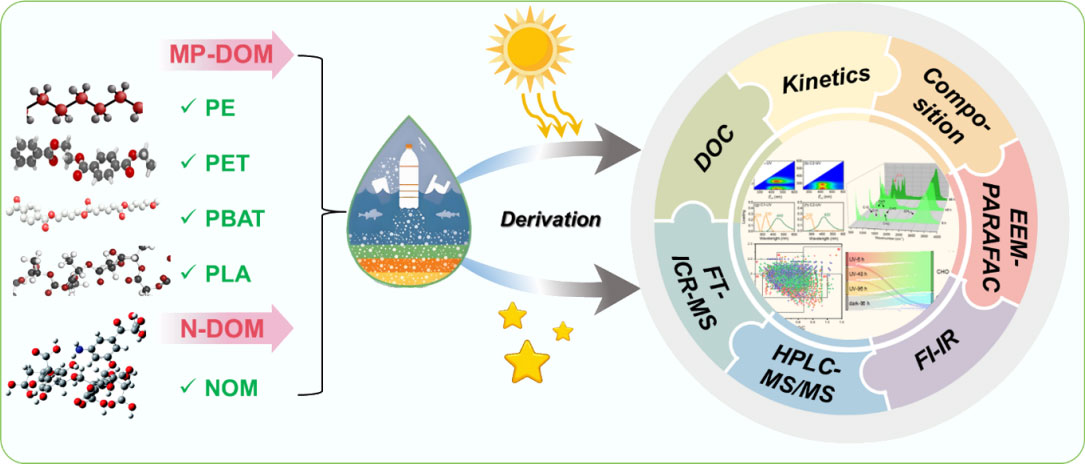
Using kinetic models, the team found that the release followed zero order behavior, meaning the process was controlled by physical and chemical constraints at the plastic surface rather than by the concentration of material already in the water. Film diffusion was identified as the rate-limiting step under ultraviolet light.
A chemically rich mix of additives, monomers, and oxidized fragments
Advanced spectroscopy and mass spectrometry revealed that MPs DOM contains a diverse set of molecules originating from additives, monomers, oligomers, and photooxidized fragments. Aromatic plastics such as PET and PBAT produced particularly complex mixtures.
As plastics weathered, oxygen-containing functional groups increased, indicating the formation of alcohols, carboxylates, ethers, and carbonyls. Additives such as phthalates also appeared, consistent with their weak bonding within polymer matrices.
Fluorescence analyses demonstrated that MPs DOM resembled material produced by microbial activity rather than by terrestrial sources, in sharp contrast to natural dissolved organic matter. Over time, the chemical composition shifted, with relative contributions of protein-like, lignin-like, and tannin-like substances changing depending on polymer type and sunlight exposure.
Environmental impacts could intensify as plastic pollution grows
The evolving chemical mixtures released from microplastics could influence aquatic ecosystems in several ways. MPs DOM is generally composed of small, bioavailable molecules that may stimulate or inhibit microbial activity, alter nutrient cycling, or interact with metals and pollutants. Previous studies have shown that MPs DOM can generate reactive oxygen species, affect disinfection byproduct formation, and modify pollutant adsorption.
“Our findings highlight the importance of considering the full life cycle of microplastics in water, including the invisible dissolved chemicals they release,” said co-author Shiting Liu. “As global plastic production continues to rise, these dissolved compounds may have growing environmental significance.”
Toward predictive tools for plastic pollution chemistry
Given the complexity of MPs DOM and its dynamic nature, the team suggests that machine learning approaches could help predict how this material evolves in the environment. Future models could support risk assessments related to aquatic health, contaminant behavior, and carbon cycling.
The authors note that microplastic inputs to rivers and oceans remain largely uncontrolled. As plastics continue to fragment and weather under sunlight, the release of MPs DOM is expected to intensify, making it essential to understand its chemical behavior across different stages of degradation.
Reference: “Molecular-level insights into derivation dynamics of microplastic-derived dissolved organic matter” by Shiting Liu, Xiamu Zelang, Chao Ma, Zhuoyu Li, Xinyue Wang, Hanyu Ju, Jingjie Zhang and Jiunian Guan, 5 December 2025, New Contaminants.
DOI: 10.48130/newcontam-0025-0016
Never miss a breakthrough: Join the SciTechDaily newsletter.
Follow us on Google and Google News.