
“Fingerprinting” Minerals To Better Understand How They Are Affected by Meteorite Collisions
Researchers mimicked these extreme impacts in the lab and discovered new details about how they transform minerals in Earth’s crust.
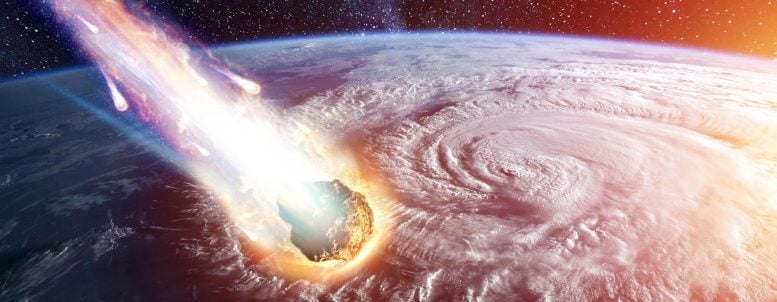
When a space rock survives the turbulent passage through Earth’s atmosphere and strikes the surface, it generates shockwaves that can compress and transform minerals in the planet’s crust. Since these changes depend on the pressure produced upon impact, experts can use features in Earth’s minerals to learn about the meteorite’s life story, from the moment of collision all the way back to the conditions from which the celestial bodies originate.
“If you compare an average mineral to one that’s been involved in a meteoritic impact, you’ll find some unique features in the shocked one,” says Arianna Gleason, a scientist at the Department of Energy’s SLAC National Accelerator Laboratory. “On the outside, they retain some of their original crystalline form, but inside they become disordered and full of beautiful interlocking linear formations called lamellae.”
Plagioclase, the most abundant mineral in the Earth’s crust, is one of the most commonly used minerals for painting a fuller picture of meteoritic impacts. However, the pressure at which this mineral loses its crystalline shape and becomes disordered – and how this process, called amorphization, plays out – is the subject of ongoing debate.
In a new experiment, SLAC researchers mimicked meteoritic impacts in the lab to explore how plagioclase transforms during shock compression. They discovered that amorphization begins at pressures much lower than previously assumed. They also discovered that, upon release, the material partially recrystallizes back into the original shape, demonstrating a memory effect that could potentially be harnessed for materials science applications. Their results, published today in Meteoritics and Planetary Science, could lead to more accurate models for learning about meteoritic impacts, including how fast meteors were traveling and the pressure they produced upon collision.
“The development of new tools and techniques allows us to recreate these impacts in the lab to get new information and see what’s happening in even greater detail,” says SLAC scientist Roberto Alonso-Mori, who co-led the research. “It really brings astronomy and planetary science right to our fingertips.”
Fingerprinting Minerals
Using the Matter in Extreme Conditions (MEC) instrument at SLAC’s Linac Coherent Light Source (LCLS) X-ray laser, the researchers struck a sample of plagioclase with a high-power optical laser to send a shockwave through it. As the shockwave traveled through the sample, the researchers hit the sample with ultrafast X-ray laser pulses from LCLS at different points in time. Some of these X-rays then scattered into a detector and formed diffraction patterns.
“Just like every person has their own set of fingerprints, the atomic structure of each mineral is unique,” says Gleason. “Diffraction patterns reveal that fingerprint, allowing us to follow how the sample’s atoms rearranged in response to the pressure created by the shockwave.”
The researchers could also tune the optical laser to different energies to see how the diffraction pattern changed at different pressures.
“Our experiment allowed us to watch the amorphization as it actually happened,” Alonso-Mori says. “We discovered that it actually starts at a lower pressure than we thought. We also found that the starting and ending ‘fingerprints’ were very similar, giving us evidence of a memory effect in the material. It changes how we think about the different shock stages of these processes and will help us refine the models we use to understand these impacts.”
Beauty From Destruction
In follow-up experiments, the researchers plan to capture and analyze information about debris kicked up during the impact. This would allow them to get a more complete picture of the impact and do side-by-side comparisons with what experts might find in the field to further improve models of meteoritic collisions. They also plan to explore other minerals and use more powerful lasers and larger volumes of material, which could provide insight into larger-scale processes such as planet formation.
Gleason adds that she’s excited about the light this research could shed on minerals found not only on Earth but also on other planets and extraterrestrial bodies. Further insights into how these minerals are affected by extreme impacts could unlock new information about astrophysical phenomena.
“I remember taking mineralogy and petrology as an undergrad and looking at these minerals through a microscope. As we changed the lighting, we illuminated all these beautiful details,” she says. “And now we’re able to understand, on an atomic level, how some of these intricate, gorgeous structures form, and in fact it correlates to this extreme, earth-shattering process. It’s fascinating that something so destructive could generate something so delicate and beautiful.”
Reference: “Ultrafast structural response of shock-compressed plagioclase” by Arianna E. Gleason, Sulgiye Park, Dylan R. Rittman, Alessandra Ravasio, Falko Langenhorst, Riccardo M. Bolis, Eduardo Granados, Sovanndara Hok, Thomas Kroll, Marcin Sikorski, Tsu-Chien Weng, Hae Ja Lee, Bob Nagler, Thomas Sisson, Zhou Xing, Diling Zhu, Gabriele Giuli, Wendy L. Mao, Siegfried H. Glenzer, Dimosthenis Sokaras and Roberto Alonso-Mori, 16 February 2022, Meteoritics and Planetary Science.
DOI: 10.1111/maps.13785
LCLS is a DOE Office of Science user facility. This research was supported by the Office of Science.
Never miss a breakthrough: Join the SciTechDaily newsletter.
Follow us on Google and Google News.
1 Comment
good article