
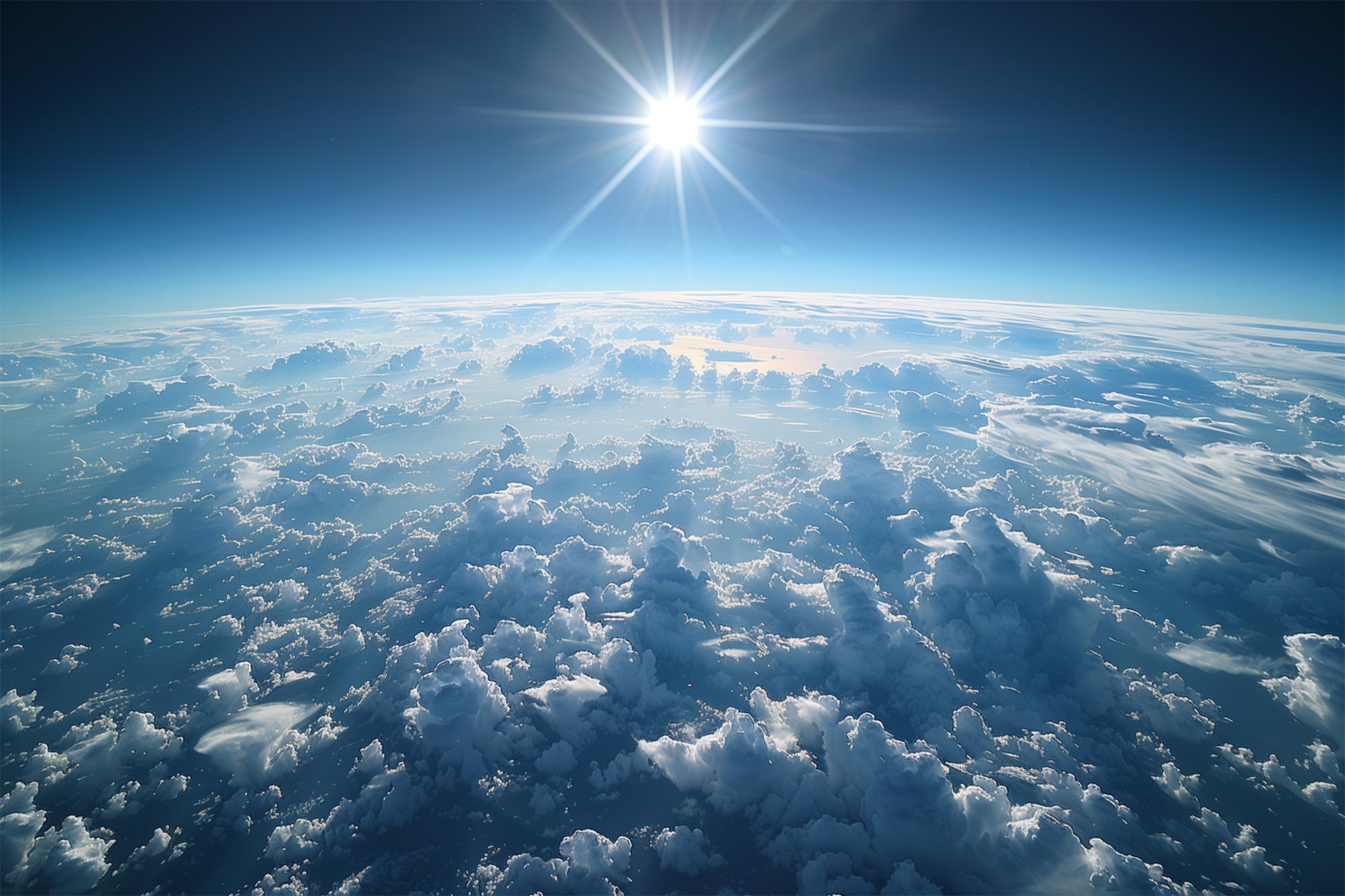
Researchers at MIT have identified a human “fingerprint” in the increasing levels of ozone in the upper troposphere.
This discovery, pinpointing the impact of human activity on this potent greenhouse gas, allows scientists to better understand where and how these emissions originate.
Ozone’s Dual Role: Protector and Pollutant
Ozone can be an agent of good or harm, depending on where you find it in the atmosphere. Way up in the stratosphere, the colorless gas shields the Earth from the sun’s harsh ultraviolet rays. But closer to the ground, ozone is a harmful air pollutant that can trigger chronic health problems including chest pain, difficulty breathing, and impaired lung function.
And somewhere in between, in the upper troposphere — the layer of the atmosphere just below the stratosphere, where most aircraft cruise — ozone contributes to warming the planet as a potent greenhouse gas.
There are signs that ozone is continuing to rise in the upper troposphere despite efforts to reduce its sources at the surface in many nations. Now, MIT scientists confirm that much of ozone’s increase in the upper troposphere is likely due to humans.
Human Impact on Upper Tropospheric Ozone
In a paper published recently in the journal Environmental Science and Technology, the team reports that they detected a clear signal of human influence on upper tropospheric ozone trends in a 17-year satellite record starting in 2005.
“We confirm that there’s a clear and increasing trend in upper tropospheric ozone in the northern midlatitudes due to human beings rather than climate noise,” says study lead author Xinyuan Yu, a graduate student in MIT’s Department of Earth, Atmospheric and Planetary Sciences (EAPS).
“Now we can do more detective work and try to understand what specific human activities are leading to this ozone trend,” adds co-author Arlene Fiore, the Peter H. Stone and Paola Malanotte Stone Professor in Earth, Atmospheric and Planetary Sciences.
The study’s MIT authors include Sebastian Eastham and Qindan Zhu, along with Benjamin Santer at the University of California at Los Angeles, Gustavo Correa of Columbia University, Jean-François Lamarque at the National Center for Atmospheric Research, and Jerald Zimeke at NASA Goddard Space Flight Center.
The Challenges of Ozone Analysis
Understanding ozone’s causes and influences is a challenging exercise. Ozone is not emitted directly, but instead is a product of “precursors” — starting ingredients, such as nitrogen oxides and volatile organic compounds (VOCs), that react in the presence of sunlight to form ozone. These precursors are generated from vehicle exhaust, power plants, chemical solvents, industrial processes, aircraft emissions, and other human-induced activities.
Whether and how long ozone lingers in the atmosphere depends on a tangle of variables, including the type and extent of human activities in a given area, as well as natural climate variability. For instance, a strong El Niño year could nudge the atmosphere’s circulation in a way that affects ozone’s concentrations, regardless of how much ozone humans are contributing to the atmosphere that year.
Detecting Human Influence Amid Natural Variability
Disentangling the human- versus climate-driven causes of ozone trend, particularly in the upper troposphere, is especially tricky. Complicating matters is the fact that in the lower troposphere — the lowest layer of the atmosphere, closest to ground level — ozone has stopped rising, and has even fallen in some regions at northern midlatitudes in the last few decades. This decrease in lower tropospheric ozone is mainly a result of efforts in North America and Europe to reduce industrial sources of air pollution.
“Near the surface, ozone has been observed to decrease in some regions, and its variations are more closely linked to human emissions,” Yu notes. “In the upper troposphere, the ozone trends are less well-monitored but seem to decouple with those near the surface, and ozone is more easily influenced by climate variability. So, we don’t know whether and how much of that increase in observed ozone in the upper troposphere is attributed to humans.”
A Human Signal Amid Climate Noise
Yu and Fiore wondered whether a human “fingerprint” in ozone levels, caused directly by human activities, could be strong enough to be detectable in satellite observations in the upper troposphere. To see such a signal, the researchers would first have to know what to look for.
For this, they looked to simulations of the Earth’s climate and atmospheric chemistry. Following approaches developed in climate science, they reasoned that if they could simulate a number of possible climate variations in recent decades, all with identical human-derived sources of ozone precursor emissions, but each starting with a slightly different climate condition, then any differences among these scenarios should be due to climate noise. By inference, any common signal that emerged when averaging over the simulated scenarios should be due to human-driven causes. Such a signal, then, would be a “fingerprint” revealing human-caused ozone, which the team could look for in actual satellite observations.
With this strategy in mind, the team ran simulations using a state-of-the-art chemistry climate model. They ran multiple climate scenarios, each starting from the year 1950 and running through 2014.
From their simulations, the team saw a clear and common signal across scenarios, which they identified as a human fingerprint. They then looked to tropospheric ozone products derived from multiple instruments aboard NASA’s Aura satellite.
“Quite honestly, I thought the satellite data were just going to be too noisy,” Fiore admits. “I didn’t expect that the pattern would be robust enough.”
But the satellite observations they used gave them a good enough shot. The team looked through the upper tropospheric ozone data derived from the satellite products, from the years 2005 to 2021, and found that, indeed, they could see the signal of human-caused ozone that their simulations predicted. The signal is especially pronounced over Asia, where industrial activity has risen significantly in recent decades and where abundant sunlight and frequent weather events loft pollution, including ozone and its precursors, to the upper troposphere.
Insights From Simulations and Satellite Data
Yu and Fiore are now looking to identify the specific human activities that are leading to ozone’s increase in the upper troposphere.
“Where is this increasing trend coming from? Is it the near-surface emissions from combusting fossil fuels in vehicle engines and power plants? Is it the aircraft that are flying in the upper troposphere? Is it the influence of wildland fires? Or some combination of all of the above?” Fiore says. “Being able to separate human-caused impacts from natural climate variations can help to inform strategies to address climate change and air pollution.”
Reference: “Anthropogenic Fingerprint Detectable in Upper Tropospheric Ozone Trends Retrieved from Satellite” by Xinyuan Yu, Arlene M. Fiore, Benjamin D. Santer, Gustavo P. Correa, Jean-François Lamarque, Jerald R. Ziemke, Sebastian D. Eastham and Qindan Zhu, 2 August 2024, Environmental Science & Technology.
DOI: 10.1021/acs.est.4c01289
This research was funded, in part, by NASA.
Never miss a breakthrough: Join the SciTechDaily newsletter.
Follow us on Google and Google News.
1 Comment
“…, a strong El Niño year COULD nudge the atmosphere’s circulation in a way that affects ozone’s concentrations, regardless of how much ozone humans are contributing to the atmosphere that year.”
In other words, they don’t know and this is only speculation. There is no mention of the upper-troposphere ozone concentration, or if there is seasonal variation, or what the Global Warming Potential (GWP) is for an equal molar fraction of O3 compared to CO2, even in the original paper. Ozone is metastable, having a very short half-life. Therefore, even if it has a high 20-year integrated GWP, the 100-year potential (recommended by the participants in the Kyoto Protocol for mixed gases) will be unremarkable.
The typical ground-level concentration of ozone is about 25 parts per billion on a volume basis (Wikipedia), or about 0.025 parts per million-volume (PPMv). Extrapolating from Figure 1 in the journal article, the upper-troposphere may have a concentration of about 0.034 +/-0.006 PPMv. Compare that to CO2 that is currently approaching 430 PPMv. The ozone levels, while measurable, are an order of magnitude smaller than the uncertainty in the CO2 measurements.
They base their claims on problematic models. They haven’t made the case that this is of more than academic interest! It is just more hand waving to attract grant funds.