
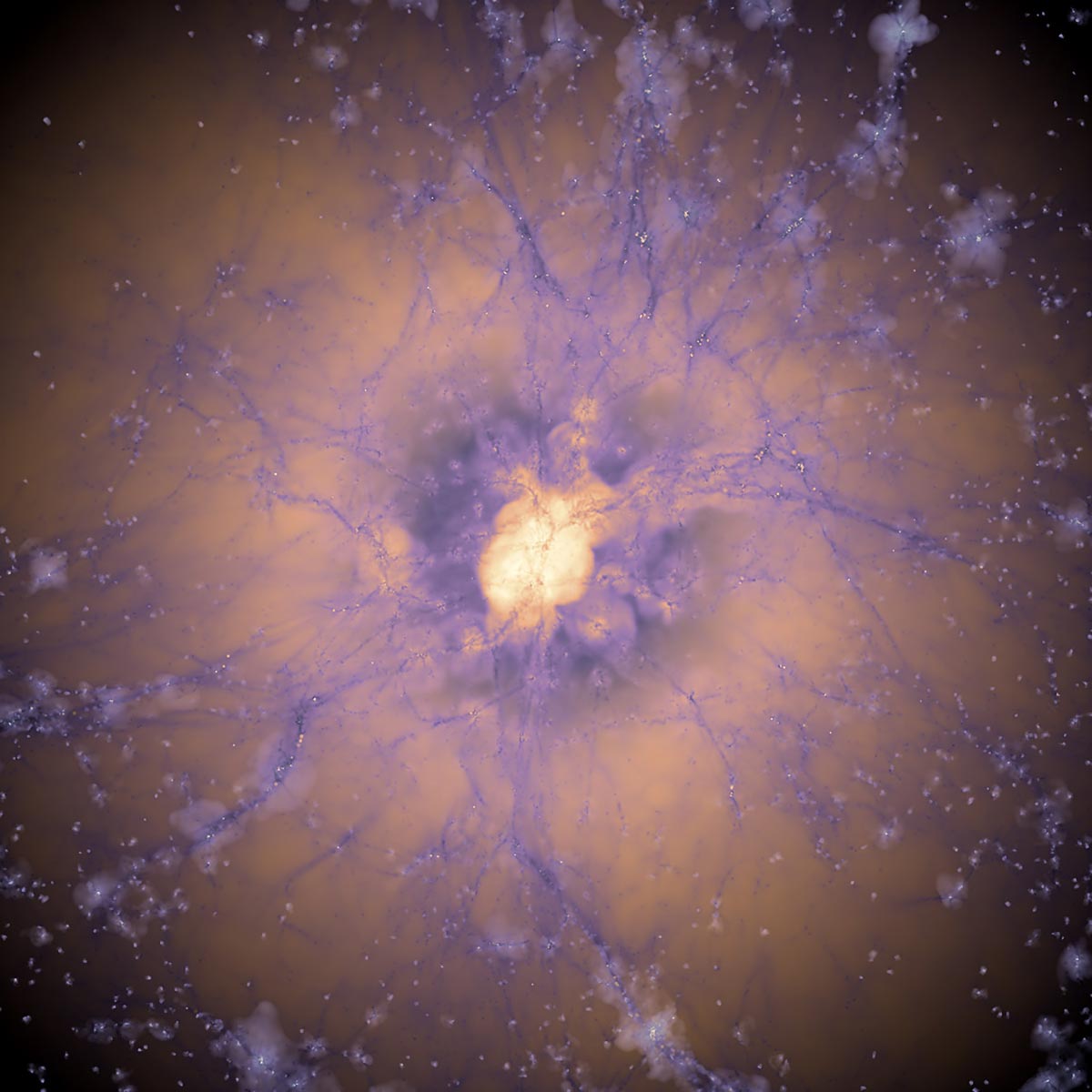
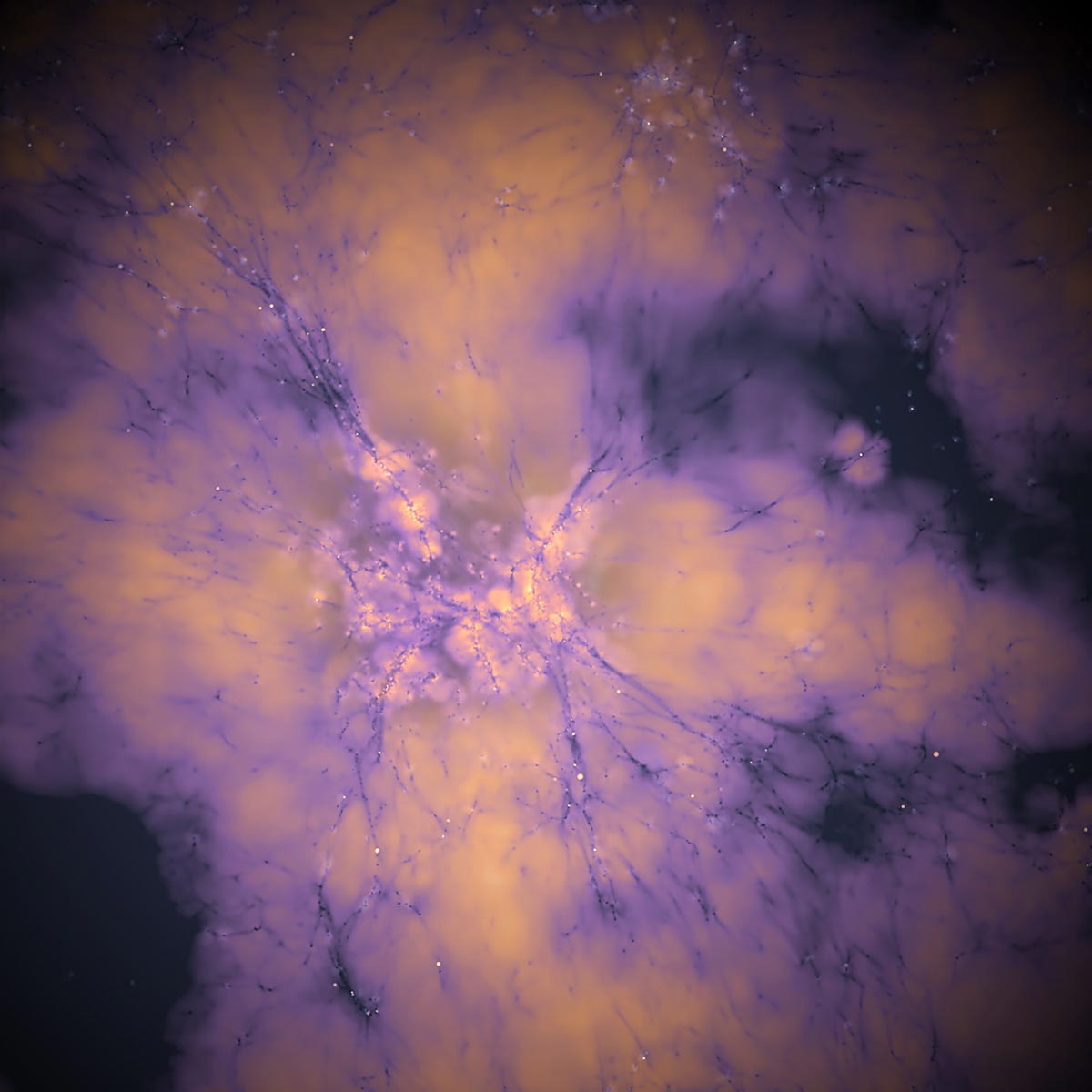
MIT physicists propose that early dark energy, a mysterious force, might be the key to resolving the “Hubble tension” and the surprising discovery of numerous bright, early galaxies.
This form of energy, thought to have influenced the universe briefly after the Big Bang, could explain why the universe is expanding at the rate observed today and why there were more large galaxies early on than previously thought. The findings suggest that early dark energy could significantly alter early universe structures, potentially increasing the number of bright galaxies formed during that period.
A new study by MIT physicists proposes that a mysterious force known as early dark energy could solve two of the biggest puzzles in cosmology and fill in some major gaps in our understanding of how the early universe evolved.
The Cosmic Puzzles and Early Dark Energy
One puzzle in question is the “Hubble tension,” which refers to a mismatch in measurements of how fast the universe is expanding. The other involves observations of numerous early, bright galaxies that existed at a time when the early universe should have been much less populated.
Now, the MIT team has found that both puzzles could be resolved if the early universe had one extra, fleeting ingredient: early dark energy. Dark energy is an unknown form of energy that physicists suspect is driving the expansion of the universe today. Early dark energy is a similar, hypothetical phenomenon that may have made only a brief appearance, influencing the expansion of the universe in its first moments before disappearing entirely.
Some physicists have suspected that early dark energy could be the key to solving the Hubble tension, as the mysterious force could accelerate the early expansion of the universe by an amount that would resolve the measurement mismatch.
Role of Early Dark Energy in Early Universe Dynamics
The MIT researchers have now found that early dark energy could also explain the baffling number of bright galaxies that astronomers have observed in the early universe. In their new study, reported on September 13 in the Monthly Notices of the Royal Astronomical Society, the team modeled the formation of galaxies in the universe’s first few hundred million years. When they incorporated a dark energy component only in that earliest sliver of time, they found the number of galaxies that arose from the primordial environment bloomed to fit astronomers’ observations.
“You have these two looming open-ended puzzles,” says study co-author Rohan Naidu, a postdoc in MIT’s Kavli Institute for Astrophysics and Space Research. “We find that in fact, early dark energy is a very elegant and sparse solution to two of the most pressing problems in cosmology.”
The study’s co-authors include lead author and Kavli postdoc Xuejian (Jacob) Shen, and MIT professor of physics Mark Vogelsberger, along with Michael Boylan-Kolchin at the University of Texas at Austin, and Sandro Tacchella at the University of Cambridge.
Big City Lights
Based on standard cosmological and galaxy formation models, the universe should have taken its time spinning up the first galaxies. It would have taken billions of years for primordial gas to coalesce into galaxies as large and bright as the Milky Way.
But in 2023, NASA’s James Webb Space Telescope (JWST) made a startling observation. With an ability to peer farther back in time than any observatory to date, the telescope uncovered a surprising number of bright galaxies as large as the modern Milky Way within the first 500 million years, when the universe was just 3 percent of its current age.
“The bright galaxies that JWST saw would be like seeing a clustering of lights around big cities, whereas theory predicts something like the light around more rural settings like Yellowstone National Park,” Shen says. “And we don’t expect that clustering of light so early on.”
For physicists, the observations imply that there is either something fundamentally wrong with the physics underlying the models or a missing ingredient in the early universe that scientists have not accounted for. The MIT team explored the possibility of the latter, and whether the missing ingredient might be early dark energy.
Physicists have proposed that early dark energy is a sort of antigravitational force that is turned on only at very early times. This force would counteract gravity’s inward pull and accelerate the early expansion of the universe, in a way that would resolve the mismatch in measurements. Early dark energy, therefore, is considered the most likely solution to the Hubble tension.
Galaxy Skeleton
The MIT team explored whether early dark energy could also be the key to explaining the unexpected population of large, bright galaxies detected by JWST. In their new study, the physicists considered how early dark energy might affect the early structure of the universe that gave rise to the first galaxies. They focused on the formation of dark matter halos — regions of space where gravity happens to be stronger, and where matter begins to accumulate.
“We believe that dark matter halos are the invisible skeleton of the universe,” Shen explains. “Dark matter structures form first, and then galaxies form within these structures. So, we expect the number of bright galaxies should be proportional to the number of big dark matter halos.”
Future Implications and Theoretical Contributions
The team developed an empirical framework for early galaxy formation, which predicts the number, luminosity, and size of galaxies that should form in the early universe, given some measures of “cosmological parameters.” Cosmological parameters are the basic ingredients, or mathematical terms, that describe the evolution of the universe.
Physicists have determined that there are at least six main cosmological parameters, one of which is the Hubble constant — a term that describes the universe’s rate of expansion. Other parameters describe density fluctuations in the primordial soup, immediately after the Big Bang, from which dark matter halos eventually form.
The MIT team reasoned that if early dark energy affects the universe’s early expansion rate, in a way that resolves the Hubble tension, then it could affect the balance of the other cosmological parameters, in a way that might increase the number of bright galaxies that appear at early times. To test their theory, they incorporated a model of early dark energy (the same one that happens to resolve the Hubble tension) into an empirical galaxy formation framework to see how the earliest dark matter structures evolved and gave rise to the first galaxies.
“What we show is, the skeletal structure of the early universe is altered in a subtle way where the amplitude of fluctuations goes up, and you get bigger halos, and brighter galaxies that are in place at earlier times, more so than in our more vanilla models,” Naidu says. “It means things were more abundant, and more clustered in the early universe.”
Conclusion and Perspectives on Future Research
“A priori, I would not have expected the abundance of JWST’s early bright galaxies to have anything to do with early dark energy, but their observation that EDE pushes cosmological parameters in a direction that boosts the early-galaxy abundance is interesting,” says Marc Kamionkowski, professor of theoretical physics at Johns Hopkins University, who was not involved with the study. “I think more work will need to be done to establish a link between early galaxies and EDE, but regardless of how things turn out, it’s a clever — and hopefully ultimately fruitful — thing to try.”
“We demonstrated the potential of early dark energy as a unified solution to the two major issues faced by cosmology. This might be an evidence for its existence if the observational findings of JWST get further consolidated,” Vogelsberger concludes. “In the future, we can incorporate this into large cosmological simulations to see what detailed predictions we get.”
Reference: “Early galaxies and early dark energy: a unified solution to the hubble tension and puzzles of massive bright galaxies revealed by JWST” by Xuejian Shen, Mark Vogelsberger, Michael Boylan-Kolchin, Sandro Tacchella and Rohan P Naidu, 13 September 2024, Monthly Notices of the Royal Astronomical Society.
DOI: 10.1093/mnras/stae1932
This research was supported, in part, by NASA and the National Science Foundation.
Never miss a breakthrough: Join the SciTechDaily newsletter.
Follow us on Google and Google News.
5 Comments
Right! When 3/4 of the universe is made of something, it would be foolish to neglect it or assume anything else. A purely personal belief, matter has an almost negligible secondary role in the history of the universe, of course quite essential for our existence.
First, created ” dark matter”
Uphemistically named undefinable Like the word infinity. Man never observed what he can not replicate. A presupposition of prior existence unsubstantiated is not fact, nor if presented as fact, truth.
The comprehension of which has solved no human problems on earth.
These scientists have been cribbing off the book of Genesis again 🤔
I’ve got an alternative theory: instead of Early Dark Energy, it’s the Bob the Builder bosun. Or maybe Pretendium. If we’re going to invent things out of whole cloth, why bother calling it science?
Another Universal cosmic joke.