
Close Menu
    Facebook X (Twitter) Instagram
    SciTechDaily
    • Biology
    • Chemistry
    • Earth
    • Health
    • Physics
    • Science
    • Space
    • Technology
    Facebook X (Twitter) Pinterest YouTube RSS
    SciTechDaily
    Home»Technology»Molecular Marvels: Scientists Revolutionize UV Sensing With Smart Technology
    Technology

    Molecular Marvels: Scientists Revolutionize UV Sensing With Smart Technology

    By Higher Education PressJuly 24, 2024No Comments3 Mins Read
    Facebook Twitter Pinterest Telegram LinkedIn WhatsApp Email Reddit
    Share
    Facebook Twitter LinkedIn Pinterest Telegram Email Reddit
    Dye Doped PDMS Optical Fiber
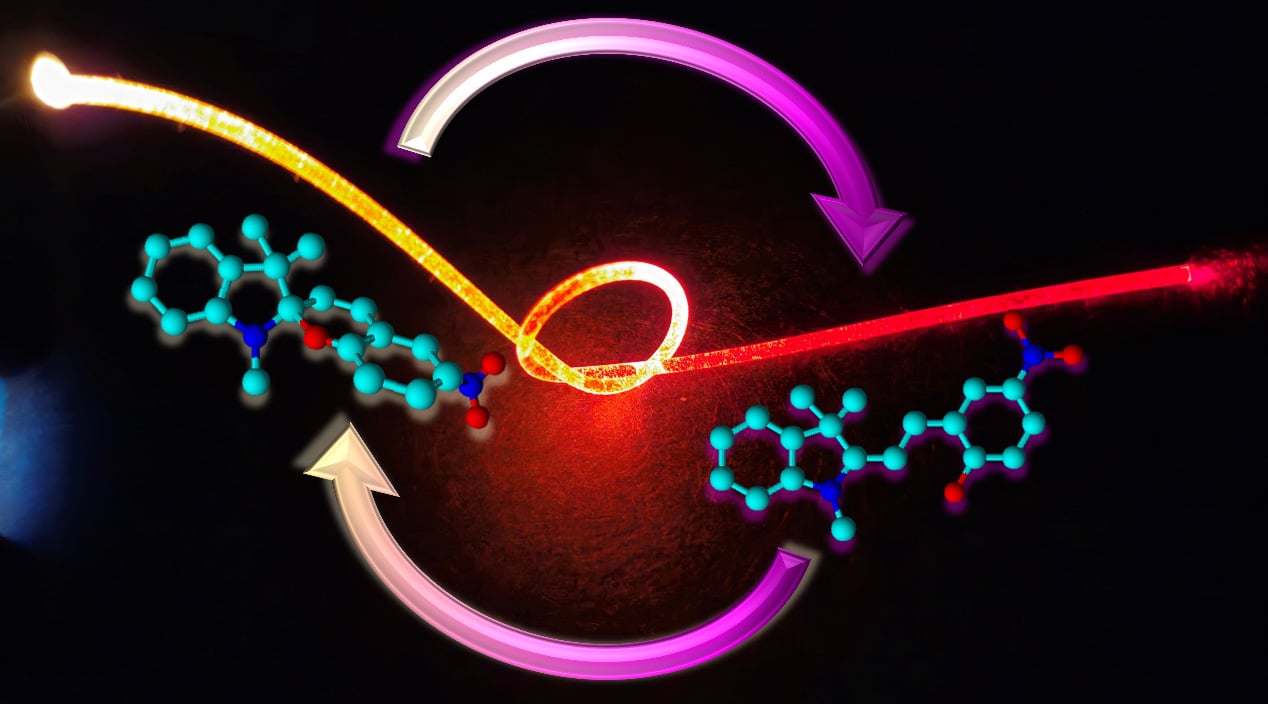
    Dye-doped PDMS optical fiber at the center whose flexibility is demonstrated by a knot, and the switching mechanism of the organic dye. Credit: Camila Aparecida Zimmermann, Koffi Novignon Amouzou, Dipankar Sengupta, Aashutosh Kumar, Nicole Raymonde Demarquette, Bora Ung

    Scientists have developed a flexible, reusable optical fiber for UV detection, promising enhanced integration with smart devices and advancing UV monitoring technologies.

    The old saying “the dose makes the poison” applies equally to ultraviolet (UV) light. While UV light is essential for vitamin D production, shows promising results in phototherapy, and plays a role in various industrial processes and plant growth, it also has harmful effects such as premature skin aging and cancer.

    The beneficial or harmful effects of UV light depend, among other variables, on the delivered UV dose. With the rise of point-of-care technology and the Internet of Things, there’s a growing demand for real-time monitoring of environmental variables that impact our health. However, the existing UV optical sensing technologies rely on materials with limited flexibility, or on costly and fragile (scientific grade) apparatus.

    Innovative UV Detection Technology

    To bridge this gap, researchers led by Prof. Bora Ung at École de Technologie Supérieure (ÉTS), Canada, fabricated a new rubber-like optical fiber for UV detection. For that, poly(dimethylsiloxane) (PDMS), a highly flexible, stretchable, and biocompatible plastic, was doped with an organic dye that acts as a molecular switch to render PDMS responsive to UV light.

    The molecular structure of the organic dye, named spiropyran, undergoes a reversible transformation triggered by UV irradiation which results in changes in the optical properties of the PDMS compound. These changes can be measured using commonly available LED/laser sources and photodiodes. Once the UV exposure stops, the material recovers its initial properties, much like a switch, and can be reused many times.

    The researchers expect its integrability to smart textiles and wearable devices for continuous UV dose monitoring, leveraging the advantages of optical sensors, such as immunity to electromagnetic interference and corrosion. The findings are an important step toward the research in elastomeric optics, smart optical materials, and polymer optical waveguide sensors.

    Reference: “Novel elastomeric spiropyran-doped poly(dimethylsiloxane) optical waveguide for UV sensing” by Camila Aparecida Zimmermann, Koffi Novignon Amouzou, Dipankar Sengupta, Aashutosh Kumar, Nicole Raymonde Demarquette and Bora Ung, 15 July 2024, Frontiers of Optoelectronics.
    DOI: 10.1007/s12200-024-00124-4

    Funding: Fonds de recherche du Québec – Nature et technologies, ÉTS Research Chair in Engineering Marcelle-Gauvreau

    Never miss a breakthrough: Join the SciTechDaily newsletter.
    Follow us on Google and Google News.

    Materials Science Optoelectronics
    Share. Facebook Twitter Pinterest LinkedIn Email Reddit

    Related Articles

    Scientists Discover “Shape-Shifting” Semiconductors Activated by Light

    This Microphone Made of Glass Can Survive Extreme Heat and Electromagnetic Chaos

    Scientists Discover New Class of Semiconductor Nanocrystals

    Atomic-Scale Spin-Optical Laser: Pioneering the Future of Optoelectronic Devices

    Efficient Light-Electricity Conversion: Changing a 2D Material’s Symmetry Can Unlock Its Promise

    SLIPS Prevents Ice From Sticking on Metal Surfaces

    3D Self-Assembling Polymer Materials Could Lead to New Microchips

    Elastomeric “Soft” Robots Running on Pneumatic Actuators

    Researchers Develop World’s Lightest Material

    Leave A Reply Cancel Reply

    • Facebook
    • Twitter
    • Pinterest
    • YouTube

    Don't Miss a Discovery

    Subscribe for the Latest in Science & Tech!

    Trending News

    After 50 Years, Astronomers Finally Found What the Milky Way’s Black Hole Was Hiding

    The Most Powerful Drug of All Isn’t Found in a Pill Bottle

    Scientists Capture Immune Cells Eating Live Cancer Cells for the First Time

    Why Older Adults Need To Pay Closer Attention to Vitamin B12

    Scientists Say a Daily Probiotic May Help Fight Depression in Older Adults

    This Deadly Disease Was Wiping Out Humans 5,500 Years Ago

    Beyond DNA: Scientists Discover Inheritance That Breaks the Rules of Genetics

    Scientists Just Discovered the Eye Defies a Long-Held Rule of Vision

    Follow SciTechDaily
    • Facebook
    • Twitter
    • YouTube
    • Pinterest
    • Newsletter
    • RSS
    SciTech News
    • Biology News
    • Chemistry News
    • Earth News
    • Health News
    • Physics News
    • Science News
    • Space News
    • Technology News
    Recent Posts
    • After Decades of Mystery, Researchers Locate a Missing Page of the Archimedes Palimpsest
    • The 4,000-Year-Old City That Defied History’s Rules on Wealth and Power
    • The World’s Biggest Population Fear Has Flipped – and It Could Change Everything
    • US and UK Veterans Who Volunteered in Ukraine Return Home With Hidden Health Crises
    • Scientists Discover Troubling Link Between Processed Foods and Preschool Behavior
    Copyright © 1998 - 2026 SciTechDaily. All Rights Reserved.
    • Science News
    • About
    • Contact
    • Editorial Board
    • Privacy Policy
    • Terms of Use

    Type above and press Enter to search. Press Esc to cancel.