
Close Menu
    Facebook X (Twitter) Instagram
    SciTechDaily
    • Biology
    • Chemistry
    • Earth
    • Health
    • Physics
    • Science
    • Space
    • Technology
    Facebook X (Twitter) Pinterest YouTube RSS
    SciTechDaily
    Home»Technology»Scientists Discover “Shape-Shifting” Semiconductors Activated by Light
    Technology

    Scientists Discover “Shape-Shifting” Semiconductors Activated by Light

    By University of California - DavisApril 3, 20262 Comments3 Mins Read
    Facebook Twitter Pinterest Telegram LinkedIn WhatsApp Email Reddit
    Share
    Facebook Twitter LinkedIn Pinterest Telegram Email Reddit
    Light Bends Perovskite Crystal Lattice
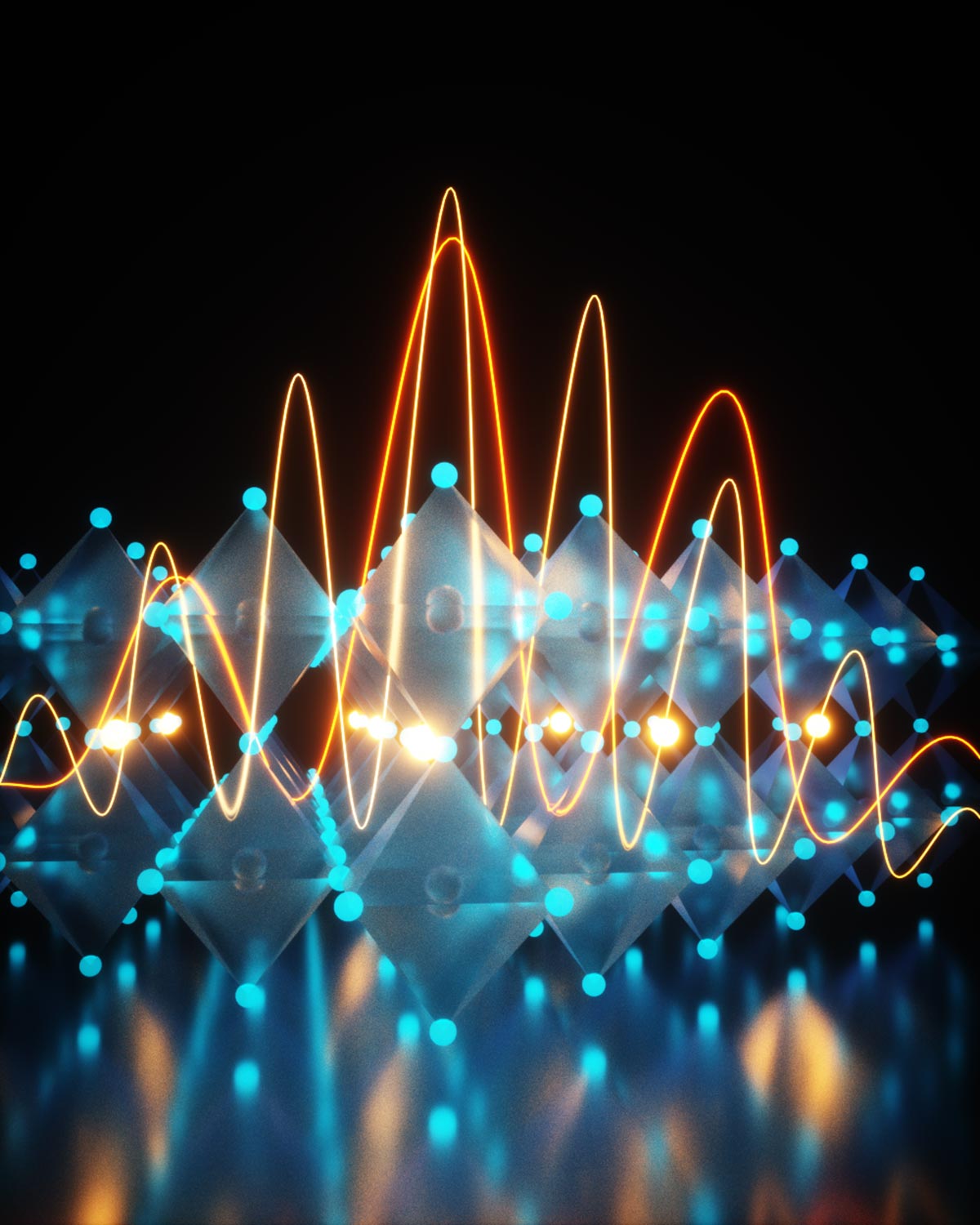
    A new study shows that perovskites can dynamically shift their structure under light in a controllable way. This unusual property hints at future technologies where devices respond directly to light stimuli. Credit: Marina Leite, UC Davis

    Researchers have discovered that perovskite crystals can rapidly and reversibly change shape when exposed to light, revealing a unique behavior not seen in traditional semiconductors.

    A new study from researchers at the University of California, Davis suggests that perovskites could enable a new class of light-responsive semiconductor devices. Published in Advanced Materials, the research shows that halide perovskite crystals can reversibly change shape when exposed to light.

    Although perovskites are semiconductors, they behave quite differently from traditional materials such as silicon and gallium arsenide. They can combine organic and inorganic components and are often less expensive to produce.

    “They are ‘smart materials’ that can be tuned to respond to a stimulus in a way we can control,” said Marina Leite, professor of materials science engineering at UC Davis and senior author on the paper. “Their chemistry is very different in a way that can be beneficial for creating devices we couldn’t build before.”

    All perovskites share a basic ABX3 crystal structure. This arrangement can be visualized as a central atom surrounded by six others in an octahedron (two pyramids attached at the base), all contained within a cube with atoms at each corner. These materials are already being explored for use in optoelectronics and next generation solar cells.

    Rapid and reversible changes

    In the study, graduate student Mansha Dubey used laser light to illuminate perovskite crystals and tracked changes in their atomic structure using an X ray probe. The crystals were produced by collaborators Bekir Turedi, Andrii Kanak and Professor Maksym Kovalenko at ETH Zürich, Switzerland.

    The experiments revealed that light exposure causes the crystal lattice to shift in a fast and fully reversible way.

    “There is a dramatic change in the lattice when you shine light on it, a unique phenomenon that you don’t see with silicon or gallium arsenide,” Leite said. She noted that this photostriction effect can be repeated many times without degrading the material.

    Researchers can also adjust how perovskites interact with light by altering their composition, which changes the bandgap, or the range of light wavelengths the material absorbs and emits. Different formulations show varying levels of structural response when exposed to light above this bandgap. The effect can be finely controlled by adjusting both the light’s frequency and its intensity, Leite said.

    “It’s not a binary on/off effect; it can be a scaled response, like a dimmer, depending on the light you shine on it,” she said.

    Leite said this light driven structural response could lead to new types of devices that can be switched or tuned using light, including sensors and actuators.

    Reference: “Reversible, Photo-Induced Lattice Distortions in Halide Perovskites” by Mansha Dubey, Bekir Turedi, Andrii Kanak, Maksym V. Kovalenko and Marina S. Leite, 3 March 2026, Advanced Materials.
    DOI: 10.1002/adma.202521800

    The work was supported by a federal Defense Advanced Research Projects Agency program to develop new materials for switchable photonic devices, and by a grant from the National Science Foundation. The project made use of the UC Davis Advanced Materials Characterization and Testing (AMCaT) laboratory, established with a grant from NSF.

    Never miss a breakthrough: Join the SciTechDaily newsletter.
    Follow us on Google and Google News.

    Materials Science Optoelectronics Photonics Semiconductors UC Davis
    Share. Facebook Twitter Pinterest LinkedIn Email Reddit

    Related Articles

    How “Empty Space” Is Supercharging Atomically Thin Semiconductors

    This Microphone Made of Glass Can Survive Extreme Heat and Electromagnetic Chaos

    Breaking the Bottleneck: All-Optical Chip Could Unlock Light-Speed Communication

    Laser Holograms Could Revolutionize 3D Chip Manufacturing

    The Atomic Trick That Supercharges Electro-Optic Materials

    Unlocking the Secret World of Dark Excitons for Next-Gen Energy

    Scientists Discover New Class of Semiconductor Nanocrystals

    Revolutionizing Photonics: Lithium Tantalate Powers Next-Gen Optical Circuits

    The First All-optical Nanowire Switch

    2 Comments

    1. kamir bouchareb st on April 3, 2026 8:31 am

      thanks

      Reply
    2. Menjadigital on April 8, 2026 1:57 am

      Amazing

      Reply
    Leave A Reply Cancel Reply

    • Facebook
    • Twitter
    • Pinterest
    • YouTube

    Don't Miss a Discovery

    Subscribe for the Latest in Science & Tech!

    Trending News

    Popular Sugar-Free Sweetener Linked to Liver Disease, Study Warns

    What Is Hantavirus? The Deadly Disease Raising Alarm Worldwide

    Scientists Just Discovered How the Universe Builds Monster Black Holes

    Scientists Unveil New Treatment Strategy That Could Outsmart Cancer

    A Simple Vitamin May Hold the Key to Treating Rare Genetic Diseases

    Scientists Think the Real Fountain of Youth May Be Hiding in Your Gut

    Ravens Don’t Follow Wolves, They Predict Them

    This Common Knee Surgery May Be Doing More Harm Than Good

    Follow SciTechDaily
    • Facebook
    • Twitter
    • YouTube
    • Pinterest
    • Newsletter
    • RSS
    SciTech News
    • Biology News
    • Chemistry News
    • Earth News
    • Health News
    • Physics News
    • Science News
    • Space News
    • Technology News
    Recent Posts
    • Study Reveals Dangerous Flaw in AI Symptom Checkers
    • New MRI Breakthrough Captures Stunningly Clear Images of the Eye and Brain
    • Scientists Warn Sitting Too Much Can Harm Your Body in Surprising Ways
    • Your Blood Pressure Reading Could Be Wrong Because of One Simple Mistake
    • Scientists Discover Cheap Material That Kills Deadly Superbugs
    Copyright © 1998 - 2026 SciTechDaily. All Rights Reserved.
    • Science News
    • About
    • Contact
    • Editorial Board
    • Privacy Policy
    • Terms of Use

    Type above and press Enter to search. Press Esc to cancel.