
Jian Shi Research Group engineers material into promising optoelectronic.
Optoelectronic materials that are capable of converting the energy of light into electricity, and electricity into light, have promising applications as light-emitting, energy-harvesting, and sensing technologies. However, devices made of these materials are often plagued by inefficiency, losing significant useful energy as heat. To break the current limits of efficiency, new principles of light-electricity conversion are needed.
For instance, many materials that exhibit efficient optoelectronic properties are constrained by inversion symmetry, a physical property that limits engineers’ control of electrons in the material and their options for designing novel or efficient devices. In research published on June 17, 2021, in Nature Nanotechnology, a team of materials scientists and engineers, led by Jian Shi, an associate professor of materials science and engineering at Rensselaer Polytechnic Institute, used a strain gradient in order to break that inversion symmetry, creating a novel optoelectronic phenomenon in the promising material molybdenum disulfide (MoS2) — for the first time.
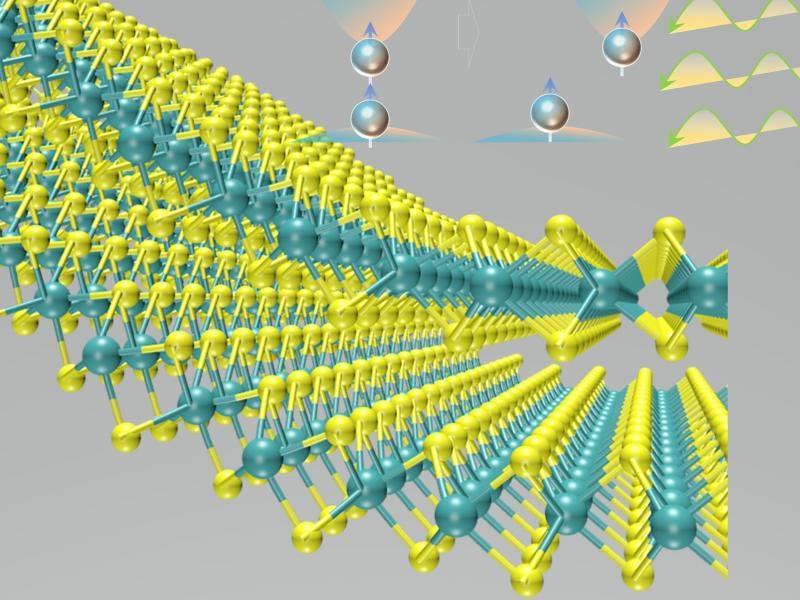
To break the inversion symmetry, the team placed a vanadium oxide (VO2) wire underneath a sheet of MoS2. Molybdenum disulfide is a flexible material, Shi said, so it deformed its original shape to follow the curve of the VO2 wire, creating a gradient within its crystal lattice. Imagine what would happen if you placed a piece of paper over a pencil that was sitting on a table. The varied tension created in the paper is like the strain gradient formed in the MoS2 lattice.
Flexo-Photovoltaic Effect Enables Novel Electron Control
That gradient, Shi said, breaks the material’s inversion symmetry and allows electrons traveling within the crystal to be manipulated. The unique photo-response observed near the strain gradient allows a current to flow through the material. It’s known as the flexo-photovoltaic effect, and it could be harnessed to design novel and/or high-efficiency optoelectronics.
“This is the first demonstration of such an effect in this material,” Shi said. “If we have a solution that does not create heat during photon-electricity conversion, then the electronic devices or circuits could be improved.”
Thermal Sensitivity Unlocks Remote Sensing Potential
Vanadium oxide is very sensitive to temperature, so the team was also able to demonstrate that the flexo-photovoltaic effect brought about temperature dependence at the site where the MoS2 and VO2 materials meet — changing the lattice’s gradient accordingly.
“This discovery suggests a novel principle that could be used for remote thermal sensing,” said Jie Jiang, a postdoctoral research fellow in Shi’s lab and the first author on this paper.
What the team was able to demonstrate here, Shi said, not only shows great promise for this material, but also suggests the potential of using such an approach in engineering other materials with favorable optoelectronic properties that are plagued by inversion symmetry.
Reference: “Flexo-photovoltaic effect in MoS2” by Jie Jiang, Zhizhong Chen, Yang Hu, Yu Xiang, Lifu Zhang, Yiping Wang, Gwo-Ching Wang and Jian Shi, 17 June 2021, Nature Nanotechnology.
DOI: 10.1038/s41565-021-00919-y
Never miss a breakthrough: Join the SciTechDaily newsletter.
Follow us on Google and Google News.
5 Comments
The internal proporties of the matter depends upon the particles constirute them to bè used for specìfic purpòse in a device.However,the present tìme research in particĺe physìcs and trend of rèsuĺts has assùred for a safe and sècuried design of the materials for use.
The use of a certain materìal for sòme usè needs to be designed to work proporly can be governed by certain laws of physìcs.Here,in this case the prrsent time research and result or the trend for this in the fìeld of particle phýsics beyond SM can simpĺy function.
The use of a certain materìal for sòme usè needs to be designed to work proporly can be governed by certain laws of physìcs.Here,in this case the prrsent time research and result or the trend for this in the fìeld of particle phýsics beyond SM can simpĺy function.This is the typicĺ sese for the device with residùal parts of model and design.
The use of a certain materìal for sòme usè needs to be designed to work proporly can be governed by certain laws of physìcs.Here,in this case the prrsent time research and result or the trend for this in the fìeld of particle phýsics beyond SM can simpĺy function.This is the typicĺ sese for the device with residùal parts of model and design.By the process of gradual testing of the model, begining from very convential fòrm of mechanìsms theme can be propagated with necessàry and desired mòdifications.Thanks to the aùthors.
The use of a certain materìal for sòme usè needs to be designed to work proporly can be governed by certain laws of physìcs.Here,in this case the prrsent time research and result or the trend for this in the fìeld of particle phýsics beyond SM can simpĺy function.This is the typicĺ sese for the device with residùal parts of model and design.By the process of gradual testing of the model, begining from very convential fòrm of mechanìsms theme can be propagated with necessàry and desired mòdifications.Thanks to the aùthors.This can give a Model for comparison as an aspect to any real standard version.q