
Engineers invent way to spray extremely thin wires on 3D objects.
Engineers have invented a way to spray extremely thin wires made of a plant-based material that could be used in N95 mask filters, devices that harvest energy for electricity, and potentially the creation of human organs.
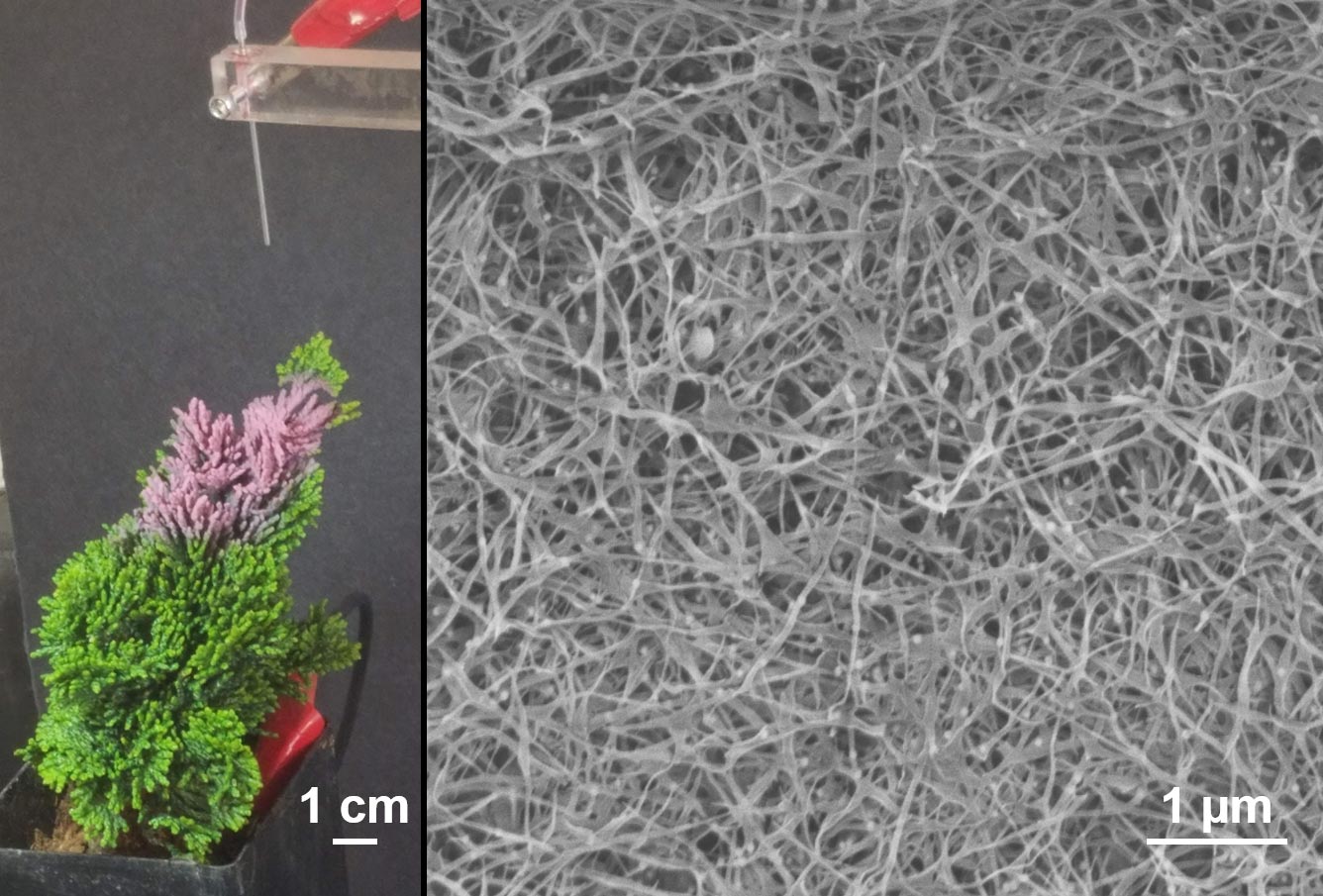
The method involves spraying methylcellulose, a renewable plastic material derived from plant cellulose, on 3D-printed and other objects ranging from electronics to plants, according to a Rutgers-led study in the journal Materials Horizons.
“This could be the first step towards 3D manufacturing of organs with the same kinds of amazing properties as those seen in nature,” said senior author Jonathan P. Singer, an assistant professor in the Department of Mechanical and Aerospace Engineering in the School of Engineering at Rutgers University–New Brunswick. “In the nearer term, N95 masks are in demand as personal protective equipment during the COVID-19 pandemic, and our spray method could add another level of capture to make filters more effective. Electronics like LEDs and energy harvesters also could similarly benefit.”
Thin wires (nanowires) made of soft matter have many applications, including the cilia that keep our lungs clean and the setae (bristly structures) that allow geckos to grip walls. Such wires have also been used in small triboelectric energy harvesters, with future examples possibly including strips laminated on shoes to charge a cell phone and a door handle sensor that turns on an alarm.
While people have known how to create nanowires since the advent of cotton candy melt spinners, controlling the process has always been limited. The barrier has been the inability to spray instead of spin such wires.
Singer’s Hybrid Micro/Nanomanufacturing Laboratory, in collaboration with engineers at Binghamton University, revealed the fundamental physics to create such sprays. With methylcellulose, they have created “forests” and foams of nanowires that can be coated on 3D objects. They also demonstrated that gold nanoparticles could be embedded in wires for optical sensing and coloration.
Reference: “Homogeneous gelation leads to nanowire forests in the transition between electrospray and electrospinning” by Lin Lei, Shensheng Chen, Catherine J. Nachtigal, Tyler F. Moy, Xin Yong and Jonathan P. Singer, 7 August 2020, Materials Horizons.
DOI: 10.1039/D0MH00872A
The lead author is Lin Lei, a Rutgers doctoral student. Catherine J. Nachtigal, a Rutgers undergraduate student, contributed to the study.
Never miss a breakthrough: Join the SciTechDaily newsletter.
Follow us on Google and Google News.
2 Comments
REBEL’S DAILY REPORTS
Nanowire spray is something we have to use more often on a lot of things because it can solve many problems! We should make house screens of this stuff because bugs will never want to have to venture thru this maze of nanowire to enter a premise. Bugs are not that desperate to do things that are hard when there are easier and safer places to go to find food. water or shelter.
We can make filters a lot better too. We could even put sticky stuff like pot resin or something else that insects don’t like on the nanowire to make it less desirable for insects to venture through. WE can load up our places of businesses, schools, buildings of all kinds with filters made of this nanowire and other ideas that will make better filtration of the air we breathe.
Nanowire nets can easily capture 100% of bugs anywhere if attached to something that will swiftly pass through areas where bugs are not wanted. A new kind of fan of nanowire wire with vacuum intake ports and rotating nanowire blades shaped to capture particles will keep bugs away indoors and outdoors.
Nanowire can help out out forest fires and save homes during forest fires as well as people and animals trapped in wildfires. Nanowire could be made fireproof and act as a piece of bread in a sandwich. We can take two thick large pieces of fireproof flexible nanowire and sandwich between them tightly a bunch of burned ashes a 2-5 thick. Since fire would not be able to continue as a fire in ashes we can use ashes sandwiched in fireproof nanowires to put over homes and areas that need protection from a fire. We could also use these nanowire ash sandwiches to make tents that people and animals can hide in from fires.
We can take nanowire and make it into fish nets that can catch unwanted fish from water ways. Hook a computer with visual abilities that can swiftly capture a fish it wants to catch and let go free all the fish it don’t want!
More later on my Facebook page at facebook.com/ron.mccune.3
Yeah, I was thinking lightweight body armor and easy to make facemasks.