
Close Menu
    Facebook X (Twitter) Instagram
    SciTechDaily
    • Biology
    • Chemistry
    • Earth
    • Health
    • Physics
    • Science
    • Space
    • Technology
    Facebook X (Twitter) Pinterest YouTube RSS
    SciTechDaily
    Home»Space»Mushballs – Giant, Slushy Hailstones – Stash Away Missing Ammonia at Uranus and Neptune
    Space

    Mushballs – Giant, Slushy Hailstones – Stash Away Missing Ammonia at Uranus and Neptune

    By EuroplanetOctober 6, 20211 Comment3 Mins Read
    Facebook Twitter Pinterest Telegram LinkedIn WhatsApp Email Reddit
    Share
    Facebook Twitter LinkedIn Pinterest Telegram Email Reddit
    Neptune, Uranus, Saturn and Jupiter
    Composite image of Neptune, Uranus, Saturn, and Jupiter. Credit: Jupiter from Juno: NASA/SwRI/MSSS/Gerald Eichstädt/Seán Doran; Saturn from Cassini: NASA/JPL-Caltech/Space Science Institute; Uranus and Neptune from HST: NASA/ESA/A. Simon (NASA Goddard Space Flight Center), and M.H. Wong and A. Hsu (University of California, Berkeley).

    Ammonia may be hidden in Uranus and Neptune’s depths, trapped in mushballs similar to those discovered on Jupiter.

    Mushballs – giant, slushy hailstones made from a mixture of ammonia and water – may be responsible for an atmospheric anomaly at Neptune and Uranus that has been puzzling scientists. A study presented by Tristan Guillot at the Europlanet Science Congress (EPSC) 2021 shows that mushballs could be highly effective at carrying ammonia deep into the ice giants’ atmospheres, hiding the gas from detection beneath opaque clouds.

    Recently, remote observations at infrared and radio wavelengths have shown that Uranus and Neptune lack ammonia in their atmosphere compared to the other giant planets in our Solar System. This is surprising because they are otherwise very rich in other compounds, such as methane, found in the primordial cloud from which the planets formed.

    Either the planets formed under special conditions, from material that was also poor in ammonia, or some ongoing process must be responsible. Guillot, a researcher at the CNRS, Laboratoire Lagrange in Nice, France, turned to a recent discovery at Jupiter for a possible answer to the puzzle.
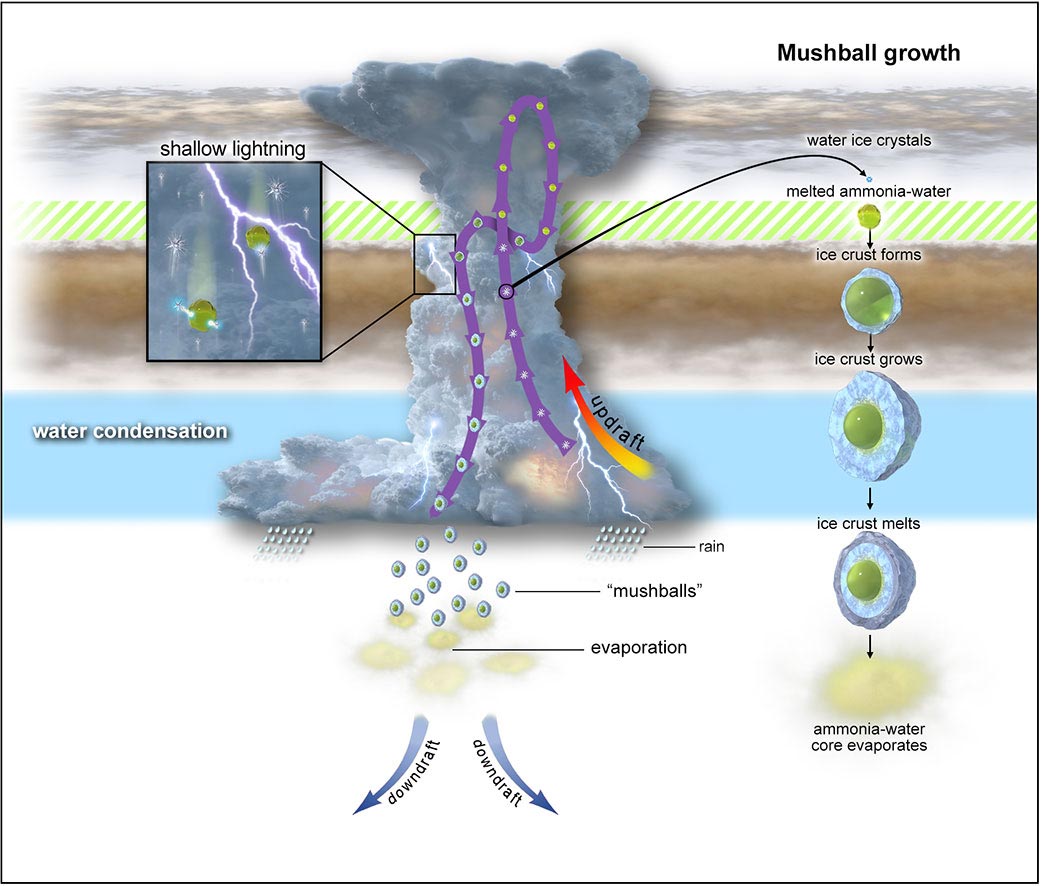
    How Mushballs Form in Giant Planets’ Atmospheres
    Artist’s impression showing how mushballs form in giant planets’ atmospheres. Credit: NASA/JPL-Caltech/SwRI/CNRS

    “The Juno spacecraft has shown that in Jupiter, ammonia is present in abundance, but generally much deeper than expected – thanks to the formation of mushballs. I show that what we have learned at Jupiter can be applied to provide a plausible solution to this mystery at Uranus and Neptune,” said Guillot.

    The Mushball Mechanism

    The Juno observations at Jupiter have shown that ammonia-water hailstones can form rapidly during storms because of ammonia’s ability to liquefy water ice crystals, even at very low temperatures of around -90 degrees Celsius (-130 degrees Fahrenheit). Models indicate that these mushballs in Jupiter may grow to weights of up to a kilogram (2.2 pounds) or more, slightly higher than the largest hailstones on Earth. As they plunge downwards, they transport ammonia very efficiently to the deep atmosphere, where it ends up locked away beneath the cloud base.

    “Thermodynamic chemistry implies that this process is even more efficient in Uranus and Neptune, and the mushball seed region is extended and occurs at greater depths,” said Guillot. “Thus, ammonia is probably simply hidden in the deep atmospheres of these planets, beyond the reach of present-day instruments.”

    To determine exactly how deep down the mushballs are carrying ammonia and water may have to wait until an orbiter with instruments can probe the atmospheres of the ice giants close up.

    “To fully understand the processes, we need a dedicated mission to map the deep atmospheric structure and understand mixing in hydrogen atmospheres,” said Guillot. “Neptune and Uranus are a critical link between giant planets, like Jupiter and Saturn, and ice giant exoplanets that we are discovering in the galaxy. We really need to go there!”

    Reference: “Mushballs and the lack of Ammonia in Uranus and Neptune” by Tristan Guillot, September 2021, European Planetary Science Congress 2021.
    DOI: 10.5194/epsc2021-422

    Never miss a breakthrough: Join the SciTechDaily newsletter.
    Follow us on Google and Google News.

    Ammonia Atmospheric Science Neptune Planets The Europlanet Society Uranus
    Share. Facebook Twitter Pinterest LinkedIn Email Reddit

    Related Articles

    Astronomical Illusions: New Images Reveal What Neptune and Uranus Really Look Like

    Discovering Uranus’ Glow: New Hints for Life on Icy Exoplanets

    NASA’s Twisted Discovery: First Observation of a Polar Cyclone on Uranus

    Why Are Some Planets Surrounded by Rings?

    Spectacular Planetary-Scale “Heat Wave” Discovered in Jupiter’s Atmosphere

    New Discovery Reveals Why Uranus and Neptune Are Different Colors

    How Do Ice Giants Like Uranus and Neptune Maintain Their Magnetic Fields?

    Deep Water on Ice Giants Neptune and Uranus May Be Magnesium-Rich

    Two Strange Planets: Unsolved Magnetic Mystery on Uranus and Neptune

    1 Comment

    1. Jim Oss on October 6, 2021 2:46 pm

      Really? I see that when I believe it. ‘Giant mushy ammonia snow balls’. Oh please.

      Reply
    Leave A Reply Cancel Reply

    • Facebook
    • Twitter
    • Pinterest
    • YouTube

    Don't Miss a Discovery

    Subscribe for the Latest in Science & Tech!

    Trending News

    Breakthrough Bowel Cancer Trial Leaves Patients Cancer-Free for Nearly 3 Years

    Natural Compound Shows Powerful Potential Against Rheumatoid Arthritis

    100,000-Year-Old Neanderthal Fossils in Poland Reveal Unexpected Genetic Connections

    Simple “Gut Reset” May Prevent Weight Gain After Ozempic or Wegovy

    2.8 Days to Disaster: Scientists Warn Low Earth Orbit Could Suddenly Collapse

    Common Food Compound Shows Surprising Power Against Superbugs

    5 Simple Ways To Remember More and Forget Less

    The Atomic Gap That Could Cost the Semiconductor Industry Billions

    Follow SciTechDaily
    • Facebook
    • Twitter
    • YouTube
    • Pinterest
    • Newsletter
    • RSS
    SciTech News
    • Biology News
    • Chemistry News
    • Earth News
    • Health News
    • Physics News
    • Science News
    • Space News
    • Technology News
    Recent Posts
    • After 37 Years, the World’s Longest-Running Soil Warming Experiment Uncovers a Startling Climate Secret
    • NASA Satellite Captures First-Ever High-Res View of Massive Pacific Tsunami
    • ADHD Isn’t Just a Deficit: Study Reveals Powerful Hidden Strengths
    • Scientists Uncover “Astonishing” Hidden Property of Light
    • Scientists Discover Stem Cells That Could Regrow Teeth and Bone
    Copyright © 1998 - 2026 SciTechDaily. All Rights Reserved.
    • Science News
    • About
    • Contact
    • Editorial Board
    • Privacy Policy
    • Terms of Use

    Type above and press Enter to search. Press Esc to cancel.