
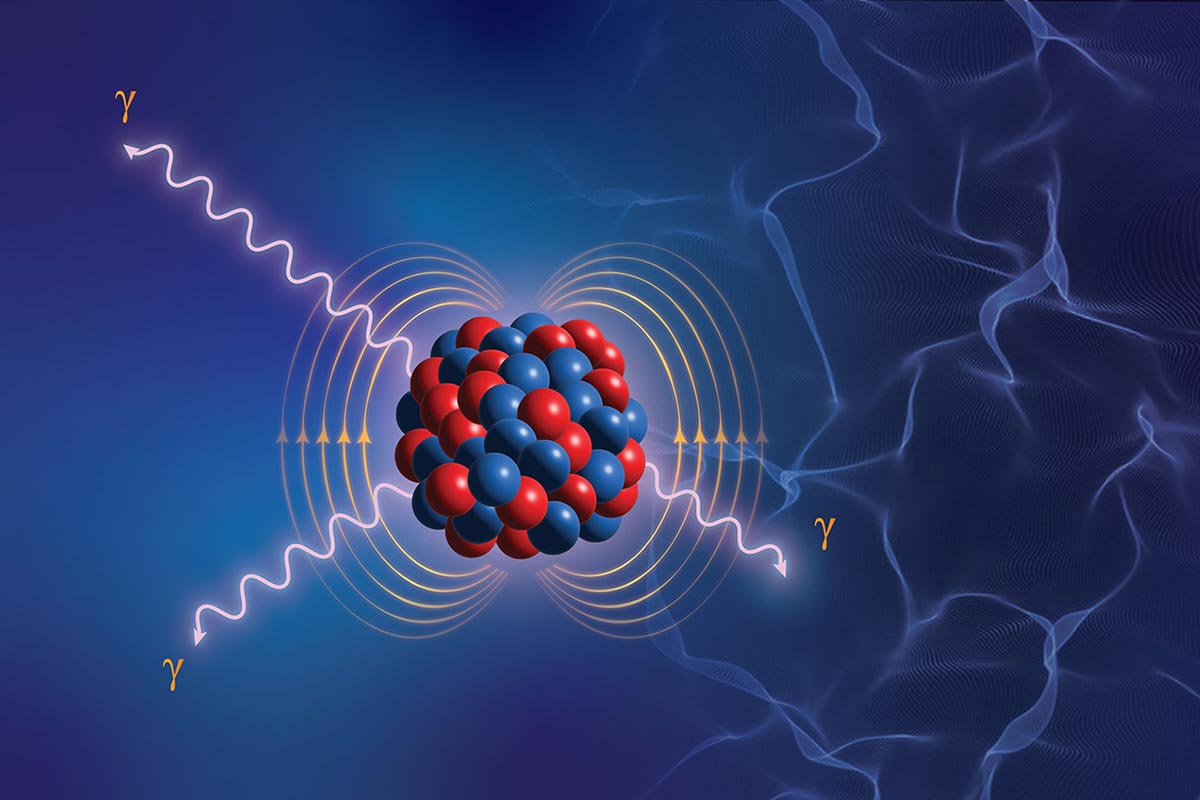
Scientists have traced a decades-old gamma-ray mystery to hidden magnetic transitions inside atomic nuclei.
For decades, nuclear physicists have faced a puzzling question: why do some atomic nuclei release far more low-energy gamma rays than expected?
A new study led by the Facility for Rare Isotope Beams (FRIB), with contributions from scientists at Lawrence Livermore National Laboratory (LLNL), may finally provide the answer. Published in Nature, the research offers new insight into the inner workings of atomic nuclei and could have important implications for astrophysics, nuclear energy, national security, and nuclear forensics.
A Decades-Old Gamma-Ray Puzzle
Gamma rays are a form of electromagnetic radiation, just like visible light and radio waves, but they carry much more energy. When an atomic nucleus is in an excited state, it can release gamma rays as it decays into a lower and more stable energy state.
For years, scientists have noticed that some nuclei produce an unexpectedly large number of low-energy gamma rays. This phenomenon, known as “low-energy enhancement,” has been difficult to explain. It does not appear in every nucleus, and researchers have had no reliable way to predict where it will occur.
“This low-energy enhancement wasn’t predicted by theory, so it was kind of a shock to the community when it was first observed,” said Eleanor Ronning, lead author of the study and former FRIB graduate student. “It is difficult to predict where [low-energy enhancement] occurs — we don’t know which nuclei will exhibit it.”
The new findings provide strong evidence that the effect is caused by magnetic transitions within the nucleus.
“This is a key step forward,” said Andrea Richard, co-lead of the study, former postdoctoral researcher at LLNL and current assistant professor at Ohio University. “We now have a consistent explanation that connects experimental observations with theory.”
Separating Electric and Magnetic Decay
To investigate the mystery, the researchers measured gamma rays produced when a radioactive isotope of copper decayed into zinc. Using FRIB’s specialized instruments and experimental capabilities, the team was able to separate two distinct types of nuclear decay.
In one case, the decay involved an electric transition. As the copper nucleus changed, its protons shifted their positions.
The other decay followed a magnetic transition. In this process, neutrons and protons inside the nucleus effectively flipped their internal magnetic orientations.
Only the magnetic transition produced the unusual increase in low-energy gamma rays. That result showed that the enhancement is magnetic in origin.
The experiment was proposed jointly by Ronning and Richard. Along with Richard’s work as a postdoctoral researcher, LLNL scientists contributed technical expertise and helped monitor the experiment around the clock during a full week of continuous measurements.
Implications Beyond a Single Nucleus
Although the experiment focused on only one nucleus, the results could improve scientists’ understanding of nuclear behavior much more broadly.
“We can improve the knowledge of our stockpile performance and interpretation of past test program results using the improved theory based on these discoveries,” said author and LLNL scientist Darren Bleuel. “In addition, we can improve nuclear forensics — our ability to determine if a nuclear event has occurred and identify the most likely source.”
The findings could also strengthen models of nuclear reactions occurring in stars, supernovae and neutron star mergers — including the processes responsible for creating heavy elements — as well as improve understanding of reactions relevant to nuclear energy.
Reference: “Magnetic character of the low-energy enhancement in 70Zn” by E. K. Ronning, A. L. Richard, S. N. Liddick, A. Spyrou, R. Ringle, H. Arora, H. C. Berg, J. M. Berkman, D. L. Bleuel, K. Bosmpotinis, S. E. Campbell, X. Chen, B. P. Crider, R. J. Coleman, P. A. DeYoung, A. A. Doetsch, H. Erington, T. Gaballah, N. D. Gamage, E. C. Good, B. Greaves, A. C. Hartley, J. Huffman, C. M. Ireland, C. Izzo, R. Jain, A. C. Larsen, J. E. L. Larsson, R. S. Lubna, F. M. Maier, M. J. Mogannam, D. Mücher, M. R. Mumpower, G. Owens-Fryar, T. H. Ogunbeku, D. P. Scriven, M. K. Smith, C. S. Sumithrarachchi, A. Sweet, K. Taft, A. Tsantiri, S. Uthayakumaar and M. Wiedeking, 15 July 2026, Nature.
DOI: 10.1038/s41586-026-10758-3
Never miss a breakthrough: Join the SciTechDaily newsletter.
Follow us on Google and Google News.
1 Comment
Mysterious Gamma Rays Reveal Hidden Magnetism Inside Atomic Nuclei.
VERY GOOD.
It invites researchers to ponder a fundamental question:
How does a point particle give rise to magnetism?