
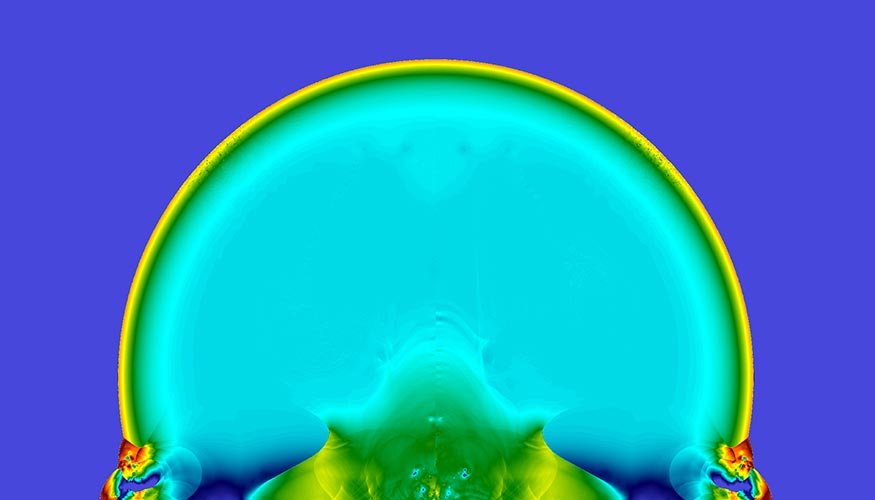
LLNL scientists improved nuclear blast modeling by extending Taylor’s shock wave theory to near-surface detonations. These results enhance predictive power for nuclear effects in urban and non-ideal environments, with important implications for national defense and disaster preparedness.
A Lawrence Livermore National Laboratory (LLNL) team has taken a closer look at how nuclear weapon blasts close to the Earth’s surface create complications in their effects and apparent yields. Attempts to correlate data from events with low heights of burst revealed a need to improve the theoretical treatment of strong blast waves rebounding from hard surfaces.
This led to an extension of the fundamental theory of strong shocks in the atmosphere, which was first developed by G.I. Taylor in the 1940s. The work represents an improvement to the Lab team’s basic understanding of nuclear weapon effects for near-surface detonations. The results indicate that the shock wave produced by a nuclear detonation continues to follow a fundamental scaling law when reflected from a surface, which enables the team to more accurately predict the damage a detonation will produce in a variety of situations, including urban environments.
Universal Scaling Laws in Shock Wave Reflection
The findings, featured in Proceedings A of the Royal Society Publishing, are authored by Andy Cook, Joe Bauer and Greg Spriggs. The work, “The Reflection of a Blast Wave by a Very Intense Explosion,” also is highlighted on the cover of the publication.
The paper demonstrates that the geometric similarity of Taylor’s blast wave persists beyond reflection from an ideal surface. Upon impacting the surface, the spherical symmetry of the blast wave is lost but its cylindrical symmetry endures. The preservation of axisymmetry, geometric similarity and planar symmetry in the presence of a mirror-like surface causes all flow solutions to collapse when scaled by the height of burst (HOB) and the shock arrival time at the surface. The scaled blast volume for any yield, HOB and ambient air density follows a single universal trajectory for all scaled time, both before and after reflection.
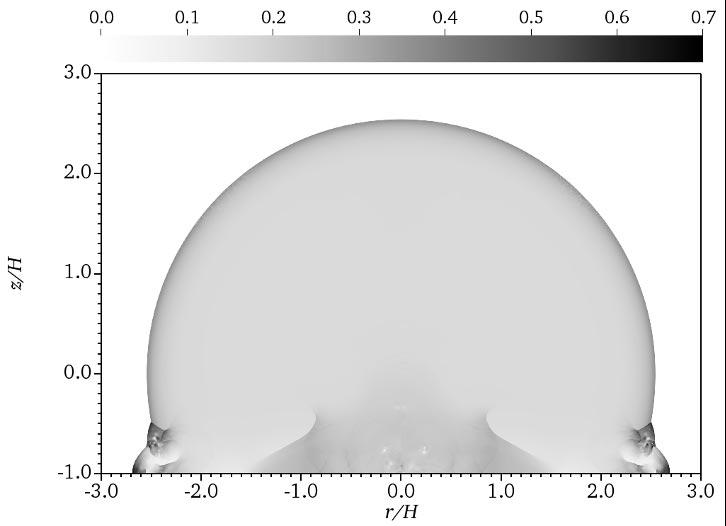
The team used the Miranda code and the Ruby supercomputer to compare theory against numerical simulations, and verified that Miranda reproduces Taylor’s similarity solution for a strong blast wave in an ideal atmosphere.
“Before gathering data and collecting results, we performed convergence studies by refining the grid until the answer did not change,” Cook said. “Then we performed a series of simulations at the converged resolution for different nuclear yields, heights of burst and ambient air densities. We found that the scaled blast volume in each case fell onto the same nondimensional curve. The simulations covered scales from a few millimeters to several kilometers. The largest simulations utilized 3,136 processors and ran for a week.”
The Strategic Consequence Assessment (SCA) air blast team uses the Miranda code to simulate nuclear blasts in non-ideal environments. “Non-ideal air blast” refers to anything more complicated than the Nevada desert, for example, blasts over mountainous terrain or over water or in the presence of rain or snow. These environments change the blast wave in operationally significant ways, which need to be characterized through accurate simulations. High-fidelity blast simulations enable weapons designers to assess the effectiveness of particular designs for specific scenarios.
The team said that understanding nuclear weapon blasts close to the Earth’s surface is important to the nation.
Critical Applications for National Security
“Having the capability to accurately predict the damage of a high-yield device in a wide array of cases, urban settings in particular, is of paramount interest to our national security,” Spriggs said. “This information enables us to pre-compute damage and guide emergency response personnel in the event that the United States is attacked or in case of a catastrophic accident, such as the recent Beirut explosion.”
The research spawned from decades of data collected by the “Film Scanning and Re-analysis Project,” hosted by the Lab’s Design Physics Division within the Weapons and Complex Integration Directorate at LLNL, with Spriggs serving as principal investigator. The work also has been supported by the LLNL’s Laboratory Directed Research and Development Program and by the National Nuclear Security Administration’s Mission Effectiveness Program.
“The more we know about the effects of nuclear detonations in different environments, the better prepared we will be to respond,” Spriggs said. “These new results lay the foundation for a more accurate and complete theory for nuclear blasts interacting with the environment. Numerous other effects, gleaned from the old atmospheric test films, have yet to be explained.”
Reference: “The reflection of a blast wave by a very intense explosion” by Andrew W. Cook, Joseph D. Bauer and Gregory D. Spriggs, 2 June 2021, Proceedings of the Royal Society A.
DOI: 10.1098/rspa.2021.0154
Never miss a breakthrough: Join the SciTechDaily newsletter.
Follow us on Google and Google News.