

Close Menu
    Facebook X (Twitter) Instagram
    SciTechDaily
    • Biology
    • Chemistry
    • Earth
    • Health
    • Physics
    • Science
    • Space
    • Technology
    Facebook X (Twitter) Pinterest YouTube RSS
    SciTechDaily
    Home»Earth»Mysterious Stone Forests – Pointed Rock Formations Resembling Trees – Explained by “Candy Forests”
    Earth

    Mysterious Stone Forests – Pointed Rock Formations Resembling Trees – Explained by “Candy Forests”

    By New York UniversitySeptember 11, 2020No Comments4 Mins Read
    Facebook Twitter Pinterest Telegram LinkedIn WhatsApp Email Reddit
    Share
    Facebook Twitter LinkedIn Pinterest Telegram Email Reddit
    Gradient Pinnacles
    This false-color photograph shows a “forest” of many candy pinnacles that have been dissolved in water. The candy was initially a solid block containing pores, which the dissolving process has reshaped into a bed-of-nails formation. Credit: NYU’s Applied Mathematics Lab

    Stone forests — pointed rock formations resembling trees that populate regions of China, Madagascar, and many other locations worldwide — are as majestic as they are mysterious, created by uncertain forces that give them their shape.


    This video shows an experiment in which a dissolving block of candy develops into an array of sharp spikes. The block starts out with internal pores and is entirely immersed under water, where it dissolves and becomes a “candy forest” before collapsing. Credit: NYU’s Applied Mathematics Lab
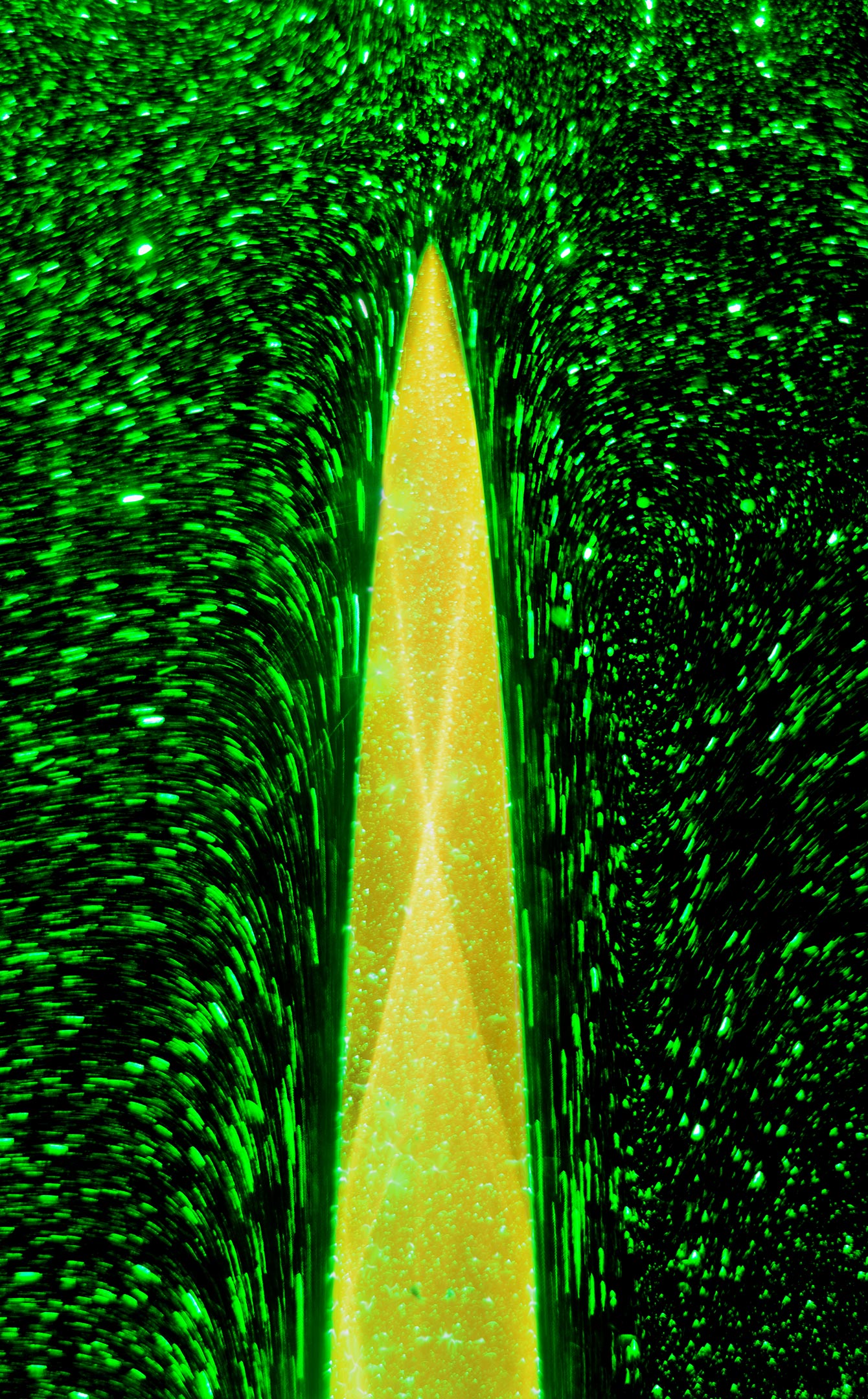
    Single Candy Pinnacle
    This photograph shows a single candy pinnacle dissolving into water. Microparticles are added to the water to trace the flow, and a green laser sheet is shone from above. The time-exposed photograph shows the flows that are generated as the heavy, sugar-rich fluid near the body sinks downward under gravity. Credit: NYU’s Applied Mathematics Lab

    A team of scientists has now shed new light on how these natural structures are created. Its research, reported in the latest issue of the journal Proceedings of the National Academy of Sciences (PNAS), also offers promise for the manufacturing of sharp-tipped structures, such as the micro-needles and probes needed for scientific research and medical procedures.

    “This work reveals a mechanism that explains how these sharply pointed rock spires, a source of wonder for centuries, come to be,” says Leif Ristroph, an associate professor at New York University’s Courant Institute of Mathematical Sciences and one of the paper’s co-authors. “Through a series of simulations and experiments, we show how flowing water carves ultra-sharp spikes in landforms.”

    The researchers, who included Michael Shelley, a professor at the Courant Institute, note that the study also illuminates a mechanism that explains the prevalence of sharply pointed rock spires in karst — a topography formed by the dissolution of rocks, such as limestone.

    In their study, the scientists simulated the formation of these pinnacles over time through a mathematical model and computer simulations that took into account how dissolving produces flows and how these flows also affect dissolving and thus reshaping of a formation.

    To confirm the validity of their simulations, the researchers conducted a series of experiments in NYU’s Applied Mathematics Lab. Here, the scientists replicated the formation of these natural structures by creating sugar-based pinnacles, mimicking soluble rocks that compose karst and similar topographies, and submerging them in tanks of water. Interestingly, no flows had to be imposed, since the dissolving process itself created the flow patterns needed to carve spikes.


    This video shows a side-by-side comparison of the shape development of a single dissolving pillar from experiment and simulation. Both methods show that an initially smooth apex is carved into an ultra-sharp spike. Credit: NYU’s Applied Mathematics Lab

    The experimental results reflected those of the simulations, thereby supporting the accuracy of the researchers’ model (see “Video2ExperimentSimulation” in the below drive). The authors speculate that these same events happen — albeit far more slowly — when minerals are submerged under water, which later recedes to reveal stone pinnacles and stone forests.

    Reference: “Ultra-sharp pinnacles sculpted by natural convective dissolution” by Jinzi Mac Huang, Joshua Tong, Michael Shelley and Leif Ristroph, 8 September 2020, Proceedings of the National Academy of Sciences.
    DOI: 10.1073/pnas.2001524117

    The paper’s other co-authors included Jinzi Mac Huang, an NYU doctoral student at the time of the research, and Joshua Tong, an NYU undergraduate at the time of the study.

    The research was supported by a grant from the National Science Foundation (CBET-1805506).

    Never miss a breakthrough: Join the SciTechDaily newsletter.
    Follow us on Google and Google News.

    Atmospheric Science Climate Change Geophysics New York University
    Share. Facebook Twitter Pinterest LinkedIn Email Reddit

    Related Articles

    Climate Change Will Result in More Rainbows

    Earth’s Radiation Budget Is Out of Balance – Doubled During 14-Year Period

    The Earth Has a Pulse: 27.5-Million-Year Cycle of Geological Activity Discovered

    NASA, NOAA Scientists: Earth’s Energy Imbalance Has Doubled

    Earth’s Permanent Oxygen Rise Occurred 100 Million Years Later Than Thought

    COVID-19 Lockdowns Caused Cleaner Air – And Warmed the Planet

    Tipping Point: Irreversible Hotter and Drier Climate Over Inner East Asia

    Who Is Driving Whom? Climate and Carbon Cycle in Perpetual Interaction and Changing Feedback Mechanisms

    Small Volcanoes Underestimated in Climate Models

    Leave A Reply Cancel Reply

    • Facebook
    • Twitter
    • Pinterest
    • YouTube

    Don't Miss a Discovery

    Subscribe for the Latest in Science & Tech!

    Trending News

    Your Blood Pressure Reading Could Be Wrong Because of One Simple Mistake

    Astronomers Stunned by Ancient Galaxy With No Spin

    Physicists May Be on the Verge of Discovering “New Physics” at CERN

    Scientists Solve 320-Million-Year Mystery of Reptile Skin Armor

    Scientists Say This Daily Walking Habit May Be the Secret to Keeping Weight Off After Dieting

    New Therapy Rewires the Brain To Restore Joy in Depression Patients

    Giant Squid Detected off Western Australia in Stunning Deep-Sea Discovery

    Popular Sugar-Free Sweetener Linked to Liver Disease, Study Warns

    Follow SciTechDaily
    • Facebook
    • Twitter
    • YouTube
    • Pinterest
    • Newsletter
    • RSS
    SciTech News
    • Biology News
    • Chemistry News
    • Earth News
    • Health News
    • Physics News
    • Science News
    • Space News
    • Technology News
    Recent Posts
    • New Stroke Study Challenges Decades-Old Medical Beliefs
    • These Simple Plant Foods Are Linked to Lower Blood Pressure
    • Common Blood Pressure Drug Supercharges Cancer Treatment in Surprising New Study
    • Key Magic Mushroom Ingredient Increases Laziness and Reduces Aggression
    • Researchers Solve 15-Year Mystery Behind Cancer-Causing Gut Toxin
    Copyright © 1998 - 2026 SciTechDaily. All Rights Reserved.
    • Science News
    • About
    • Contact
    • Editorial Board
    • Privacy Policy
    • Terms of Use

    Type above and press Enter to search. Press Esc to cancel.