
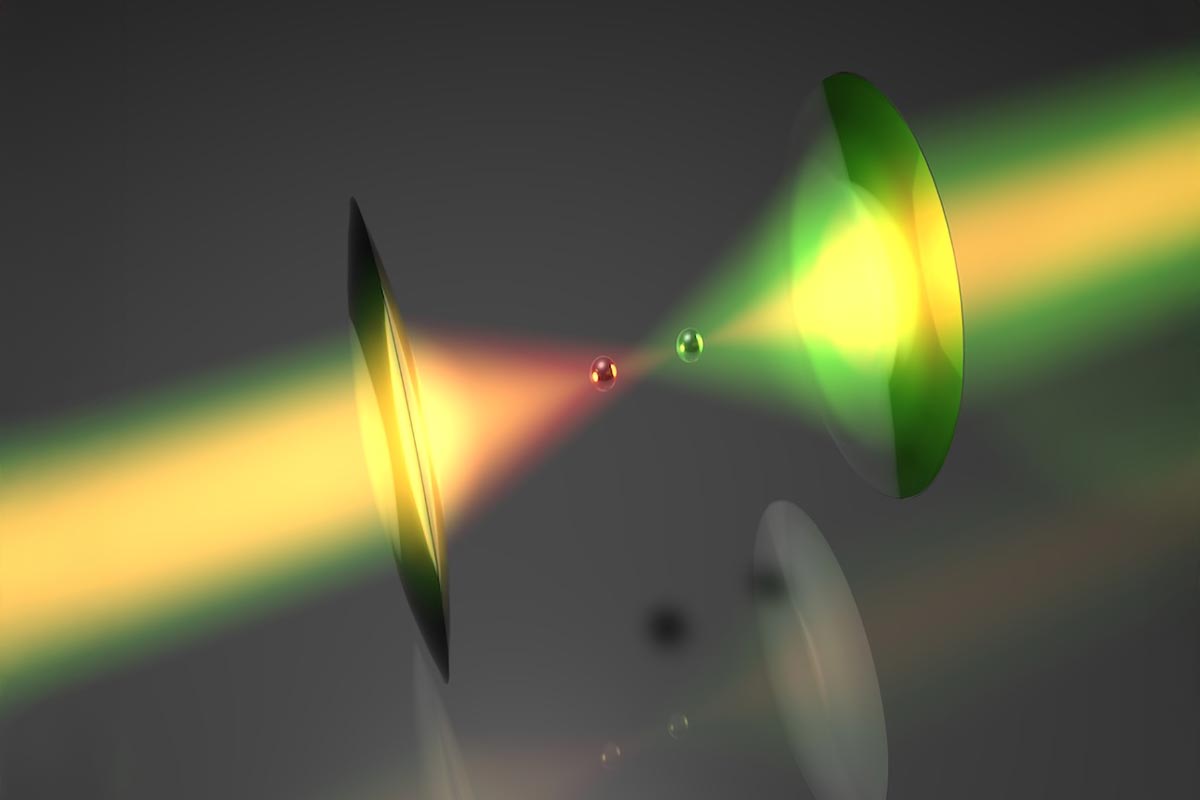
Scientists in Florence have built a device that allows them to study quantum and classical physics side by side.
Using levitating nanospheres trapped in laser beams, they can observe how matter behaves in ways never seen before. This breakthrough could help unravel the mysteries of the quantum world.
Exploring the Boundary Between Classical and Quantum Worlds
A recent study published in the scientific journal Optica introduces a groundbreaking experimental device that bridges the gap between classical and quantum physics. This innovative instrument enables researchers to observe and study phenomena from both realms simultaneously. Developed in Florence, the device is the result of a collaborative effort within the National Quantum Science and Technology Institute (NQSTI). It involves experts from the University of Florence’s Department of Physics and Astronomy, the National Institute of Optics (CNR-INO), the European Laboratory for Nonlinear Spectroscopy (LENS), and the Florence branch of the National Institute for Nuclear Physics (INFN).
How Matter Behaves at Different Scales
As scientists investigate matter at increasingly smaller scales, its behavior shifts dramatically from what we observe in the macroscopic world. This transition is where quantum physics comes into play, offering insight into the nature of matter at the tiniest levels. Until now, classical and quantum behaviors have been studied separately. However, the new device created by CNR-INO researchers allows scientists to examine both perspectives within the same experiment.
The Power of Levitating Nano-Objects
The instrument operates by levitating nano-scale objects using a tightly focused laser beam. This process, known as optical trapping, exploits light’s ability to hold and manipulate microscopic particles. First discovered in the 1980s, this technique was significantly advanced by physicist Arthur Ashkin, who won the 2018 Nobel Prize in Physics for his pioneering work in optical tweezers.
Trapping Light and Observing the Quantum Realm
The Italian team, led by Francesco Marin (University of Florence and CNR-INO), has applied this technique to simultaneously trap, using beams of light of different colors, a pair of glass nanospheres. Within the optical trap, these spheres oscillate around their equilibrium point with very specific frequencies, allowing for the observation of both “classical” and “quantum” behaviors, the latter often being decidedly counterintuitive.
Unlocking the Mystery of Nano-Oscillators
“These nano-oscillators are among the rare systems in which we can investigate the behavior of macroscopic objects in a highly controlled manner,” says Marin. “The spheres are electrically charged and interact with each other, so the trajectory followed by one sphere is strongly dependent on the other. This opens the way for the study of collectively interacting nanosystems in both the classical and quantum regimes, thus allowing the experimental exploration of the subtle boundary between these two worlds.”
Reference: “Coulomb coupling between two nanospheres trapped in a bichromatic optical tweezer” by F. Marino, Q. Deplano, F. Marin, A. Pontin and A. Ranfagni, 19 December 2024, Optica.
DOI: 10.1364/OPTICA.538760
The study is also made possible thanks to the support of two initiatives financed by the Ministry of University and Research with European Union funds as part of the #NextGenerationEU program (PNRR – National Recovery and Resilience Plan): the “National Quantum” partnership Science and Technology Institute” (NQSTI) and the “Integrated Infrastructure Initiative in Photonic and Quantum Science” (IPHOQS) infrastructure.
Never miss a breakthrough: Join the SciTechDaily newsletter.
Follow us on Google and Google News.
1 Comment
The spheres are electrically charged and interact with each other, so the trajectory followed by one sphere is strongly dependent on the other. This opens the way for the study of collectively interacting nanosystems in both the classical and quantum regimes.
GOOD.
Ask the researchers:
What is the difference between classical physics and quantum physics?
What one researcher see or touch about an elephant will be different, and what different researchers see or touch will be even more different. It is a scientific phenomenon, not the essence of nature. Scientific research guided by correct theories can enable researchers to think more.
According to the Topological Vortex Theory (TVT), spins create everything, spins shape the world. There are substantial distinctions between Topological Vortex Theory (TVT) and traditional physical theories. Grounded in the inviscid and absolutely incompressible spaces, TVT introduces the concept of topological phase transitions and employs topological principles to elucidate the formation and evolution of matter in the universe, as well as the impact of interactions between topological vortices and anti-vortices on spacetime dynamics and thermodynamics.
Within TVT, low-dimensional spacetime matter serves as the foundation for high-dimensional spacetime matter, and the hierarchical structure of matter and its interaction mechanisms challenge conventional macroscopic and microscopic interpretations. The conflict between Quantum Physics and Classical Physics can be attributed to their differing focuses: Quantum Physics emphasizes low-dimensional spacetime matter, whereas Classical Physics centers on high-dimensional spacetime matter.
Subatomic particles in the quantum world often defy the familiar rules of the physical world. The fact repeatedly suggests that the familiar rules of the physical world are pseudoscience. In the familiar rules of the physical world, two sets of cobalt-60 can form the mirror image of each other by rotating in opposite directions, and should receive the Nobel Prize for physics.
Please witness the grand performance of some so-called peer review publications (including PRL, PNAS, Nature, Science, etc.). https://scitechdaily.com/microscope-spacecrafts-most-precise-test-of-key-component-of-the-theory-of-general-relativity/#comment-854286. Some so-called academic publications (including PRL, PNAS, Nature, Science, etc.) are addicted to their own small circles and have deviated from science for a long time.
If the researchers are truly interested in science, please read: The Application of Inviscid and Absolutely Incompressible Spaces in Engineering Simulation (https://scitechdaily.com/microscope-spacecrafts-most-precise-test-of-key-component-of-the-theory-of-general-relativity/#comment-870077).