
Close Menu
    Facebook X (Twitter) Instagram
    SciTechDaily
    • Biology
    • Chemistry
    • Earth
    • Health
    • Physics
    • Science
    • Space
    • Technology
    Facebook X (Twitter) Pinterest YouTube RSS
    SciTechDaily
    Home»Biology»Nano-Switch Discovery: How a Single Hydrogen Atom Powers Life’s Energy Reactions
    Biology

    Nano-Switch Discovery: How a Single Hydrogen Atom Powers Life’s Energy Reactions

    By Osaka UniversityDecember 12, 2024No Comments4 Mins Read
    Facebook Twitter Pinterest Telegram LinkedIn WhatsApp Email Reddit
    Share
    Facebook Twitter LinkedIn Pinterest Telegram Email Reddit
    Energy Reaction Art Concept
    Japanese researchers have identified a mechanism in ferredoxin that controls its electron transfer ability, pivotal for energy processes in life forms. Their analysis reveals that a single hydrogen atom acts as a ‘nano-switch’, potentially impacting the development of new sensors and drugs. Credit: SciTechDaily.com

    A new study reveals a ‘nano-switch’ in ferredoxin that affects its electron transfer, which could lead to advancements in sensors and drug development.

    Researchers in Japan have discovered a mechanism for controlling the potential of an “electron carrier” protein in the redox reaction that all organisms need to obtain energy. Through experiments, the precise 3D structure of the protein, including hydrogen atoms, was determined, and theoretical calculations using this data visualized the electronic structure of the iron-sulfur cluster.

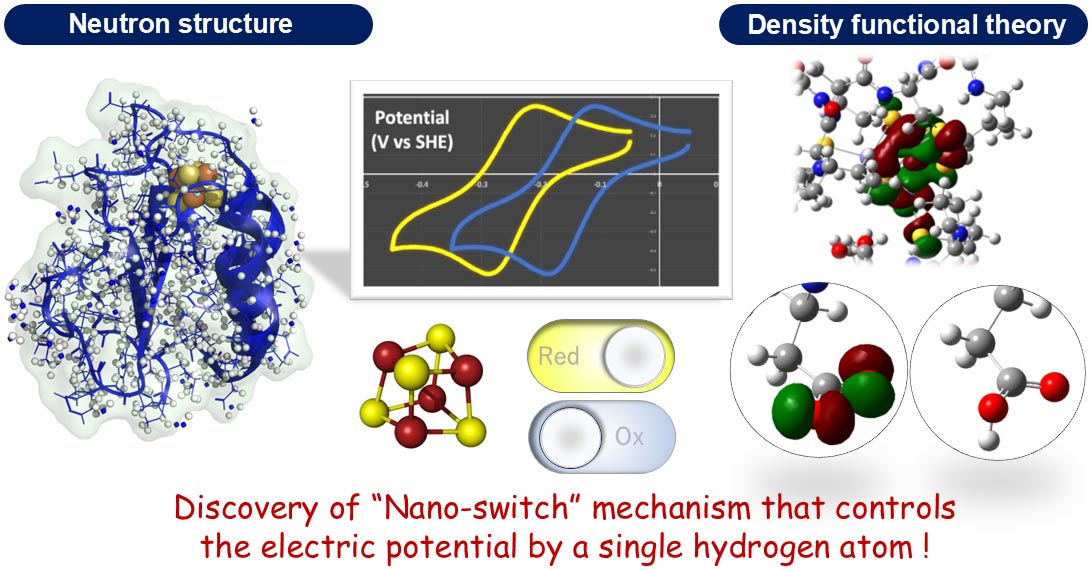
    The results revealed, for the first time, that the electric potential of the iron-sulfur cluster changes dramatically depending on the presence or absence of a single hydrogen atom at an amino acid side chain, a so-called “nano-switch” mechanism. This research, recently published in the journal eLife, not only deepens our scientific understanding of biological reactions but also provides crucial insights for the future development of ultra-sensitive sensors for oxygen and nitric oxide, as well as novel drugs.
    "Nano-Switch" Mechanism Schematic
    Discovery of “Nano-switch” mechanism that controls the electric potential by a single hydrogen atom! Credit: Ibaraki University

    Unveiling Electron Transfer in Ferredoxin

    Most reactions in living organisms involve the “electrons” transfer, called redox reaction. For example, respiration and photosynthesis can be classified as redox reactions. Some proteins that assist in the electron transfer contain irons and sulfurs.

    Ferredoxin is a small protein that holds iron-sulfur clusters inside it and is known as the “electron carrier” in living organisms. It is a universal protein thought to be present in almost all living organisms; however, the mechanism by which ferredoxin stably carries electrons has remained a mystery to date.
    Schematic of Electron Transfer Mechanism by Ferredoxin
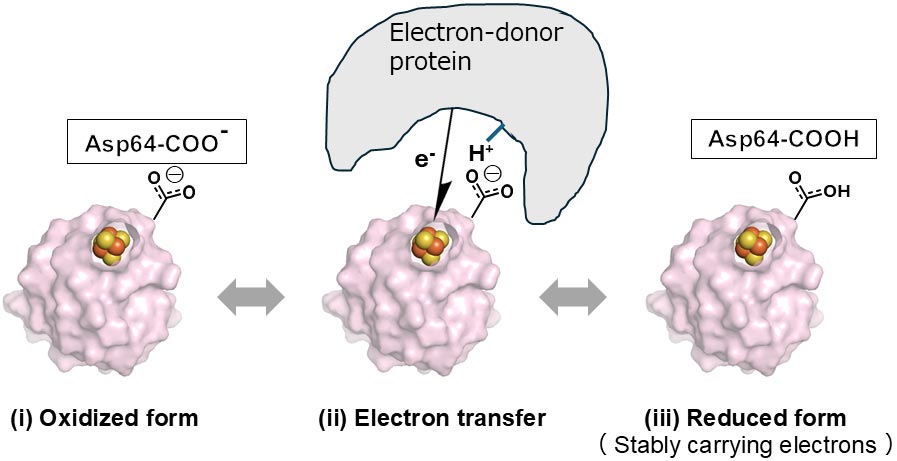
    A schematic drawing of the electron transfer mechanism by ferredoxin that revealed in this study. Credit: Ibaraki University

    Breakthroughs in Structural Biology

    In this study, the researchers conducted experiments using the Ibaraki Biological Crystal Diffractometer (iBIX) at the Materials and Life Science Experimental Facility (MLF) in the Japan Proton Accelerator Research Complex (J-PARC) and succeeded in determining the precise three-dimensional structure of a ferredoxin at the hydrogen atomic level in experiments using a neutron beam. Visualizing hydrogen atoms in protein molecules using neutrons is extremely difficult, and only less than 0.2% of the entire protein three-dimensional structure database (Protein Data Bank; PDB) has been reported.

    Structure Around the Iron-Sulfur Cluster
    Structure around the iron-sulfur cluster. Credit: Ibaraki University

    Insights into Electron Transfer Mechanisms

    Theoretical calculations using experimental geometry, including hydrogen atoms, were performed to elucidate the electronic structure of the iron-sulfur cluster in the ferredoxin. As a result, it was revealed, for the first time, that an amino acid residue (aspartic acid 64) located far from the iron-sulfur cluster has a significant effect on the probability of electron transfer in the iron-sulfur cluster and plays a role like a switch that controls the electron transfer in ferredoxin. Furthermore, it was shown that the mechanism is universal in various organisms.

    The results will not only deepen our scientific understanding of biological reactions but also provide a major clue to the future development of ultra-sensitive sensors for oxygen and nitric oxide and novel drugs.

    Reference: “Protonation/deprotonation-driven switch for the redox stability of low-potential [4Fe-4S] ferredoxin” by Kei Wada, Kenji Kobayashi, Iori Era, Yusuke Isobe, Taigo Kamimura, Masaki Marukawa, Takayuki Nagae, Kazuki Honjo, Noriko Kaseda, Yumiko Motoyama, Kengo Inoue, Masakazu Sugishima, Katsuhiro Kusaka, Naomine Yano, Keiichi Fukuyama, Masaki Mishima, Yasutaka Kitagawa and Masaki Unno, 9 December 2024, eLife.
    DOI: 10.7554/eLife.102506.2

    Never miss a breakthrough: Join the SciTechDaily newsletter.
    Follow us on Google and Google News.

    Atoms Electron Hydrogen Neutrons Photosynthesis Popular Structural Biology University of Osaka
    Share. Facebook Twitter Pinterest LinkedIn Email Reddit

    Related Articles

    Common Weed Discovered To Be a “Super Plant”

    What Drives the Circadian Rhythms: Unlocking Complex Workings of the Biological Clock

    Cryo-EM Reveals How “911” Molecule Helps Repair DNA Damage

    Not Science Fiction: German Scientists Harness the Power of Photosynthesis for New Way To “Breathe”

    Surprising Research Reveals Photosynthesis Could Be As Old as Life Itself

    Future Energy Source: Scientists Build Tiny Microbial Factories That Produce Hydrogen by Photosynthesis

    Elusive Photosynthesis Details Unlocked With Rapid X-Ray Pulses

    Velvet Worms Secrete Stiff Fibers Spun from Slime

    Synthetic Molecule Destroys Key Allergy-Inducing Complexes

    Leave A Reply Cancel Reply

    • Facebook
    • Twitter
    • Pinterest
    • YouTube

    Don't Miss a Discovery

    Subscribe for the Latest in Science & Tech!

    Trending News

    Largest-Ever Study Finds Medicinal Cannabis Ineffective for Anxiety, Depression, PTSD

    250-Million-Year-Old Egg Solves One of Evolution’s Biggest Mysteries

    Living With Roommates Might Be Changing Your Gut Microbiome Without You Knowing

    Century-Old Cleaning Chemical Linked to 500% Increased Risk of Parkinson’s Disease

    What if Your Memories Never Happened? Physicists Take a New Look at the Boltzmann Brain Paradox

    One of the Universe’s Largest Stars May Be Getting Ready To Explode

    Scientists Discover Enzyme That Could Supercharge Ozempic-Like Weight Loss Drugs

    Popular Sweetener Linked to DNA Damage – “It’s Something You Should Not Be Eating”

    Follow SciTechDaily
    • Facebook
    • Twitter
    • YouTube
    • Pinterest
    • Newsletter
    • RSS
    SciTech News
    • Biology News
    • Chemistry News
    • Earth News
    • Health News
    • Physics News
    • Science News
    • Space News
    • Technology News
    Recent Posts
    • Scientists Say This Overlooked Organ Could Hold the Key to Longer Life
    • Want Less Stress? Landmark Study Points to a Simple Habit
    • Scientists Reveal Eating Fruits and Vegetables May Increase Your Risk of Lung Cancer
    • AI Reveals Explosive Growth of Floating Algae Across the World’s Oceans
    • 5.5 Million Bees Discovered Living Beneath a New York Cemetery
    Copyright © 1998 - 2026 SciTechDaily. All Rights Reserved.
    • Science News
    • About
    • Contact
    • Editorial Board
    • Privacy Policy
    • Terms of Use

    Type above and press Enter to search. Press Esc to cancel.