
Close Menu
    Facebook X (Twitter) Instagram
    SciTechDaily
    • Biology
    • Chemistry
    • Earth
    • Health
    • Physics
    • Science
    • Space
    • Technology
    Facebook X (Twitter) Pinterest YouTube RSS
    SciTechDaily
    Home»Technology»Nanotech Pores Keep Bacteria from Sticking to Surfaces
    Technology

    Nanotech Pores Keep Bacteria from Sticking to Surfaces

    By Krishna Ramanujan, Cornell UniversityJanuary 12, 2015No Comments3 Mins Read
    Facebook Twitter Pinterest Telegram LinkedIn WhatsApp Email Reddit
    Share
    Facebook Twitter LinkedIn Pinterest Telegram Email Reddit
    New Tech Keeps Bacteria from Sticking to Surfaces
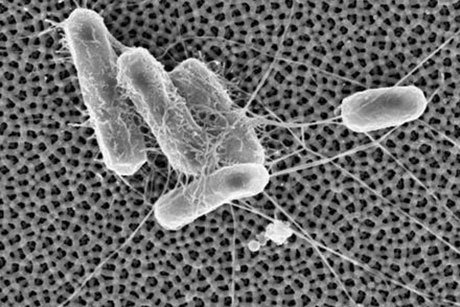
    Nanoporous alumina repels E. coli cells. Credit: Guoping Feng

    A team of researchers used anodization to create nanoscale pores that change the electrical charge and surface energy of a metal surface, creating a nanoporous surface called alumina that prevents bacteria from attaching to the surface.

    Just as the invention of nonstick pans was a boon for chefs, a new type of nanoscale surface that bacteria can’t stick to holds promise for applications in the food processing, medical, and even shipping industries.

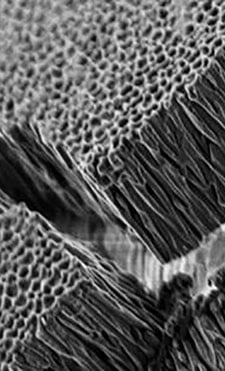
    The technology, developed collaboratively by researchers from Cornell University and Rensselaer Polytechnic Institute, uses an electrochemical process called anodization to create nanoscale pores that change the electrical charge and surface energy of a metal surface, which in turn exerts a repulsive force on bacterial cells and prevents attachment and biofilm formation. These pores can be as small as 15 nanometers; a sheet of paper is about 100,000 nanometers thick.

    When the anodization process was applied to aluminum, it created a nanoporous surface called alumina, which proved effective in preventing surrogates of two well-known pathogens, Escherichia coli O157:H7 and Listeria monocytogenes, from attaching, according to a study recently published in the journal Biofouling. The study also investigates how the size of the nanopores changes the repulsive forces on bacteria.
    New Nanotech Pores Keep Bacteria from Sticking to Surfaces
    A cross-section of nanoporous alumina. Credit: Guoping Feng

    “It’s probably one of the lowest-cost possibilities to manufacture a nanostructure on a metallic surface,” said Carmen Moraru, associate professor of food science and the paper’s senior author. Guoping Feng, a research associate in Moraru’s lab, is the paper’s first author.

    Finding low-cost solutions to limiting bacterial attachments is key, especially in biomedical and food processing applications. “The food industry makes products with low profit margins,” said Moraru. “Unless a technology is affordable it doesn’t stand the chance of being practically applied.”

    Anodized metals could be used to prevent buildups of biofilms – slick communities of bacteria that adhere to surfaces and are tricky to remove – in biomedical clean rooms and in equipment parts that are hard to reach or clean, Moraru said.

    There are other strategies for limiting bacterial attachment to surfaces, including chemicals and bactericides, but these have limited applications, especially when it comes to food processing, Moraru said. With food processing, surfaces must meet food safety guidelines and be inert to food that they may contact.

    Anodized metal could also have marine applications, such as keeping ship hulls free of algae.

    Future work will investigate the repulsive effect of these surfaces on other bacteria, and the use of other anodized materials for this purpose.

    The collaborating group from Rensselaer Polytechnic Institute is led by Diana Borca-Tasciuc, associate professor of mechanical, aerospace, and nuclear engineering.

    The study was funded by the U.S. Department of Agriculture.

    Reference: “Alumina surfaces with nanoscale topography reduce attachment and biofilm formation by Escherichia coli and Listeria spp.” by Guoping Feng, Yifan Cheng, Shu-Yi Wang, Lillian C. Hsu, Yazmin Feliz and Diana A. Borca-Tasciuc, Biofouling: The Journal of Bioadhesion and Biofilm Research.
    DOI: 10.1080/08927014.2014.976561


    Never miss a breakthrough: Join the SciTechDaily newsletter.
    Follow us on Google and Google News.

    Bacteria Bionanotechnology Cornell University Nanotechnology
    Share. Facebook Twitter Pinterest LinkedIn Email Reddit

    Related Articles

    Nanocapsules Battle Cancer without Harming Healthy Cells

    Nanosensors Check if Replacement Cells Are Still Alive

    First Electron Microscope Image of DNA Double Helix

    Bacteria-Resistant Hospital Fabrics That Actively Fight Microbes

    Magnetic Nanoparticles Control Thousands of Cells Simultaneously

    Environmentally Friendly Treatments Could Reduce Odors in Cotton Fabric

    Engineered Nanoparticles Deliver Antibiotics Directly to Bacteria

    Researchers Develop DNA Nanorobot to Seek Specific Cell Targets

    Researchers Study the Use of Photosystem-I as Photovoltaic Panels

    Leave A Reply Cancel Reply

    • Facebook
    • Twitter
    • Pinterest
    • YouTube

    Don't Miss a Discovery

    Subscribe for the Latest in Science & Tech!

    Trending News

    Enormous Prehistoric Insects Puzzle Scientists

    Scientists Develop Bioengineered Chewing Gum That Could Help Fight Oral Cancer

    After 37 Years, the World’s Longest-Running Soil Warming Experiment Uncovers a Startling Climate Secret

    NASA Satellite Captures First-Ever High-Res View of Massive Pacific Tsunami

    ADHD Isn’t Just a Deficit: Study Reveals Powerful Hidden Strengths

    Scientists Discover Stem Cells That Could Regrow Teeth and Bone

    Early Cannabis Use May Stall Key Brain Skills in Teens

    Popular Vitamin D Supplement Has “Previously Unknown” Negative Effect, Study Finds

    Follow SciTechDaily
    • Facebook
    • Twitter
    • YouTube
    • Pinterest
    • Newsletter
    • RSS
    SciTech News
    • Biology News
    • Chemistry News
    • Earth News
    • Health News
    • Physics News
    • Science News
    • Space News
    • Technology News
    Recent Posts
    • One in Five at Risk: Scientists Identify a Hidden Blood Particle Linked to Higher Risk of Stroke and Death
    • Darwin’s Islands Still Evolving: Giant Daisies Rewrite the Rules of Evolution
    • Ancient Document Confirms “Legendary” African King Actually Existed
    • First-of-Its-Kind Discovery: Homer’s Iliad Found Embedded in a 1,600-Year-Old Egyptian Mummy
    • Beyond Inflammation: Scientists Uncover New Cause of Persistent Rheumatoid Arthritis
    Copyright © 1998 - 2026 SciTechDaily. All Rights Reserved.
    • Science News
    • About
    • Contact
    • Editorial Board
    • Privacy Policy
    • Terms of Use

    Type above and press Enter to search. Press Esc to cancel.