
A new study from Yale University reveals that a topical formulation of an oral medication used to treat bone marrow diseases can be used to grow hair.
A young woman who had no scalp or eyebrow hair for years now enjoys a full mane after using a novel cream devised by researchers at Yale School of Medicine.
The 17-year-old patient suffered from alopecia areata, a disfiguring autoimmune disease that affects tens of millions of people worldwide and has limited treatment options. Alopecia areata may cause spotty hair loss or complete loss of scalp hair, eyebrows, eyelashes, and all other body hair. The patient in this study, published December 9 in JAMA Dermatology, had tried multiple treatments with no success.
To treat the condition, Dr. Brett King, assistant professor of dermatology, and his co-authors, Dr. Brittany Craiglow and Daniel Tavares, devised a topical formulation of an oral medication used to treat bone marrow diseases.
The drug, ruxolitinib, belongs to a class of medications called JAK inhibitors, which alter the immune system. King had previously used another oral JAK inhibitor, tofacitinib, to restore hair to a male patient with alopecia universalis in 2014, and other researchers have shown that oral ruxolitinib restores hair in this condition, too.
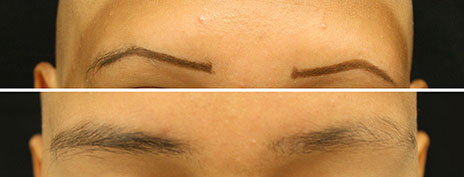
For this study, the patient applied the cream twice a day to the scalp and eyebrows. After 12 weeks, she had complete restoration of eyebrows and partial regrowth of her scalp. After switching from the cream to a pill form to continue her treatment, the patient now has a full head of hair.
The outcome was better than anticipated, said King. “The results with the cream are as good as what is expected with pills over the same amount of time,” he noted. “The results are remarkable.”
A cream is more appropriate for many patients with alopecia areata, including those concerned about possible risks, such as cancer or infections, that have been associated with oral JAK inhibitors, said the researchers. No side effects were observed in the patient using the cream.
“This is a first in the treatment of a devastating and common autoimmune disease and builds on our recent efforts to show that treatment is within reach for millions of people who suffer from alopecia areata and will hopefully continue to build interest in finding solutions for this and other autoimmune diseases,” said King.
Reference: “Topical Ruxolitinib for the Treatment of Alopecia Universalis” by Brittany G. Craiglow, MD; Daniel Tavares, PharmD and Brett A. King, MD, Ph.D., December 9, 2015, JAMA Dermatol.
DOI: 10.1001/jamadermatol.2015.4445
Never miss a breakthrough: Join the SciTechDaily newsletter.
Follow us on Google and Google News.
7 Comments
Alopacea areata beardae can be treated by using salt and lemon juice over the area and rubbing it hard. Here the hair growth will be sooner and otherwise if we leave it without treatment they will grow again say in a year’s time. The hair cells roots which got retarded (but not destroyed)will be awakened by this procedure. But this treatment is not recommended for Alopacea areata totallis. The article talks of a cream which may work but it is to be established well . The reason is the candidates available will be less to test and study this. Thank You.
WE ALL NEED THIS -NOW-! Pretty much most Alopecia sufferers would do anything for this, so why isn’t it readily available?
If it is true,why it is not available to millions of people
As others are eluding to, when will this be available? Are further trials being conducted, including other types of alopecia? Namely congenital triangular alopecia (or temporal triangular alopecia). If this is indeed effective it needs to be available asap at a reasonable price
My skin conditions are eczema and icthyosis. In spite of my skin conditions I’ve always had a full head of healthy long hair until about one and a half years ago. I’m horrified! Are further trials being conducted in Kansas City, Missouri inclusive of Alopecia Areata? Where is this miracle topical cream available?
I would like to participate in your research. I’m a 70 year old female in Nashville TN. I still work and sing but my hair is getting embarrassingly thin. Let me be one of your ginny pigs. I would like to help you and help me!
I AM 80 YEARS OLD AND HAVE USEDCLOBETASOL TOPICAL SOLUTION WITH LIMITED
RESULT AND WOULD BE HAPPY TO GIVE RUXOLITINIB TOPICAL CREAM A TRY OUT.