
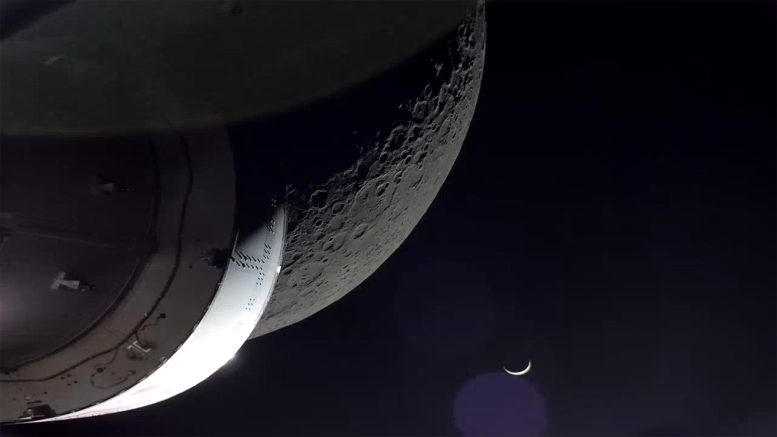
NASA’s Orion spacecraft is on course for its return to Earth on Sunday, December 11. On Flight Day 20 of the Artemis I mission, the spacecraft made its second and final close approach to the Moon at 10:43 a.m. CST Monday, December 5, just before its return powered flyby burn, passing 80.6 miles (129.7 km) above the lunar surface.
The burn, which used the spacecraft’s main engine on the European-built service module, lasted 3 minutes, 27 seconds, and changed the velocity of the spacecraft by about 655 mph (961 feet per second). It was the final major engine maneuver of the flight test.
On flight day 20, Orion prepares for its return powered flyby and closest approach to the Moon. This video was captured prior to the spacecraft’s 3-minute, 27-second, return powered flyby burn, committing Orion to a return to Earth and splashdown on December 11, 2022. Credit: NASA
“Orion is heading home! Today the team achieved another momentous accomplishment, flying Orion just 80 miles from the surface of the Moon. The lunar flyby enabled the spacecraft to harness the Moon’s gravity and slingshot it back toward Earth for splashdown,” said Administrator Bill Nelson. “When Orion re-enters Earth’s atmosphere in just a few days, it will come back hotter and faster than ever before – the ultimate test before we put astronauts on board. Next up, re-entry!”
Several hours before the lunar flyby, the spacecraft performed a trajectory correction burn at 4:43 a.m. CST using the reaction control system thrusters on the service module. The burn lasted 20.1 seconds and changed the velocity of the spacecraft by 1.39 mph (2.04 feet per second) or 2.24 km/h (0.62 meters per second).
On the 20th day of the Artemis I mission, Orion completed the 3-minute, 27-second, return powered flyby burn, making its closest approach just 80 miles (130 km) above the lunar surface. Orion will splash down in the Pacific Ocean on Sunday, December 11. Credit: NASA
The mission management team convened and polled “go” to deploy recovery assets off the coast of California ahead of Orion’s splashdown on December 11. As soon as Orion splashes down, a team of divers, engineers, and technicians will depart the ship on small boats and arrive at the capsule. Once there, they will secure it and prepare to tow it into the back of the ship, known as the well deck. The divers will attach a cable to pull the spacecraft into the ship, called the winch line, and up to four additional tending lines to attach points on the spacecraft. The winch will pull Orion into a specially designed cradle inside the ship’s well deck and the other lines will control the motion of the spacecraft. Once Orion is positioned above the cradle assembly, the well deck will be drained and Orion will be secured on the cradle.
Recovery teams prepare for the splashdown of Orion on December 11, 2022, off the coast of San Diego, California. The spacecraft will complete its 25.5-day mission by splashing down in the Pacific Ocean, where it will be recovered by teams aboard the USS Portland. Credit: NASA
“Last week, we completed our final rehearsal with the USS Portland, which will be our recovery ship for Artemis I,” said Melissa Jones, landing and recovery director, NASA’s Kennedy Space Center. “We had a great three days working with them to refine our procedures and integrate our teams so we can meet the objectives of recovering the Orion spacecraft.”
Orion has used approximately 8,050 pounds of propellant during Artemis I, which is 180 pounds less than expected prelaunch. There are 2,075 pounds of margin available over what was planned for the mission, a 165-pound increase.
As of 5:29 p.m. CST on December 5, Orion was traveling 244,629 miles (393,692 km) from Earth and 16,581 miles (26,685 km) from the Moon, cruising at 668 mph (1,075 km/h).
NASA Television and the agency’s website will resume live coverage of Orion’s journey at 9 a.m. Tuesday.
As Orion leaves the lunar sphere of influence for the final time, watch NASA astronaut Thomas Marshburn read the children’s book Goodnight Moon from space during his expedition aboard the International Space Station as part of a collaboration with Crayola Education to bring stories and the unique teachings of space to life with art and creativity.
Never miss a breakthrough: Join the SciTechDaily newsletter.
Follow us on Google and Google News.