
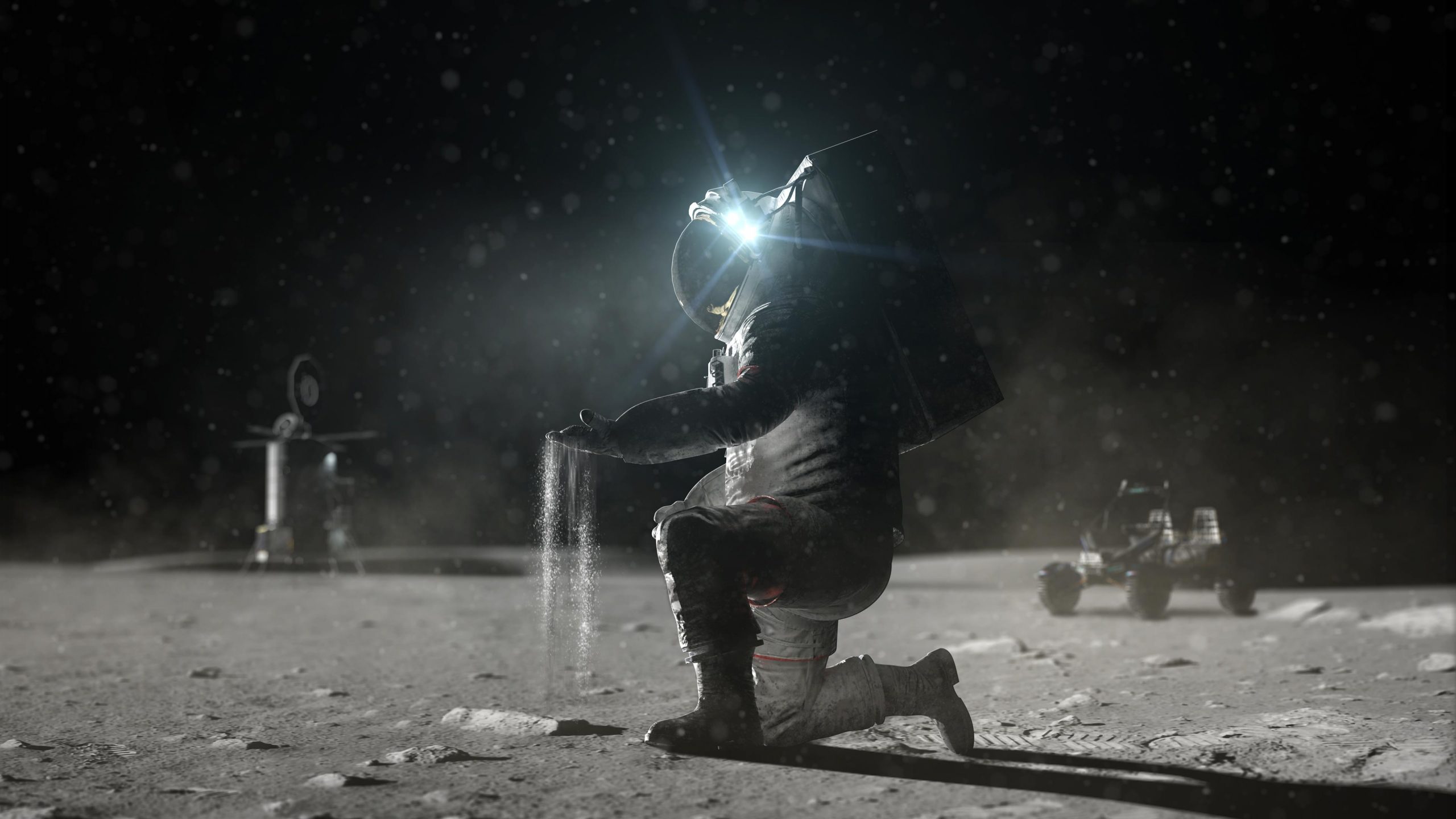
NASA asked university students around the country to help solve the pesky problem of lunar dust as the agency plans for sustainable human exploration of the Moon. Through the 2021 competitive Breakthrough, Innovative, and Game-changing (BIG) Idea Challenge and the Space Grant project, NASA has awarded nearly $1 million to seven university teams to develop their innovative lunar dust mitigation solutions.
“This challenge is an exciting opportunity both for university students and the space agency,” said Niki Werkheiser, the director of technology maturation within NASA’s Space Technology Mission Directorate (STMD). “Lunar dust affects everything we do on the Moon, so we need many strategies for reducing or preventing its abrasive effects. These innovative student concepts could help solve some of NASA’s most pressing lunar dust problems.”
The selected teams will develop methods and technologies for both active dust mitigation capabilities, like air filtration systems, and passive concepts, like dust-free landing pads and workspaces.
The award values vary and are based on each team’s proposed prototype and budget. The 2021 BIG Idea Challenge awardees are:
Brown University in Providence, Rhode Island, with Rhode Island School of Design in Providence
Tufted Electrostatic Solution to Regolith Adhesion Dilemma
Provides systematic layers of protection at a spacesuit’s most vulnerable points through implementing tufted electrostatically charged repulsion fibers and regolith catching fibers where abrasion is most likely to occur.
California Institute of Technology in Pasadena
Habitat Orientable and Modular Electrodynamic Shield
A collection of panels embedded with an electrodynamic dust shielding system to mitigate lunar dust intruding in habitable spaces.
Colorado School of Mines in Golden
The Lunar In-Situ Landing/Launch Environment Pad
The proposed system consists of two parts: the polymer nozzle distribution area, which includes a binder-regolith reinforced surface, and the landing/launch pad, a carbon fiber fabric barrier that is anchored to the surface. The team will collaborate with ICON, Masten Space Systems, and Adherent Technologies Inc.
Georgia Institute of Technology in Atlanta
Hybrid Dust Mitigation Brush Utilizing EDS and UV Technologies
A hybrid brush that utilizes electrodynamic dust shielding and ultraviolet technologies to remove lunar regolith from spacesuits and other applicable surfaces. The brush bristles contain electrodes that attract charged lunar regolith particles and clear them off the suit. Remaining, uncharged regolith particles are charged by ultraviolet emitters to enable removal by the system.
Missouri University of Science and Technology in Rolla
Contaminant Ultrasonic Removal via Vibration Ejection from Solar Cells
Removes lunar dust from solar cells via ultrasonic vibration through a strategy of maximizing surface acceleration by optimally placing lead zirconate titanate elements on a phosphor bronze substrate supporting the solar cells. The method also uses sol-gel surface treatments to reduce Van der Waals forces.
University of Central Florida in Orlando
Lunar Dust Mitigating Electrostatic micro-Textured Overlay
A bio-inspired materials engineering solution that includes constructing a hair-like surface microstructure that mimics pollinators to decrease the strong interaction between the dust and the exterior of the spacesuit. The team, in collaboration with Morphotonics, will make conductive fabrics that dissipate charges on lunar dust and use origami-based design to improve material longevity.
Washington State University in Pullman
Leidenfrost Dusting as a Novel Tool for Lunar Dust Mitigation
Liedenfrost dusting uses the novel evaporation of cryogenic liquid droplets to lift and transport lunar dust from spacesuit materials. A cryogenic spray bar utilizing present fluids and no auxiliary power will remove and collect dust at the lowest point and pressurize within an airlock.
The grants will be used to develop and test the technologies in simulated environments over the next 10 months. The teams will present the results of their research and development to a panel of NASA and industry subject matter experts in November 2021.
“This challenge is a great way to cast a very wide net for solutions to a pervasive issue affecting lunar landing, exploration, and habitation,” said Rajiv Doreswamy, acting Space Grant manager within NASA’s Office of STEM Engagement.
The Game Changing Development program within STMD partnered with the Space Grant project to fund the innovative concepts. Funds contributed by the Office of STEM Engagement allow for larger awards, more opportunities for high-fidelity concept development, and enriched student participation in NASA’s missions by leveraging the vast network of institutions comprising the Space Grant consortia spanning every state, Puerto Rico, and D.C.
The BIG Idea Challenge is managed by the National Institute of Aerospace.
Never miss a breakthrough: Join the SciTechDaily newsletter.
Follow us on Google and Google News.
3 Comments
Just now? Really? NASA you dumb ass dumbasses. If those people are not completely disbanded their going to kill 25 more Astronauts.
Maybe layout giant tarps? Melt some of the S, Polar ice, and spray an ice rink, that will hold large areas of dust down. Refrigeration is free in space. 🙂
… just use nano materials to mimic something like a lotus leaf…