
Close Menu
    Facebook X (Twitter) Instagram
    SciTechDaily
    • Biology
    • Chemistry
    • Earth
    • Health
    • Physics
    • Science
    • Space
    • Technology
    Facebook X (Twitter) Pinterest YouTube RSS
    SciTechDaily
    Home»Space»NASA DART Launch: Key Step Forward in Planetary Defense
    Space

    NASA DART Launch: Key Step Forward in Planetary Defense

    By Northern Arizona UniversityNovember 30, 20211 Comment3 Mins Read
    Facebook Twitter Pinterest Telegram LinkedIn WhatsApp Email Reddit
    Share
    Facebook Twitter LinkedIn Pinterest Telegram Email Reddit
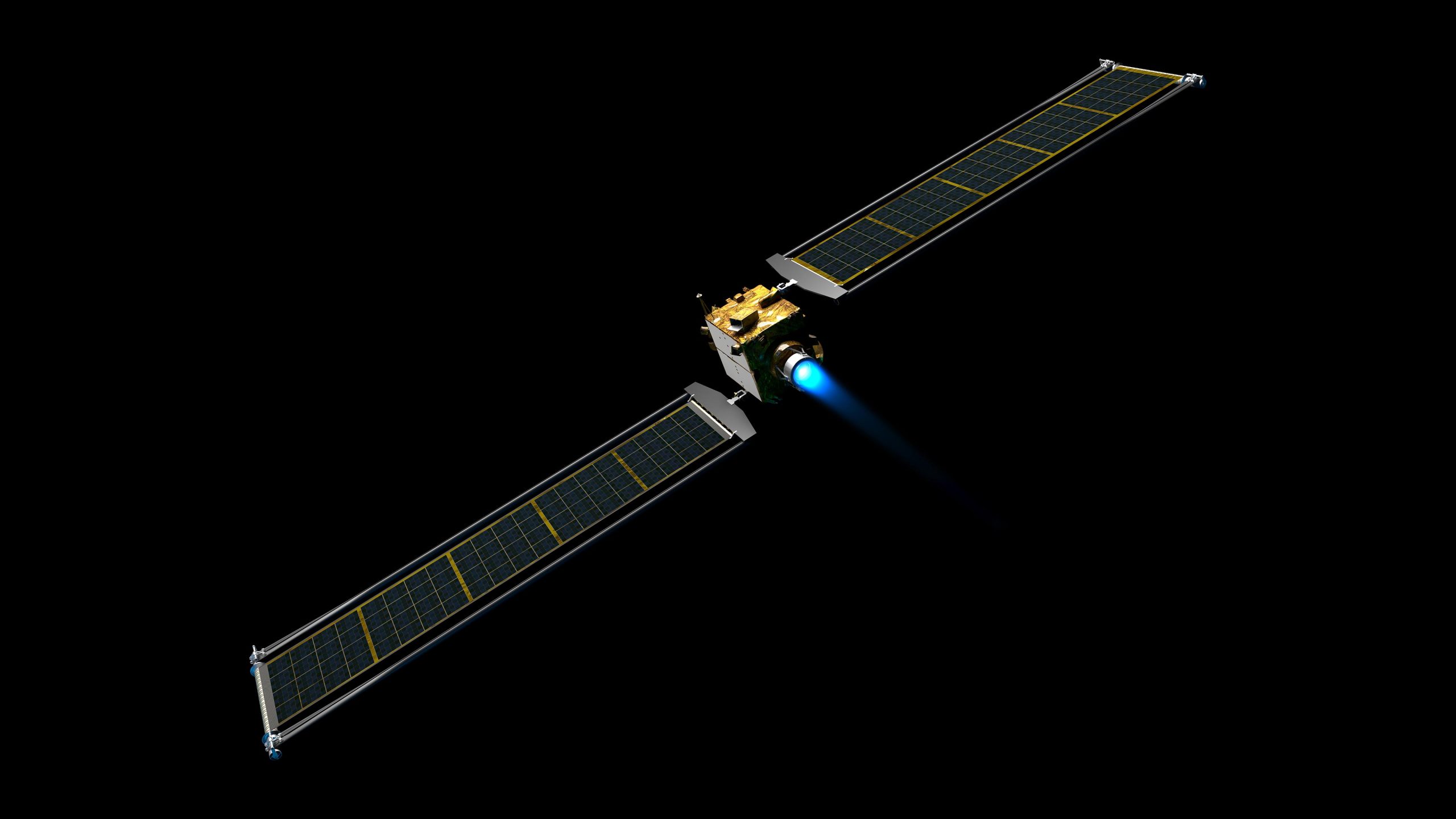
    DART Spacecraft With ROSA Arrays
    Illustration of the DART spacecraft with the Roll Out Solar Arrays (ROSA) extended. Each of the two ROSA arrays in 8.6 meters by 2.3 meters. Credit: NASA

    NASA’s latest launch into outer space is going to make an impact. In fact, that’s its entire mission.

    DART (Double Asteroid Redirection Test), which launched at 10:21 p.m. PST on November 23 out of Vandenberg Air Force Base in California, is NASA’s first planetary defense mission. This mission will demonstrate asteroid deflection via kinetic impact. The goal is to collide with the target to see how the orbit changes. It’s a test run to see if such a plan is feasible should we find an asteroid on a collision course with Earth one day.

    Cristina Thomas, an assistant professor of astronomy and planetary sciences at Northern Arizona University and lead of the DART Observations Working Group, is excited to see the effects of the impact. She and her international team have been working for years to obtain a precise pre-impact orbit of Dimorphos, the satellite asteroid, around Didymos, the primary asteroid in a near-Earth asteroid system.

    Near-Earth, of course, is relative; the planet is in no danger from Didymos. However, an asteroid heading toward Earth is possible, and scientists throughout the world are working on ways to identify these potential threats and how to mitigate them. If this mission goes according to plan, this technique, called kinetic impact deflection, could be an important piece of a planetary defense system.

    “DART is a critical next step for planetary defense,” Thomas said. “It is, on the surface, a simple test, but we will not completely understand what will happen until we do it.”

    Using data from 2003, when the satellite was discovered, through early 2021, the working group has been able to precisely constrain the characteristics of the orbit and the position of Dimorphos in the orbit at the time of impact in fall 2022. They take repeated images of the same object, which shows dips in brightness when the satellite passes in front of or behind the primary. The timing of these brightness dips, called mutual events, allows the scientists to determine the orbital period of the satellite.

    “This is essentially thinking of the satellite Dimorphos as a clock, which will return to its position in front of or behind Didymos at consistent intervals,” Thomas said. “Our working group will begin observations again in the months prior to the DART impact. We want to have the most complete picture of the current orbit before we change it through impact.”

    Thomas were in California for the launch, and she and her team will continue to do observations after the collision to determine the change in the orbital period caused by the spacecraft’s impact.

    What is DART?

    NASA’s Double Asteroid Redirection Test is the world’s first full-scale planetary defense test, demonstrating one method of asteroid deflection technology. DART is a focused mission, proving that a spacecraft can autonomously navigate to a target asteroid and intentionally collide with it (called a kinetic impact) at roughly 4 miles per second (6 kilometers per second). Its target is the asteroid moonlet Dimorphos (Greek for “two forms”), which orbits a larger asteroid named Didymos (Greek for “twin”). As part of NASA’s larger planetary defense strategy, DART will simultaneously test new technologies and provide important data to enhance modeling and predictive capabilities and help scientists better prepare for an asteroid that might pose a threat to Earth, should one be discovered.

    Never miss a breakthrough: Join the SciTechDaily newsletter.
    Follow us on Google and Google News.

    Asteroid NASA NASA DART Northern Arizona University Planetary Defense
    Share. Facebook Twitter Pinterest LinkedIn Email Reddit

    Related Articles

    NASA’s Planetary Defense Test: DART About To Impact an Asteroid

    NASA’s DART Spacecraft Sets Sights on Asteroid Target

    NASA’s DART Confirmed on Target To Impact Asteroid Dimorphos

    Planetary Defense: Study Finds That NASA’s DART Spacecraft Could Obliterate Asteroids

    We Asked a NASA Expert: Is NASA Really Crashing a Spacecraft Into an Asteroid? [Video]

    NASA’s DART Kinetic Impactor Spacecraft Launches in World’s First Planetary Defense Test Mission

    NASA’s DART Mission To Crash a Spacecraft Into an Asteroid Is Set To Launch – Watch It Live

    We Asked a NASA Scientist: What if an Asteroid Was Going To Hit Earth? [Video]

    NASA To Launch Double Asteroid Redirection Test Mission – Preventing a Hazardous Asteroid From Striking Earth

    1 Comment

    1. Dan on November 30, 2021 5:00 pm

      It’s Vandenberg SPACE Force base, not Air Force

      Reply
    Leave A Reply Cancel Reply

    • Facebook
    • Twitter
    • Pinterest
    • YouTube

    Don't Miss a Discovery

    Subscribe for the Latest in Science & Tech!

    Trending News

    New Study Reveals Why Ozempic Works Better for Some People Than Others

    Climate Change Is Altering a Key Greenhouse Gas in a Way Scientists Didn’t Expect

    New Study Suggests Gravitational Waves May Have Created Dark Matter

    Scientists Discover Why the Brain Gets Stuck in Schizophrenia

    Scientists Engineer “Tumor-Eating” Bacteria That Devour Cancer From Within

    Even “Failed” Diets May Deliver Long-Term Health Gains, Study Finds

    NIH Scientists Discover Powerful New Opioid That Relieves Pain Without Dangerous Side Effects

    Collapsing Plasma May Hold the Key to Cosmic Magnetism

    Follow SciTechDaily
    • Facebook
    • Twitter
    • YouTube
    • Pinterest
    • Newsletter
    • RSS
    SciTech News
    • Biology News
    • Chemistry News
    • Earth News
    • Health News
    • Physics News
    • Science News
    • Space News
    • Technology News
    Recent Posts
    • This 15,000-Year-Old Discovery Changes What We Know About Early Human Creativity
    • 35-Million-Year-Old Mystery: Strange Arachnid Discovered Preserved in Amber
    • Revolutionary Gas Turbine Generates Power Without Air Compression
    • Is AI Really Just a Tool? It Could Be Altering How You See Reality
    • JWST Reveals a “Forbidden” Planet With a Baffling Composition
    Copyright © 1998 - 2026 SciTechDaily. All Rights Reserved.
    • Science News
    • About
    • Contact
    • Editorial Board
    • Privacy Policy
    • Terms of Use

    Type above and press Enter to search. Press Esc to cancel.