
Close Menu
    Facebook X (Twitter) Instagram
    SciTechDaily
    • Biology
    • Chemistry
    • Earth
    • Health
    • Physics
    • Science
    • Space
    • Technology
    Facebook X (Twitter) Pinterest YouTube RSS
    SciTechDaily
    Home»Space»NASA Prepping for Ingenuity Helicopter’s Third Flight Test
    Space

    NASA Prepping for Ingenuity Helicopter’s Third Flight Test

    By Håvard Grip, Jet Propulsion LaboratoryApril 24, 20214 Comments5 Mins Read
    Facebook Twitter Pinterest Telegram LinkedIn WhatsApp Email Reddit
    Share
    Facebook Twitter LinkedIn Pinterest Telegram Email Reddit
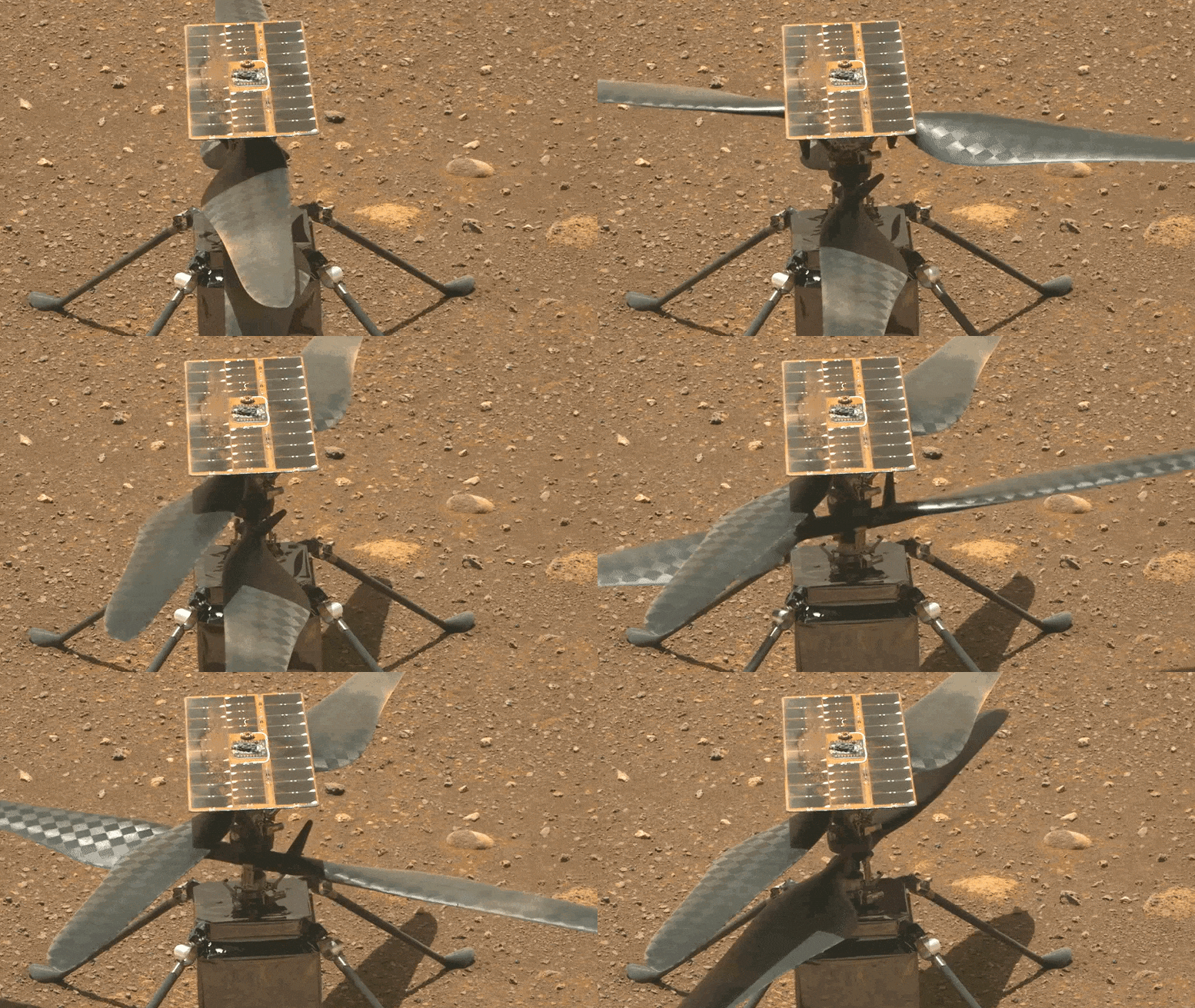
    NASA Mars Ingenuity Helicopter Spin
    The Ingenuity Mars Helicopter’s carbon fiber blades can be seen in this video taken by the Mastcam-Z instrument aboard NASA’s Perseverance Mars rover on April 8, 2021, the 48th Martian day, or sol, of the mission. They are performing a wiggle test before the actual spin-up to ensure they were working properly. Credit: NASA/JPL-Caltech/ASU

    Friday (April 23, 2021) I got to write the entry for the second successful experimental flight test from “Wright Brothers Field” in the project’s official logbook, which is called “The Nominal Pilot’s Logbook for Planets and Moons.” The next chance to make an entry is coming up fast: We’re targeting our third flight for this Sunday, April 25, with initial datasets and imagery arriving in our control room at NASA’s Jet Propulsion Laboratory around 7:16 a.m. PDT (10:16 a.m. EDT).
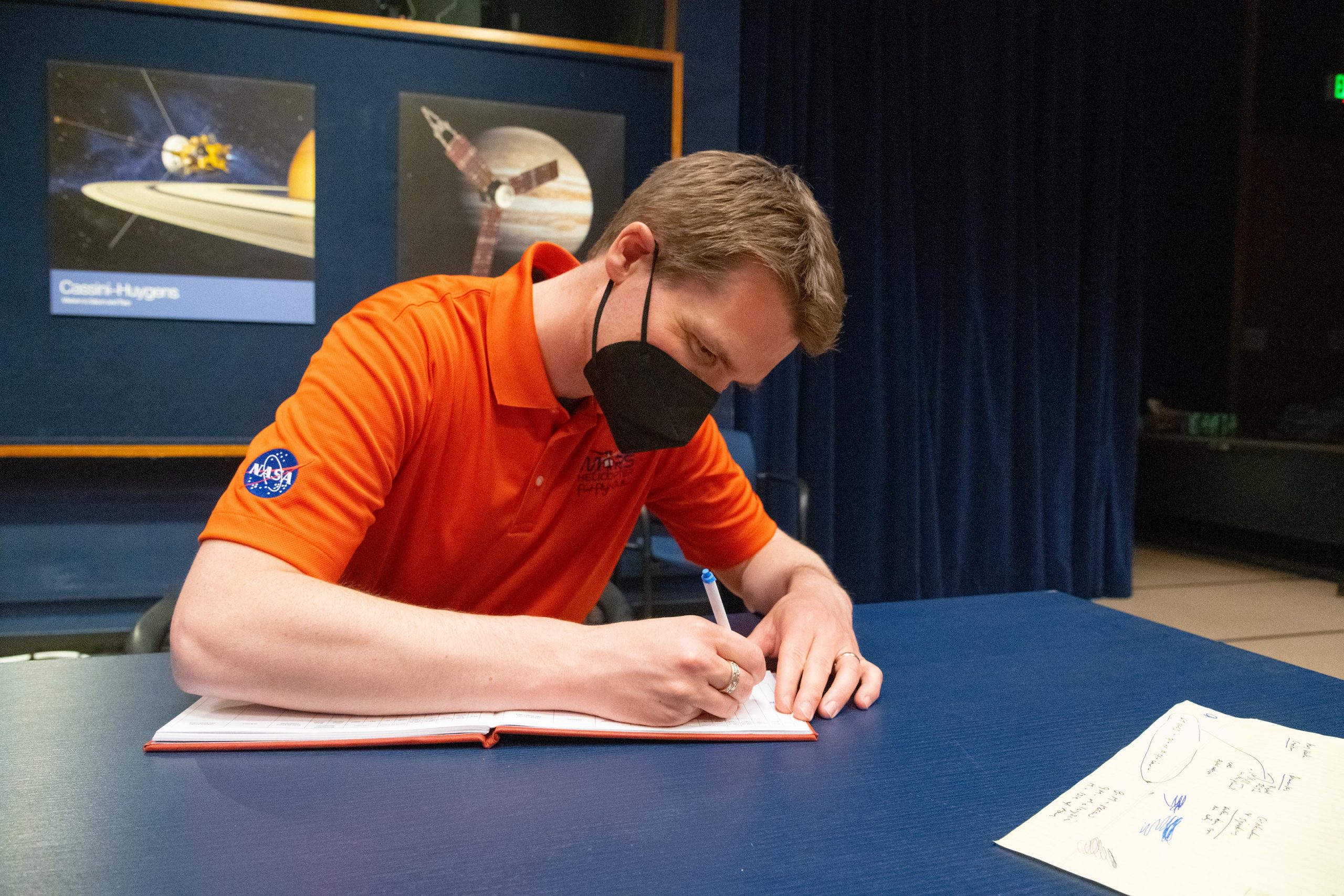
    Pilot Logs First Flight on Another World
    Ingenuity Mars chief pilot Håvard Grip records data of the first flight of the Ingenuity Mars Helicopter into the official pilot’s logbook for the project – the “Nominal Pilot’s Logbook for Planets and Moons.” The image was taken at NASA’s Jet Propulsion Laboratory in Southern California on April 19, 2021. Pilot logbooks are used by aviators to provide a record of their flights, including current and accumulated flight time, number and locations of takeoffs and landings, as well as unique operating conditions and certifications. Credit: NASA/JPL-Caltech

    Ingenuity’s second Mars flight was logged after a 51.9-second hop; its third, longer flight aims to test higher speed and broader range, ushering in a new era of interplanetary flight.

    As many of you know, we carry a piece of the original Wright Flyer aboard our helicopter. Even though we are conducting our flight tests in a tenuous atmosphere over 180 million miles (290 million kilometers) from Earth, we model our methodical approach to experimental flight on the Wright brothers’ approach. Our plan from Day One has been to prepare like crazy, fly, analyze the data (like crazy), and then plan for an even bolder test in the next flight.

    Material From the Wright Brothers’ First Airplane
    This 0.5-inch x 0.5-inch (1.3 x 1.3 centimeter) square of unbleached muslin material from the Wright brothers’ first airplane was encapsulated in a protective polyamide film before being attached to a cable underneath the solar panel of NASA’s Ingenuity Mars Helicopter. Procured by the Wrights from a local department store in downtown Dayton, Ohio, the cotton fabric (called “Pride of the West Muslin”) was at the time mostly used for ladies undergarments. In the front parlor of their home, the Wrights cut the material into strips and used the family sewing machine to create wing coverings for their airplane Flyer 1, which achieved the first powered, controlled flight on Earth on December 17, 1903. The swatch of material from the Wright brothers’ first airplane was obtained from the Carillon Historical Park, in Dayton, Ohio — home to the Wright Brothers National Museum. The image was taken in a clean room at NASA’s Jet Propulsion Laboratory on January 15, 2020. Credit: NASA/JPL-Caltech

    During the second flight, on April 22, Ingenuity autonomously climbed to 5 meters (16 feet) in height, traveled 2 meters (7 feet) to the east and back, and remained airborne 51.9 seconds. It also made three turns, totaling about 276 degrees.

    We’re being cautious with each new foray in the skies of Mars as we continue to build confidence in the capabilities of this new exploration platform. For the third flight, we’re targeting the same altitude, but we are going to open things up a bit too, increasing our max airspeed from 0.5 meters per second to 2 meters per second (about 4.5 mph) as we head 50 meters (164 feet) north and return to land at Wright Brothers Field. We’re planning for a total flight time of about 80 seconds and a total distance of 100 meters (330 feet).
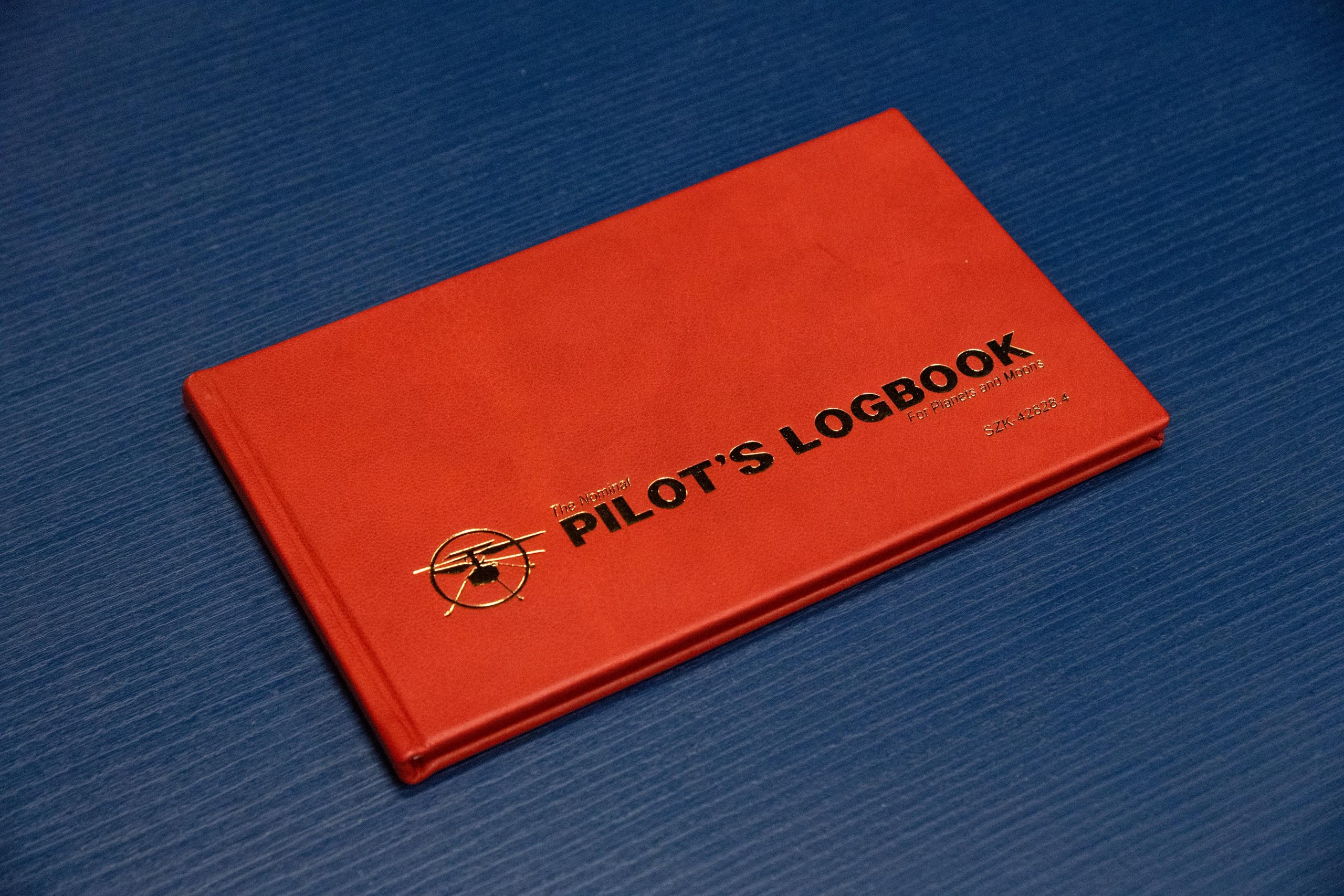
    Ingenuity Mars Helicopter Pilot's Logbook
    This image of the official pilot’s logbook for the Ingenuity Mars Helicopter flights – the “Nominal Pilot’s Logbook for Planets and Moons” – was taken at NASA’s Jet Propulsion Laboratory in Southern California on April 19, 2021, the day of Ingenuity’s first historic flight. Pilot logbooks are used by aviators to provide a record of their flights, including current and accumulated flight time, number and locations of takeoffs and landings, as well as unique operating conditions and certifications. Credit: NASA/JPL-Caltech

    While that number may not seem like a lot, consider that we never moved laterally more than about two-pencil lengths when we flight-tested in the vacuum chamber here on Earth. And while the 4 meters (13.2 feet) of lateral movement in Flight Two (2 meters out and then 2 meters back) was great, providing lots of terrific data, it was still only 4 meters. As such, Flight Three is a big step, one in which Ingenuity will begin to experience freedom in the sky. ​

    After each of our flights, I have had the privilege of filling out our logbook and capturing the flight highlights — something pilots have been doing since the early days of flying. While I’ve made logbook entries before as a terrestrial fixed-wing pilot, these are the most unusual entries I have made. They are also the most satisfying, not only because they represent flight on another planet, but because each notation represents a trove of valuable data that our team has spent years preparing to obtain.

    Written by Håvard Grip, Ingenuity Mars Helicopter Chief Pilot at NASA’s Jet Propulsion Laboratory.

    Never miss a breakthrough: Join the SciTechDaily newsletter.
    Follow us on Google and Google News.

    Ingenuity Mars Helicopter JPL Mars NASA
    Share. Facebook Twitter Pinterest LinkedIn Email Reddit

    Related Articles

    The Mars Helicopter That Survived 72 Flights and Changed Planetary Exploration

    Charting the Red Planet: How Open Science Fuels Mars Exploration

    Epic Mars Selfie: NASA’s Perseverance Rover With the Ingenuity Helicopter

    NASA’s Ingenuity Mars Helicopter Survives First Frigid Martian Night on Its Own

    NASA’s Ingenuity Mars Helicopter Prepares for Takeoff

    It’s Cold on Mars – What Temperatures As Low as -130°F Mean for NASA’s Ingenuity Helicopter

    NASA Ingenuity Mars Helicopter – With a Piece of the Wright Brothers’ Plane – Prepares for First Flight on Another Planet

    NASA’s Ingenuity Helicopter Reports In From Mars

    NASA’s Mars Helicopter Gets an Ingenious Name From Alabama High School Student

    4 Comments

    1. The 10th Man on April 25, 2021 6:58 am

      While NASA is getting real science here, I just think its a stunt. There is no need of flying vehicles at this point of discovery. If you need atmospheric pressure data, then release small science packets on small balloons. You NASA guys love to grandstand with very little results. So my word is STOP! Do the science and quit beating your own broken drum. Bunch of Nazi’s.

      Reply
      • Jack Brennan on April 25, 2021 8:01 am

        So your word is STOP? Based on the quality of the rest of your comment, I’m guessing someone had to help you spell that!

        Reply
    2. Debbie M. on April 25, 2021 4:21 pm

      To all the NASA guys and gals: Pay no attention to that sour grapes “The 10th Man”! He’s probably just jealous.😛 Some of us are REALLY INTO all of this Mars stuff that’s taking place 180 million miles away….it’s fascinating!!!🤗

      Reply
    3. christian Latorre valladares on April 26, 2021 8:44 am

      No puedo dejar de poner un comentario aquí a tan fascinante avance de la exploración espacial y ser parte de esta maravilla de que INGENUITY volara en Marte.. tengo mi Boarding Pass M2M586865108941 del Perseverance y solo felicitar a todos los que hicieron posible una nueva llegada. Y que sean muchos más
      Aquí quedo para la posteridad junto con Uds.
      Cada vez que leo y veo avances me llena de emoción pensar que algún día el Hombre pise ese planeta .. solo espero vivir para verlo.
      Saludos desde Chile

      Reply
    Leave A Reply Cancel Reply

    • Facebook
    • Twitter
    • Pinterest
    • YouTube

    Don't Miss a Discovery

    Subscribe for the Latest in Science & Tech!

    Trending News

    Bone-Strengthening Discovery Could Reverse Osteoporosis

    Scientists Uncover Hidden Trigger Behind Stem Cell Aging

    Scientists Find Way to Reverse Fatty Liver Disease Without Changing Diet

    Could Humans Regrow Limbs? New Study Reveals Promising Genetic Pathway

    Scientists Reveal Eating Fruits and Vegetables May Increase Your Risk of Lung Cancer

    Scientists Reverse Brain Aging With Simple Nasal Spray

    Scientists Uncover Potential Brain Risks of Popular Fish Oil Supplements

    Scientists Discover a Surprising Way To Make Bread Healthier and More Nutritious

    Follow SciTechDaily
    • Facebook
    • Twitter
    • YouTube
    • Pinterest
    • Newsletter
    • RSS
    SciTech News
    • Biology News
    • Chemistry News
    • Earth News
    • Health News
    • Physics News
    • Science News
    • Space News
    • Technology News
    Recent Posts
    • Why Are Giant Ants Letting Tiny Ants Crawl All Over Them?
    • Revolutionary Technique Sends Healthy Mitochondria Exactly Where They’re Needed
    • This Student Recreated the Universe in a Bottle. What She Discovered Could Help Reveal How Life Started on Earth
    • Alzheimer’s Symptoms May Start Outside the Brain, Study Finds
    • Cancer’s Secret Weapon? Scientists Reveal How Tumors “Learn” To Survive Treatment
    Copyright © 1998 - 2026 SciTechDaily. All Rights Reserved.
    • Science News
    • About
    • Contact
    • Editorial Board
    • Privacy Policy
    • Terms of Use

    Type above and press Enter to search. Press Esc to cancel.