
NASA’s AWE mission just released millions of gravity wave images from space, unveiling atmospheric forces that ripple through the sky and affect our tech on Earth. It’s a whole new window into space weather.
After completing its 3,000th orbit aboard the International Space Station (ISS), NASA’s Atmospheric Waves Experiment (AWE) has released its first set of scientific data. This milestone marks a major step in studying how subtle changes in Earth’s upper atmosphere can lead to disturbances, and how those disturbances can affect technologies like satellites, communications systems, and GPS on Earth and in space.
“We’ve released the first 3,000 orbits of data collected by the AWE instrument in space and transmitted back to Earth,” said Ludger Scherliess, principal investigator for the mission and physics professor at Utah State University. “This is a view of atmospheric gravity waves never captured before.”
Five Million Images, Now Publicly Available
Now available online, the dataset includes over five million images of nighttime airglow and atmospheric gravity waves, captured by AWE’s four onboard cameras. It also contains processed data showing temperature patterns and airglow intensity, offering insight into the surrounding air and the movement of the waves.
“AWE is providing incredible images and data to further understand what we only first observed less than a decade ago,” said Esayas Shume, AWE program scientist at NASA Headquarters in Washington. “We are thrilled to share this influential data set with the larger scientific community and look forward to what will be discovered.”

Mapping Waves Across the Globe
Atmospheric gravity waves are naturally occurring features of Earth’s atmosphere, shaped by weather systems and the planet’s terrain. While scientists have studied these waves for years, observations have typically been limited to a few ground-based locations. AWE now enables a much broader, space-based perspective.
“With data from AWE, we can now begin near-global measurements and studies of the waves and their energy and momentum on scales from tens to hundreds and even thousands of kilometers,” Scherliess said. “This opens a whole new chapter in this field of research.”
Data from AWE will also provide insight into how terrestrial and space weather interactions affect satellite communications, navigation, and tracking.
“We’ve become very dependent on satellites for applications we use every day, including GPS navigation,” Scherliess said. “AWE is an attempt to bring science about atmospheric gravity waves into focus, and to use that information to better predict space weather that can disrupt satellite communications. We will work closely with our collaborators to better understand how these observed gravity waves impact space weather.”

The Advanced Mapper Behind the Mission
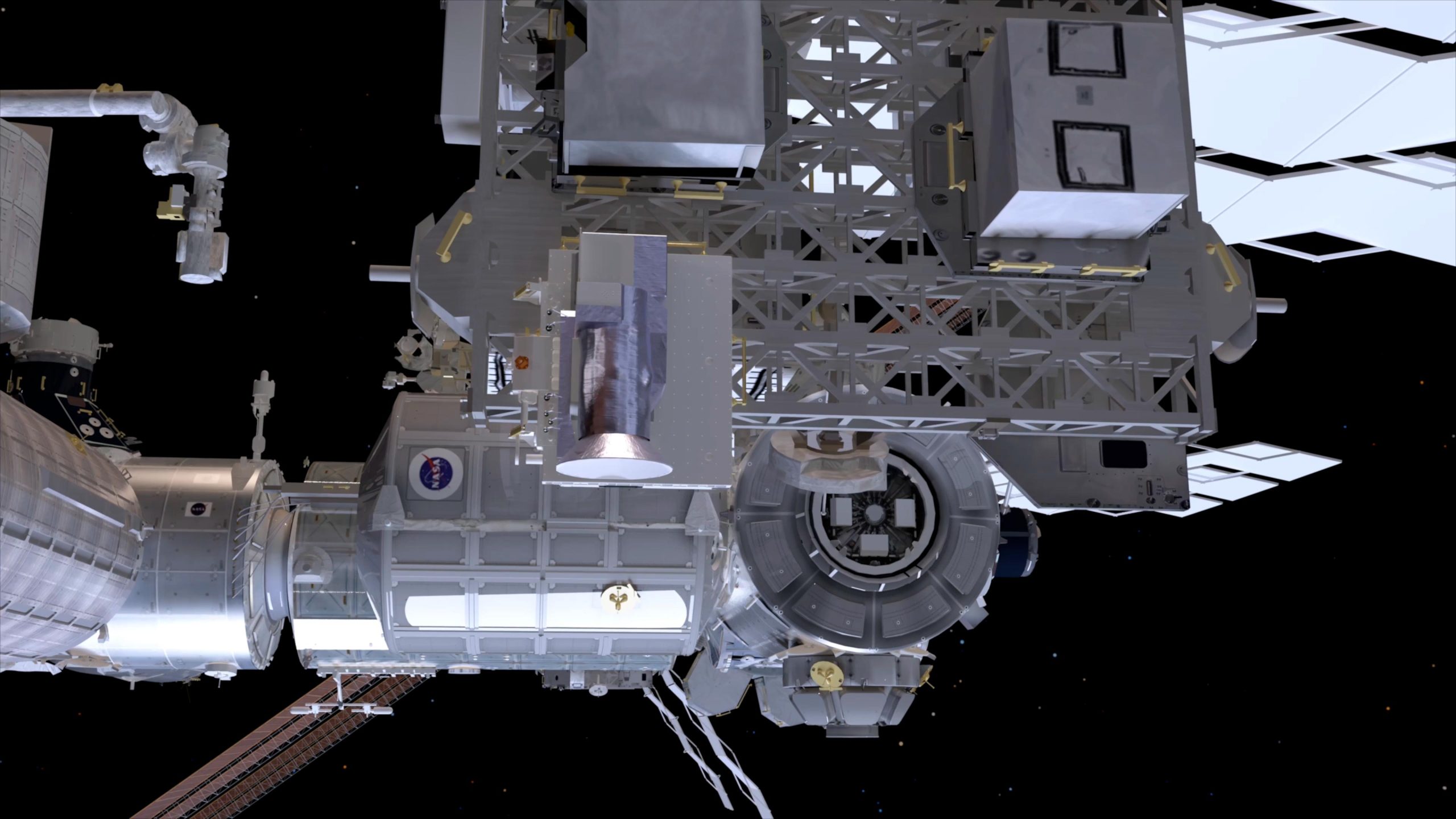
The tuba-shaped AWE instrument, known as the Advanced Mesospheric Temperature Mapper or AMTM, consists of four identical telescopes. It is mounted to the exterior of the International Space Station, where it has a view of Earth.
As the space station orbits Earth, the AMTM’s telescopes capture 7,000-mile-long swaths of the planet’s surface, recording images of atmospheric gravity waves as they move from the lower atmosphere into space. The AMTM measures and records the brightness of light at specific wavelengths, which can be used to create air and wave temperature maps. These maps can reveal the energy of these waves and how they are moving through the atmosphere.

Overcoming the Challenges of Space Imaging
To analyze the data and make it publicly available, AWE researchers and students at USU developed new software to tackle challenges that had never been encountered before.
“Reflections from clouds and the ground can obscure some of the images, and we want to make sure the data provide clear, precise images of the power transported by the waves,” Scherliess said. “We also need to make sure the images coming from the four separate AWE telescopes on the mapper are aligned correctly. Further, we need to ensure stray light reflections coming off the solar panels of the space station, along with moonlight and city lights, are not masking the observations.”
Toward a Global, Seasonal Understanding
As the scientists move forward with the mission, they’ll investigate how gravity wave activity changes with seasons around the globe. Scherliess looks forward to seeing how the global science community will use the AWE observations.
“Data collected through this mission provides unprecedented insight into the role of weather on the ground on space weather,” he said.
AWE is led by Utah State University in Logan, Utah, and it is managed by the Explorers Program Office at NASA’s Goddard Space Flight Center in Greenbelt, Maryland. Utah State University’s Space Dynamics Laboratory built the AWE instrument and provides the mission operations center.
Never miss a breakthrough: Join the SciTechDaily newsletter.
Follow us on Google and Google News.