
Greenhouse gases are cooling Earth’s mesosphere, causing it to contract and altering both satellite drag and high-altitude cloud behavior.
The sky isn’t falling, but scientists have found that parts of the upper atmosphere are gradually contracting in response to rising human-made greenhouse gas emissions.
Combined data from three NASA satellites have produced a long-term record that reveals the mesosphere, the layer of the atmosphere 30 to 50 miles (48 to 80 kilometers) above the surface, is cooling and contracting. Scientists have long predicted this effect of human-driven climate change, but it has been difficult to observe the trends over time.
“You need several decades to get a handle on these trends and isolate what’s happening due to greenhouse gas emissions, solar cycle changes, and other effects,” said Scott Bailey, an atmospheric scientist at Virginia Tech in Blacksburg, and lead of the study, published in the Journal of Atmospheric and Solar-Terrestrial Physics. “We had to put together three satellites’ worth of data.”
Together, the satellites provided about 30 years of observations, indicating that the summer mesosphere over Earth’s poles is cooling four to five degrees Fahrenheit and contracting 500 to 650 feet (150 to 200 meters) per decade. Without changes in human carbon dioxide emissions, the researchers expect these rates to continue.
Greenhouse Gases Work Differently at High Altitudes
Since the mesosphere is much thinner than the part of the atmosphere we live in, the impacts of increasing greenhouse gases, such as carbon dioxide, differ from the warming we experience at the surface. One researcher compared where we live, the troposphere, to a thick quilt.
“Down near Earth’s surface, the atmosphere is thick,” said James Russell, a study co-author and atmospheric scientist at Hampton University in Virginia. “Carbon dioxide traps heat just like a quilt traps your body heat and keeps you warm.” In the lower atmosphere, there are plenty of molecules in close proximity, and they easily trap and transfer Earth’s heat between each other, maintaining that quilt-like warmth.
That means little of Earth’s heat makes it to the higher, thinner mesosphere. There, molecules are few and far between. Since carbon dioxide also efficiently emits heat, any heat captured by carbon dioxide sooner escapes to space than it finds another molecule to absorb it. As a result, an increase in greenhouse gases like carbon dioxide means more heat is lost to space — and the upper atmosphere cools. When air cools, it contracts, the same way a balloon shrinks if you put it in the freezer.
This cooling and contracting didn’t come as a surprise. For years, “models have been showing this effect,” said Brentha Thurairajah, a Virginia Tech atmospheric scientist who contributed to the study. “It would have been weirder if our analysis of the data didn’t show this.”
While previous studies have observed this cooling, none have used a data record of this length or shown the upper atmosphere contracting. The researchers say these new results boost their confidence in our ability to model the upper atmosphere’s complicated changes.
The team analyzed how temperature and pressure changed over 29 years, using all three data sets, which covered the summer skies of the North and South Poles. They examined the stretch of sky 30 to 60 miles above the surface. At most altitudes, the mesosphere cooled as carbon dioxide increased. That effect meant the height of any given atmospheric pressure fell as the air cooled. In other words, the mesosphere was contracting.
Earth’s Middle Atmosphere
Though what happens in the mesosphere does not directly impact humans, the region is an important one. The upper boundary of the mesosphere, about 50 miles (80 kilometers) above Earth, is where the coolest atmospheric temperatures are found. It’s also where the neutral atmosphere begins transitioning to the tenuous, electrically charged gases of the ionosphere.
Even higher up, 150 miles (240 kilometers) above the surface, atmospheric gases cause satellite drag, the friction that tugs satellites out of orbit. Satellite drag also helps clear space junk. When the mesosphere contracts, the rest of the upper atmosphere above sinks with it. As the atmosphere contracts, satellite drag may wane — interfering less with operating satellites, but also leaving more space junk in low-Earth orbit.
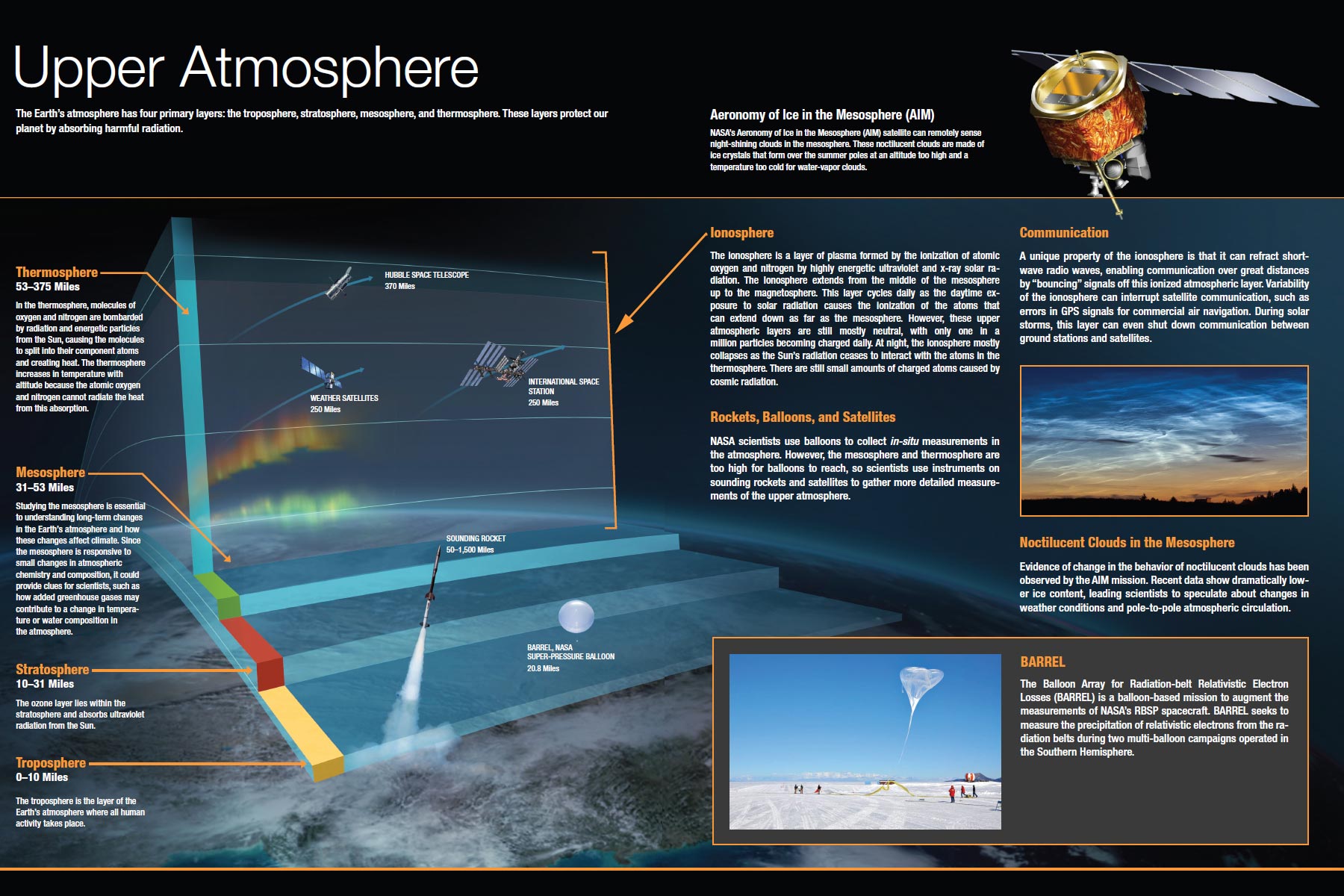
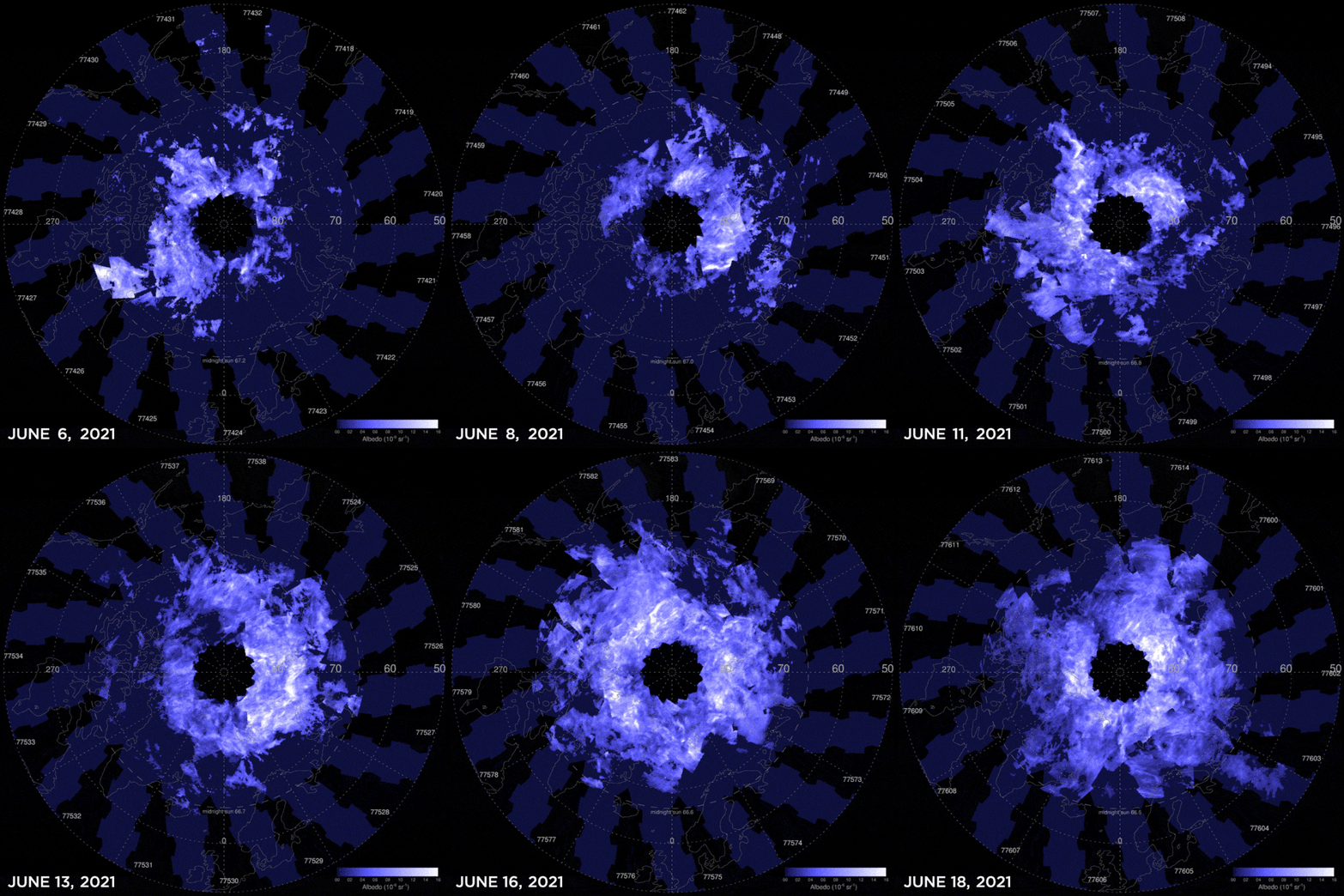
The mesosphere is also known for its brilliant blue ice clouds. They’re called noctilucent or polar mesospheric clouds, so named because they live in the mesosphere and tend to huddle around the North and South Poles. The clouds form in summer, when the mesosphere has all three ingredients to produce the clouds: water vapor, very cold temperatures, and dust from meteors that burn up in this part of the atmosphere. Noctilucent clouds were spotted over northern Canada on May 20, kicking off the start of the Northern Hemisphere’s noctilucent cloud season.
Noctilucent Clouds as Climate Indicators
Because the clouds are sensitive to temperature and water vapor, they’re a useful signal of change in the mesosphere. “We understand the physics of these clouds,” Bailey said. In recent decades, the clouds have drawn scientists’ attention because they’re behaving oddly. They’re getting brighter, drifting farther from the poles, and appearing earlier than usual. And, there seem to be more of them than in years past.
“The only way you would expect them to change this way is if the temperature is getting colder and water vapor is increasing,” Russell said. Colder temperatures and abundant water vapor are both linked with climate change in the upper atmosphere.
Currently, Russell serves as principal investigator for AIM, short for Aeronomy of Ice in the Mesosphere, the newest satellite of the three that contributed data to the study. Russell has served as a leader on all three NASA missions: AIM, the instrument SABER on TIMED (Thermosphere, Ionosphere, Mesosphere Energetics, and Dynamics), and the instrument HALOE on the since-retired UARS (Upper Atmospherics Research Satellite).
TIMED and AIM launched in 2001 and 2007, respectively, and both are still operating. The UARS mission ran from 1991 to 2005. “I always had in my mind that we would be able to put them together in a long-term change study,” Russell said. The study, he said, demonstrates the importance of long-term, space-based observations across the globe.
In the future, the researchers expect more striking displays of noctilucent clouds that stray farther from the poles. Because this analysis focused on the poles at summertime, Bailey said he plans to examine these effects over longer periods of time and — following the clouds — study a wider stretch of the atmosphere.
Reference: “Trends in the polar summer mesosphere temperature and pressure altitude from satellite observations” by Scott M. Bailey, Brentha Thurairajah, Mark E. Hervig, David E. Siskind, James M. Russell III and Larry L. Gordley, 20 April 2021, Journal of Atmospheric and Solar-Terrestrial Physics.
DOI: 10.1016/j.jastp.2021.105650
Never miss a breakthrough: Join the SciTechDaily newsletter.
Follow us on Google and Google News.
11 Comments
How do they know it is due to climate change? This is just a leap of ‘faith’ in bad science….
Could there not be something else that caused the atmospheric changes that also caused some climate change or perhaps it isn’t related to climate change at all. This is what happens when extremists get something in their heads that doesn’t exist in the real world at all. What is the proof?
The article contains the reasoning about how climate change caused this atmospheric change. Even before observing this change, they had models which predicted this change. If at this point you disbelieve their chain of reasoning then you need to refute that directly after reading their original papers. But your search for an alternate explanation when the obvious one exists is a desperate attempt to deny science.
“But your search for an alternate explanation when the obvious one exists is a desperate attempt to deny science.”
Just read this multiple times until you get what is wrong.
This is exactly the problem we face today.
People think that – Search for alternative explanation = attempt to deny science” – is wrong.
In case you didn’t know this is exactly the point of science.
The fact betz falsified oil 1919 with giberish claims no new inventions possible without gaps my automatic feathering flat radial windmills pat.lonien do not have produced higgins blossoming from only winds tides x1000 Einstine relativity
Whether it is called “climate change” or not is moot.
The upper atmosphere is cooler because there is more CO2.* Whether you call it climate change or “more CO2” it is a problem that can be addressed by adding less CO2 to the atmosphere.
—-
* *The physics is straightforward. Energetic CO2 emits infrared light. Its electrons move into a higher energy state from collisions with other molecules. These excited electrons fall back down to a lower energy state, losing that energy as infrared light. The net effect is it takes motion energy from collisions (aka thermal energy) and turns it into light which goes away into space. The net effect is less molecular motion = cooler gas, which then contracts
Hmm… The atmosphere is, effectively, a fluid. These Polar, atmospheric contraction “PHENOMENA”; could they be a result of centrifugal forces exerted by the increased density of atmosphere at the equator? In other words: TIDAL.
Ultimately, what do noctilucent clouds have to do with it? Is this information anecdotal; “pretty pictures”; or a relevant indicator of Cause and Effect? Proof, in other words. Should we presume the latter?
That apparent “hole” over the Pole; is it a feature of the data mosaic or a present and “real” indicator of proof?
Much is left unsaid. Perhaps this “silence” is a feature of “fitting” a much larger study into a smaller space, or merely a summary of what its authors presume is a given.
One picture (pretty or no) may speak a thousand words, but it will never replace exposition of detail, particularly when the issue is as broad as this article pretends.
Science should never speak in absolutes. Such “exclusivity” is the BANE and not the BOON of knowledge and, by-the-buy it, a disservice to those in-search of SOMETHING which, at the very least, approximates TRUTH.
Thanks for the heads-up.
😑
Get a degree in atmospheric research. do the research (i.e., work) and then flap your lips ’til the cows come home. Shoot for the Noble prize while you are at it!
90% of the heat-trapping particulate in the atmosphere is water vapor and ice crystals.
The Atmospheric temperature increase is the result of increased solar radiation, more specifically in the ultraviolet spectrum.This increase in ultraviolet radiation is the result of the diminishment of the ozone barrier at upper atmosphere. This ozone barrier has been diminished due to the bonding of oxygen molecules To chlorofluorocarbons.
To restore the upper atmospheric ozone barrier additional oxygen must be introduced at that elevation, more oxygen molecules more ozone formed and less ultraviolet radiation hitting the surface of the planet.
How much are BP paying you to muddy the waters BP pettie?
If you read the article again you’ll see that the observations are consistent with the modelling predictions.
Does it matter what we call it when all time temperature records across the northern hempisphere are being smashed by up to 10 fahrenheit at a time, on a daily basis as we read and type?
No doubt the climate has been turning harsher for the last about 40 years since I remember. The reasons behind this phenomenon are of two types i.e. artificial and natural. As far as artificial reasons are concerned, we may control them by proper studies followed by stringent legislation and careful implementations. However, the natural reasons are beyond our control as yet. Maybe, further R&D regarding climate change presents some solutions!
There are two major issues that I would like to point out (as I’m sure others have here).
1) These people, the ones actively trying to convince the public [in large part, successfully so] that “to question is to deny science”, are extraordinarily dangerous, corrupt and, simply put, quite evil. The whole premise of “Science” is to QUESTION EVERYTHING. History has shown that often times (tbh, almost always) the majority opinion, the definitive answer, the “fact” etc. turn out to be WRONG. The “powers that be” follow the same playbook every. single. time. They ignore, attack, demonize, ostracize and, yes, they even eliminate ANYONE who dares speak up in opposition &/or anything that contradicts their position/narrative. In time the TRUTH finds a way to prevail.
2) These people never take a moment to step back and assess. They don’t take the time to think about their actions/proposed actions and what effect they might have. They don’t understand that the Earth is remarkably resilient. The universe works in mysterious ways. These things are happening for a reason whether it be natural progression or natural correction. If we get in the way of these processes it could lead to catastrophic events. Yes, we need to take steps to limit our pollution, clean our air & water, detoxify our neighborhoods etc etc. If we do that, the Earth will be just fine. Our Creator made all of this. We need not question him. We need to question our fellow brothers & sisters who lie to us & who seek power & control as well as those why we entrust with these roles (Scientists, Politicians, Teachers, Engineers AND Journalists, Investigators, “Media” etc)