
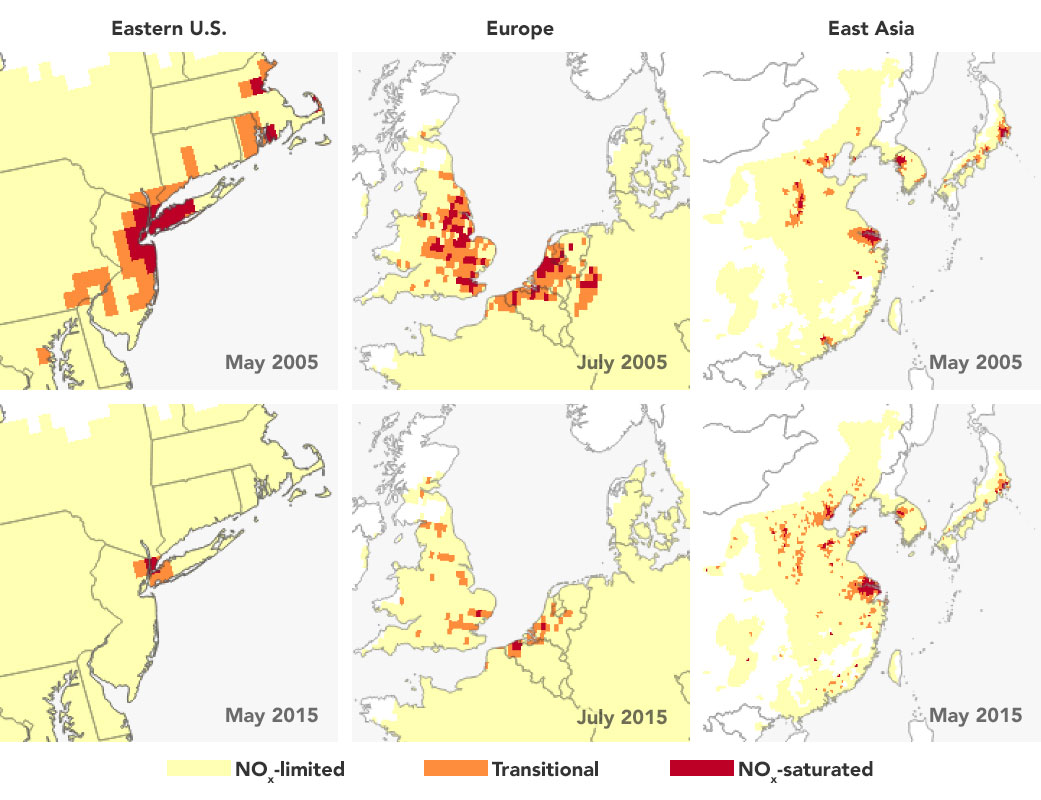
New NASA-funded research has devised a way to use satellite measurements to track ozone formation among three different sets of conditions.
Ozone pollution near Earth’s surface is one of the main ingredients of summertime smog. It is also not directly measurable from space due to the abundance of ozone higher in the atmosphere, which obscures measurements of surface ozone. New NASA-funded research has devised a way to use satellite measurements of the precursor gases that contribute to ozone formation to differentiate among three different sets of conditions that lead to its production. These observations may also assist air quality managers in assessing the most effective approaches to emission reduction programs that will improve air quality.
Unlike its presence at high altitude where ozone acts as Earth’s sunscreen from harmful ultraviolet radiation, at low altitudes, ozone is a health hazard contributing to respiratory problems like asthma and bronchitis. It is formed through complex chemical reactions initiated by sunlight and involving two types of gases, volatile organic compounds (VOC) and nitrogen oxides (NOx). Both are represented in the study by a major gas of each type, the VOC formaldehyde and NO2, that are measurable from space by the Dutch-Finnish Ozone Monitoring Instrument aboard NASA’s Aura satellite, launched in 2004.
“We’re using satellite data to analyze the chemistry of ozone from space,” said lead author Xiaomeng Jin at the Lamont-Doherty Earth Observatory at Columbia University in Palisades, New York. Their research was published in Journal of Geophysical Research: Atmospheres, a publication of the American Geophysical Union.
With a combination of computer models and space-based observations, she and her colleagues used the concentrations of ozone’s precursor molecules to infer whether ozone production increases more in the presence of NOx, VOCs, or a mix of the two, for a given location. Their study regions focused on North America, Europe, and East Asia during the summer months, when abundant sunlight triggers the highest rates of ozone formation. To understand their impact on ozone formation, Jin and her team investigated whether VOC or NOx was the ingredient that most limited ozone formation. If emissions of that molecule are reduced, then ozone formation will be reduced—critical information for air quality managers.
“We are asking, ‘If I could reduce either VOCs or NOx, which one is going to get me the biggest bang for my buck in terms of the amount of ozone that we can prevent from being formed in the lower atmosphere?’” said co-author and atmospheric chemist Arlene Fiore at Lamont-Doherty, who is also a member of NASA’s Health and Air Quality Applied Sciences Team that partially funded this work and fosters collaboration between scientists and air quality managers.
The findings show that cities in North America, Europe, and East Asia, are more often VOC-limited or in a transitional state between VOC and NOx-limited. In addition, the 12-year data record of satellite observations show that a location’s circumstances can change. For instance, in 2005 New York City’s ozone production during the warm season was limited by VOCs, but by 2015 it had transitioned to a NOx-limited system due to reduced NOx emissions resulting from controls put into place at both regional and national levels. This transition means that future NOx reductions will likely further decrease ozone production, said Jin.
Volatile organic compounds occur in high volume naturally, given off by some plants, including certain tree species. They can also arise from paint fumes, cleaning products, and pesticides, and are a by-product of burning fossil fuels in factories and automobiles. Nitrogen oxides are a byproduct of burning fossil fuels and are abundant in cities, produced by power plants, factories, and cars. Because VOCs have a large natural source during summer over the eastern United States, for example, emission reduction plans over the last two decades in this region have focused on NOx, which is overwhelmingly produced by human activities.
Space-based methods for monitoring ozone chemistry complement surface-based measurements made by air quality management agencies. The view from space offers consistent coverage of broad areas, and provides data for regions that may not have ground stations.
This work was a collaboration of researchers at Lamont-Doherty with those at University of Rochester in New York; the Royal Netherlands Meteorological Institute in De Bilt, Netherlands; Wageningen University in Wageningen, Netherlands; Belgian Institute for Space Aeronomy in Brussels, Belgium; Harvard-Smithsonian Center for Astrophysics in Cambridge, Massachusetts; the U.S. Environmental Protection Agency Office of Research and Development in Research Triangle Park in North Carolina and its Region 8 Office in Denver Colorado; and NASA’s Goddard Space Flight Center in Greenbelt, Maryland.
NASA uses the vantage point of space to increase our understanding of our home planet, improve lives, and safeguard our future. NASA develops new ways to observe and study Earth’s interconnected natural systems with long-term data records. The agency freely shares this unique knowledge and works with institutions around the world to gain new insights into how our planet is changing.
Reference: “Evaluating a Space-Based Indicator of Surface Ozone-NOx-VOC Sensitivity Over Midlatitude Source Regions and Application to Decadal Trends” by Xiaomeng Jin, Arlene M. Fiore, Lee T. Murray, Lukas C. Valin, Lok N. Lamsal, Bryan Duncan, K. Folkert Boersma, Isabelle De Smedt, Gonzalo Gonzalez Abad, Kelly Chance and Gail S. Tonnesen, 10 September 2017, Journal of Geophysical Research: Atmospheres.
DOI: 10.1002/2017JD026720
Never miss a breakthrough: Join the SciTechDaily newsletter.
Follow us on Google and Google News.