
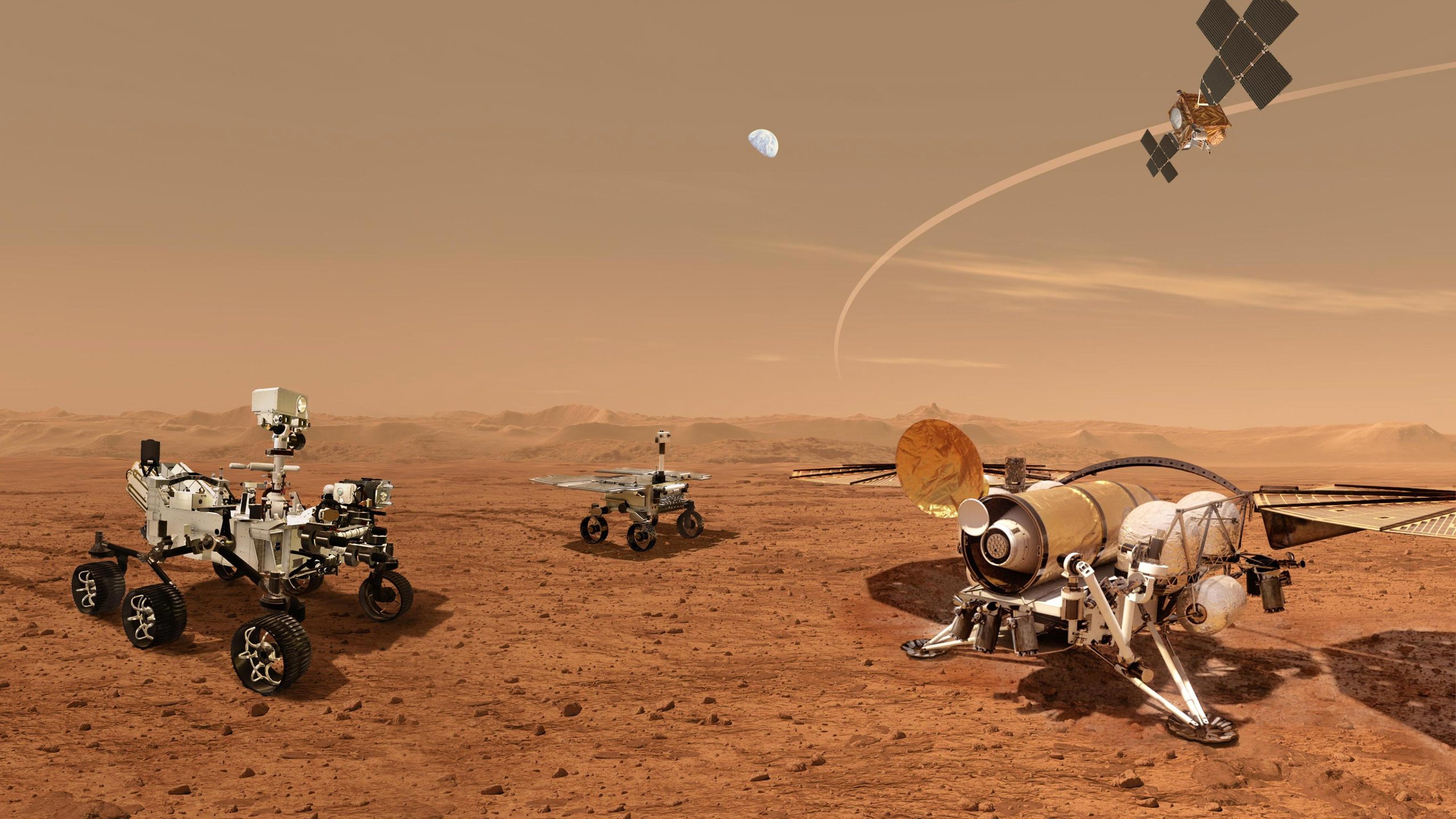
The award brings NASA a step closer to the first robotic round trip to bring samples safely to Earth through the Mars Sample Return Program.
NASA has awarded a contract to Lockheed Martin Space of Littleton, Colorado, to build the Mars Ascent Vehicle (MAV), a small, lightweight rocket to launch rock, sediment, and atmospheric samples from the surface of the Red Planet. The award brings NASA a step closer to the first robotic round trip to bring samples safely to Earth through the Mars Sample Return Program.
“This groundbreaking endeavor is destined to inspire the world when the first robotic round-trip mission retrieves a sample from another planet – a significant step that will ultimately help send the first astronauts to Mars,” NASA Administrator Bill Nelson said. “America’s investment in our Mars Sample Return program will fulfill a top priority planetary science goal and demonstrate our commitment to global partnerships, ensuring NASA remains a leader in exploration and discovery.”
The MAV’s Role in the Mars Sample Return Program
Set to become the first rocket fired off another planet, the MAV is a crucial part of a campaign to retrieve samples collected by NASA’s Perseverance rover and deliver them to Earth for advanced study. NASA’s Sample Retrieval Lander, another important part of the campaign, would carry the MAV to Mars’ surface, landing near or in Jezero Crater to gather the samples cached by Perseverance. The samples would be returned to the lander, which would serve as the launch platform for the MAV. With the sample container secured, the MAV would then launch.
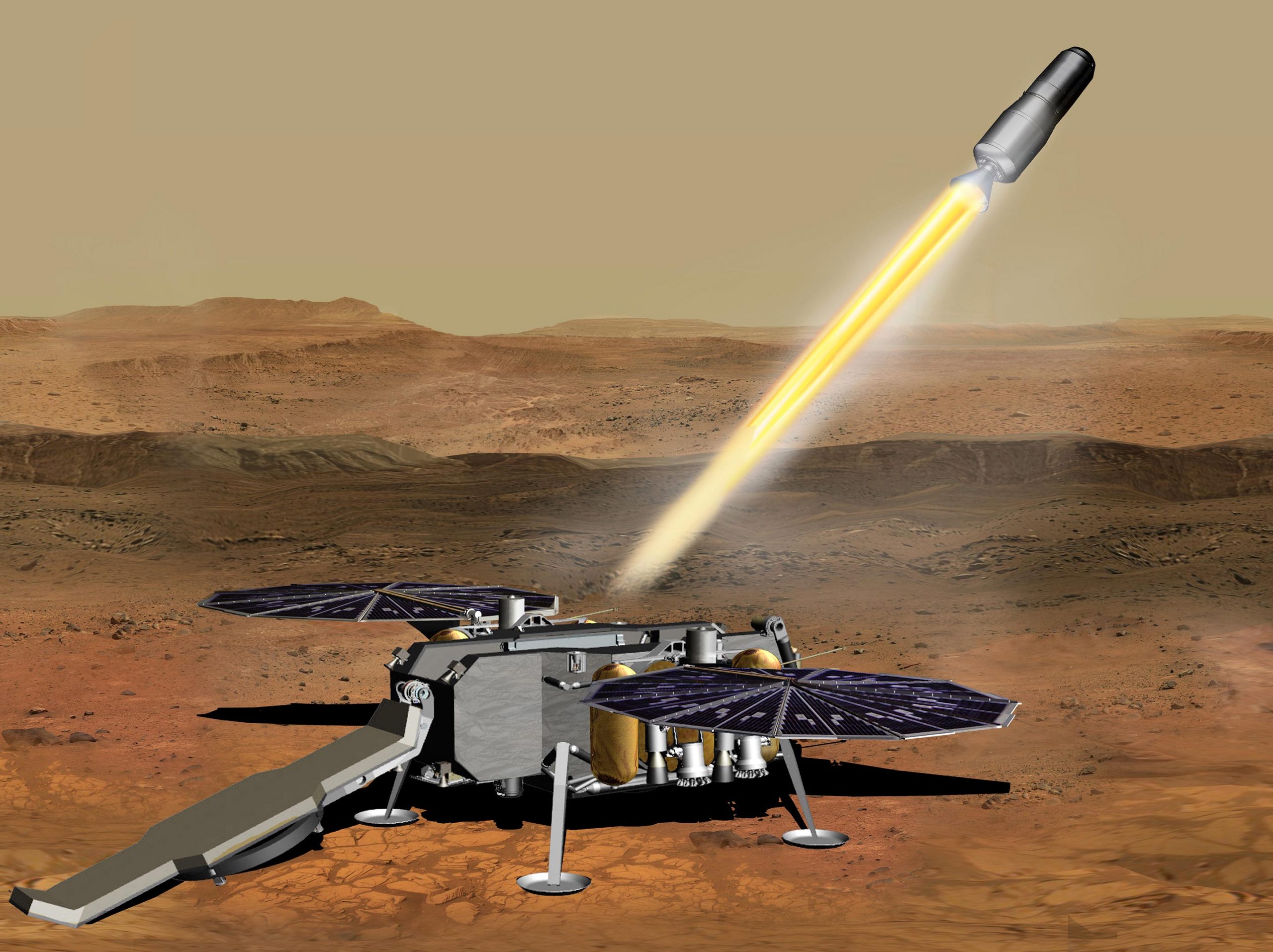
Once it reaches Mars orbit, the container would be captured by an ESA (European Space Agency) Earth Return Orbiter spacecraft outfitted with NASA’s Capture, Containment, and Return System payload. The spacecraft would bring the samples to Earth safely and securely in the early-to-mid 2030s.
“Committing to the Mars Ascent Vehicle represents an early and concrete step to hammer out the details of this ambitious project not just to land on Mars, but to take off from it,” said Thomas Zurbuchen, the associate administrator for science at NASA Headquarters in Washington. “We are nearing the end of the conceptual phase for this Mars Sample Return mission, and the pieces are coming together to bring home the first samples from another planet. Once on Earth, they can be studied by state-of-the-art tools too complex to transport into space.”
Challenges in MAV Development
Returning a sample is complicated, and MAV faces some complex development challenges. It must be robust enough to withstand the harsh Mars environment and adaptable enough to work with multiple spacecraft. It also must be small enough to fit inside the Sample Retrieval Lander. The Sample Retrieval Lander is planned for launch no earlier than 2026 from NASA’s Kennedy Space Center in Florida.
Lockheed Martin Space will provide multiple MAV test units and a flight unit. Work under the contract includes designing, developing, testing, and evaluating the integrated MAV system, and designing and developing of the rocket’s ground support equipment.
The cost-plus-fixed-fee Mars Ascent Vehicle Integrated System (MAVIS) contract has a potential value of $194 million. The performance period begins no later than February 25 and will extend six years.
NASA’s Mars Sample Return Campaign promises to revolutionize our understanding of Mars by bringing scientifically selected samples for study using the most sophisticated instruments around the world. The campaign would fulfill a solar system exploration goal, a high priority since the 1970s and in the last two National Academy of Sciences Planetary Decadal Surveys.
This strategic NASA and ESA partnership would be the first mission to return samples from another planet and the first launch from the surface of another planet. The samples collected by Perseverance during its exploration of an ancient river delta are thought to present the best opportunity to reveal the early evolution of Mars, including the potential for life.
Never miss a breakthrough: Join the SciTechDaily newsletter.
Follow us on Google and Google News.
2 Comments
Our moon might not be a planet, but Russia retrieved samples from there several time via remotely controlled rockets in 1976.
They’d better hurry. SpaceX will get there first.