
NASA Will Inspire World When It Returns Mars Samples to Earth in 2033
NASA has completed the system requirements review for its Mars Sample Return Program, which has nearly concluded its conceptual design phase. During this phase, the program team evaluated and refined the architecture to return the scientifically selected Martian samples. These samples are currently in the collection process by NASA’s Perseverance rover in the Red Planet’s Jezero Crater.
The architecture for the campaign is expected to reduce the complexity of future missions and increase the probability of success. In addition to NASA, the program includes contributions from the European Space Agency (ESA).
“The conceptual design phase is when every facet of a mission plan gets put under a microscope,” said Thomas Zurbuchen, associate administrator for science at NASA Headquarters in Washington. “There are some significant and advantageous changes to the plan, which can be directly attributed to Perseverance’s recent successes at Jezero and the amazing performance of our Mars helicopter.”
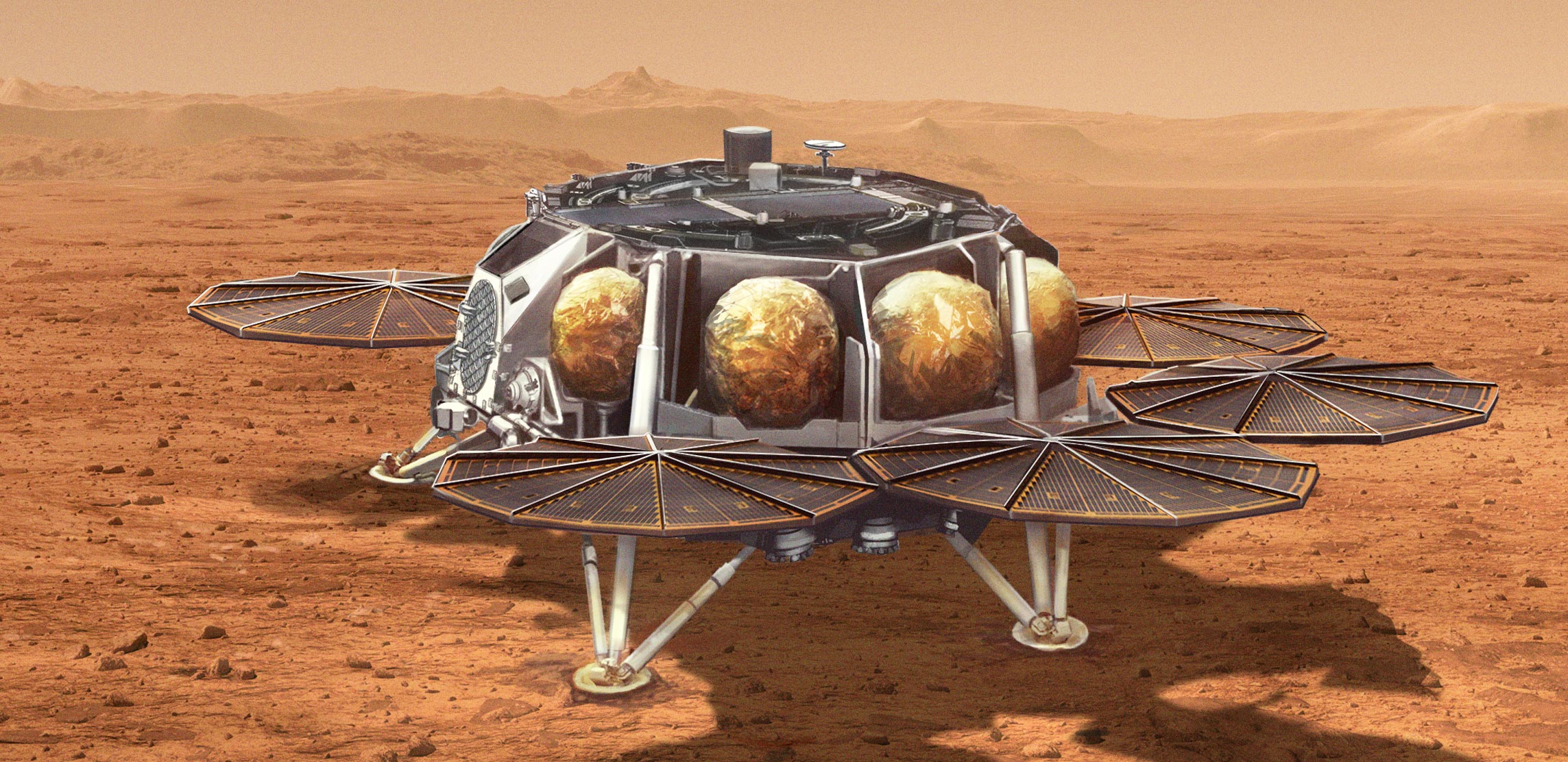
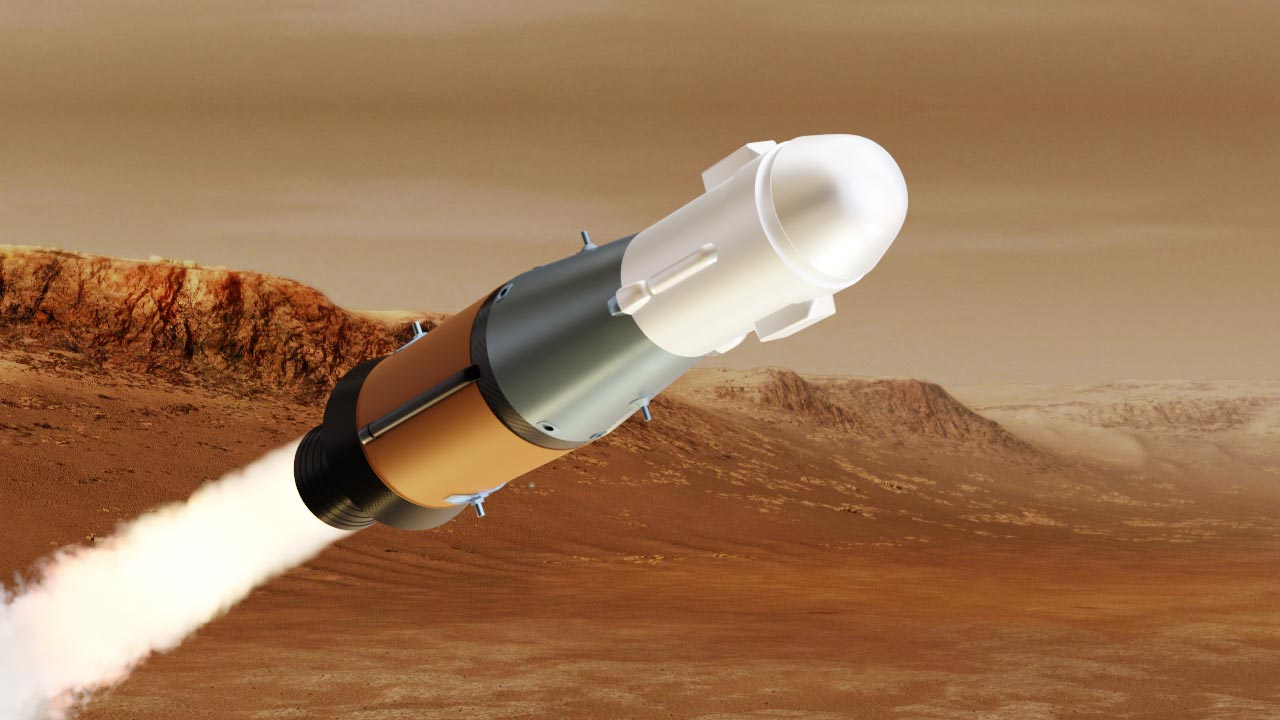
This advanced mission architecture takes into consideration a recently updated analysis of Perseverance’s expected longevity. Perseverance will now be the primary means of transporting samples to NASA’s Sample Retrieval Lander (pictured above) carrying the Mars Ascent Vehicle (pictured below) and ESA’s Sample Transfer Arm.
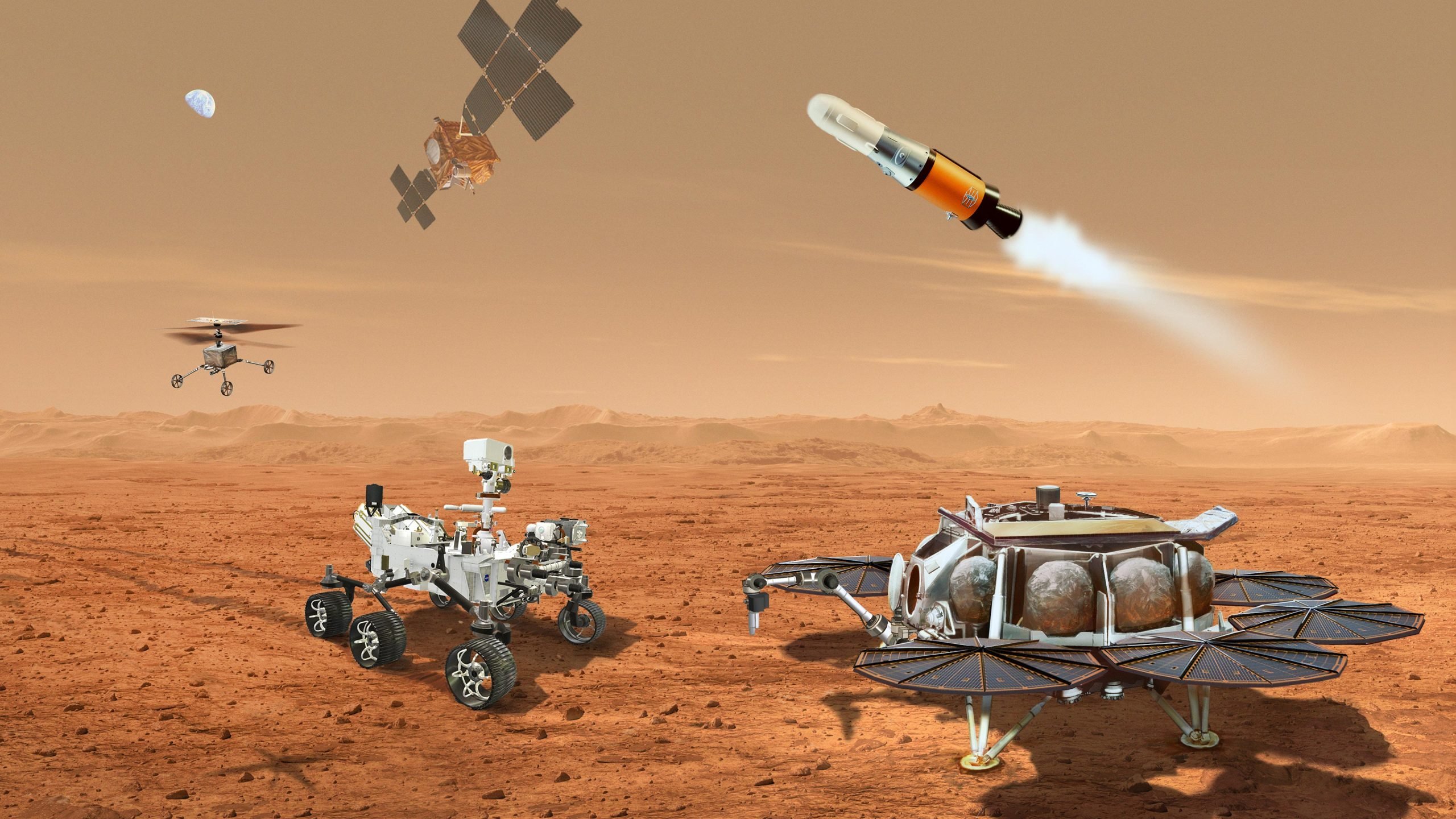
With this change, the Mars Sample Return campaign will no longer include the Sample Fetch Rover or its associated second lander. The Sample Retrieval Lander will include two sample recovery helicopters, based on the design of the Ingenuity helicopter, which has performed 29 flights on Mars and survived over a year beyond its original planned lifetime. The helicopters will provide a secondary capability to retrieve samples cached on the surface of the Red Planet.
The ESA Earth Return Orbiter and its NASA-provided Capture, Containment, and Return System remain vital elements of the program architecture.
With planned launch dates for the Earth Return Orbiter and Sample Retrieval Lander in fall 2027 and summer 2028, respectively, the samples are expected to arrive on Earth in 2033.
With its architecture solidified during this conceptual design phase, the program is expected to move into its preliminary design phase this October. In this phase, which is expected to last about 12 months, the program will complete technology development and create engineering prototypes of the major mission components.
This refined concept for the Mars Sample Return campaign was presented to the delegates from the 22 participating states of Europe’s space exploration program, Terrae Novae, in May. At their next meeting in September, the states will consider the discontinuation of the development of the Sample Fetch Rover.
ESA’s Commitment to Earth Return and Sample Transfer Systems
“ESA is continuing at full speed the development of both the Earth Return Orbiter that will make the historic round-trip from Earth to Mars and back again; and the Sample Transfer Arm that will robotically place the sample tubes aboard the Orbiting Sample Container before its launch from the surface of the Red Planet,” said David Parker, ESA director of Human and Robotic Exploration.
The respective contributions to the campaign are contingent upon available funding from the U.S. and ESA participating states. More formalized agreements between the two agencies will be established in the next year.
“Working together on historic endeavors like Mars Sample Return not only provides invaluable data about our place in the universe but brings us closer together right here on Earth,” said Zurbuchen.
The first step in the Mars Sample Return Campaign is already in progress. Since it landed at Jezero Crater on February 18, 2021, the Perseverance rover has collected 11 scientifically compelling rock core samples and one atmospheric sample.
Bringing Mars samples to Earth would allow scientists across the world to examine the specimens using sophisticated instruments too large and too complex to send to Mars and would enable future generations to study them. Curating the samples on Earth would also allow the science community to test new theories and models as they are developed, much as the Apollo samples returned from the Moon have done for decades. This strategic NASA and ESA partnership will fulfill a solar system exploration goal, a high priority since the 1970s and in the last three National Academy of Sciences Planetary Science Decadal Surveys.
Never miss a breakthrough: Join the SciTechDaily newsletter.
Follow us on Google and Google News.
11 Comments
Sounds like Jules Vern postulation.. STEAMBOAT EXPRESS (without a tech narrative).. what does it take to go to MARS and back in terms of MILLIONS KG rocket power to return 1KG ROCK BACK TO EARTH!! My guess is 1M KG!!! (i.e. 1,000,000 : 1)
Just more wasted money thrown onto the Mars Cash Cow. Anything you can test on those samples could be done on Mars with the Rover. NASA proved life exist on Mars in 1976 and has been milking Mars ever since. 10 billion more for a telescope that will be trashed in a year from space debri that they knew was there. Stop supporting NASA. Fire them all and give me the cash. I’ll save the world population.
What is the danger off bringing something back that we don’t want. How will the samples be isolated for bio hazards? The first moon missions were very careful about this. There is a possibility of organisms that are not understood or recognizable on earth. Better make sure it’s something that can be killed with chlorine or a shot gun blast. Lol. Maybe should do their analysis at the space station before transporting to earth. We find strange organisms in extreme conditions that we never imagined could exist. At the North Pole, Antarctica, and deep water with zero sunlight and little oxygen. Hope the smart people with the long titles after their names are considering all possibilities.
How would an organism living on Mars (already a stretch), be in any way, adapted to get around the immune system that’s been in an arms race with bacteria and viruses that have evolved specifically to get around our immune system? On top of that, it would have to be the first organism to be found on Mars that was so amazingly adapted. It’s not like Earth hasn’t peen pelted with rocks from Mars for the last 4.5 billion years anyway.
To the 10th man. In 1976 they found a few organic compounds. That is million miles away from finding life.
I think its coolest thing I ever seen. Wait till they use
That arm to harvest Martian weed! Lol
Did you miss the people on Mars?
My name is Chris Rivas from the great city of San Antonio Texas NASA better make sure that those samples are not infected something we do not know nothing about it could kill everything we know on Earth
Yeah if we could just get Texas wiped out, the US would be a better place. So NASA, please, if you bring back some virus or bacteria or some $hit, please dump it in TX
I can agree with people saying NASA spending billions of dollars to see who the weather is millions of miles away is wasteful. Sure, the money could be better appropriated to a better cause.
But the Federal Government is wasteful regardless of who’s in “Charge”. So if NASA closed tomorrow, the politicians would fight on how allocate it too their own needs. It’s easy to spend money when its not your own.
What would happen if you smoked a joint on Mars?