

Dust Hopping on Asteroids
Tiny grains of dust may hop around on the surface of asteroids like corn kernels popping in a frying pan, according to a new study from physicists at the University of Colorado at Boulder (CU Boulder).
That popcorn-like effect may even help to tidy up smaller asteroids, causing them to lose dust and therefore look rugged and craggy from space.
These new findings may help scientists better understand how asteroids change shape over time—and how these bodies migrate through space, sometimes bringing them dangerously close to Earth, said Hsiang-Wen (Sean) Hsu, co-lead author of the study. The researchers published their results in the journal Nature Astronomy on July 11.
“The more fine-grained material, or regolith, these asteroids lose, the faster they migrate,” said Hsu, a research associate at the Laboratory for Atmospheric and Space Physics (LASP) at CU Boulder.
The research started with a few curious photos.
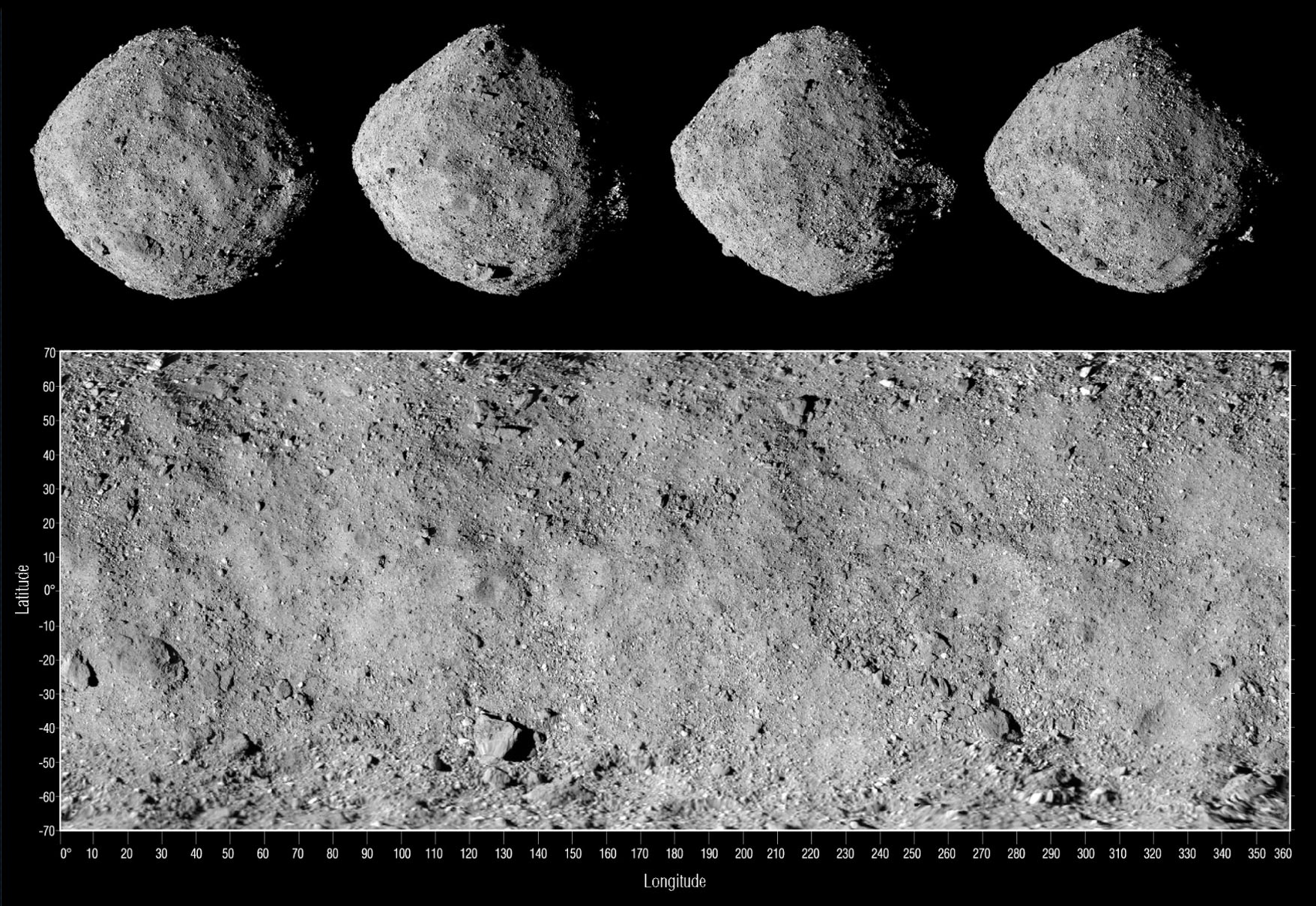
In 2018, a NASA spacecraft named OSIRIS-REx rendezvoused with the asteroid (191055) Bennu, after traveling more than 1 billion miles. But when the spacecraft arrived at Bennu, which is about as tall as the Empire State Building, scientists didn’t find what they were expecting. Researchers had predicted the asteroid’s surface to be smooth and dusty, but instead, it looked like rough sandpaper. There were even boulders the size of trucks scattered over its exterior.
Hsu and his colleagues are now investigating that mystery using computer simulations, or models, and laboratory experiments. He suggested that smaller dust grains, some of which are no larger than a single bacterium, may be being ejected off the asteroid and into space by static electricity-like forces, leaving only larger rocks behind.
Bennu isn’t alone in this regard, said study co-author Mihály Horányi.
“We’re realizing these same physics are occurring on other airless bodies like the moon and even the rings of Saturn,” said Horányi, a researcher at LASP and professor of physics at CU Boulder.
Bennu and Ryugu
Although asteroids might look like they’re frozen in time, these bodies actually continue to evolve throughout their lifetimes.
Asteroids like Bennu are constantly spinning, which exposes their surfaces to sunlight, then shadow and sunlight again, explained Hsu. That never-ending cycle of heating and cooling puts a strain on the largest rocks at the surface, until they inevitably crack.
“It’s happening every day, all the time,” Hsu said. “You wind up eroding a big piece of rock into smaller pieces.”
This is why, before OSIRIS-REx arrived at Bennu, many scientists were expecting to find it covered in ponds of smooth, sandy material—a bit like how the moon looks today. Not long before, a Japanese space mission had landed on another small asteroid called Ryugu. The scientists found a similarly rough and craggy terrain.
Hsu and his colleagues were suspicious.
Since the 1990s, scientists at LASP have used vacuum chambers in the lab to investigate the strange properties of dust in space, including a feat they call “electrostatic lofting.” Study co-lead author Xu Wang explained that as the sun’s rays bathe patches of porous regolith, negative charges start to build up on small grains of dust. Those charges will accumulate until, suddenly, the particles burst apart, like two magnets repelling each other.
In some cases, those grains of dust can pop away at speeds of more than 20 miles per hour (or more than 8 meters per second).
“No one had ever considered this process on the surface of an asteroid before,” said Wang, a research associate at LASP.
Small Asteroid, Big Asteroid
To do that, the researchers, including former CU Boulder undergraduate students Anthony Carroll and Noah Hood, ran a series of calculations examining the physics of regolith on two hypothetical asteroids. They tracked how dust might form, then hop around over hundreds of thousands of years. One of those faux asteroids was about a half-mile across (similar in size to Ryugu) and the second several miles wide (closer in diameter to giant asteroids like Eros).
That size made a difference. According to the team’s estimates, when grains of dust jumped on the bigger asteroid, they couldn’t gain enough speed to break free of its gravity. The same wasn’t true on the smaller, Ryugu-like asteroid.
“The gravity on the smaller asteroid is so weak that it can’t hold back the escape,” Hsu said. “The fine-grained regolith will be lost.”
That loss, in turn, will expose the surface of the asteroids to even more erosion, leading to a boulder-rich scenery like scientists found on Ryugu and Bennu. Within several million years, in fact, the smaller asteroid was almost completely swept clean of fine dust. The Eros-like asteroid, however, stayed dusty.
Hsu noted that this scrubbing effect could help to give the orbits of small asteroids a nudge. He explained that asteroids migrate because the sun’s radiation pushes on them slowly over time. Based on previous research by other scientists, he suspects that asteroids covered in boulders may move faster than those with a dustier appearance.
He and his colleagues may soon get more proof to back up their calculations. In less than three months, a NASA mission called the Double Asteroid Redirection Test (DART) will visit a pair of smaller asteroids—and Hsu will be watching to see how dusty they are.
“We will have new surface images to test our theory,” he said. “It’s nice for us, but also a little nerve-wracking.”
Reference: “Fine-grained regolith loss on sub-km asteroids” by Hsiang-Wen Hsu, Xu Wang, Anthony Carroll, Noah Hood and Mihály Horányi, 11 July 2022, Nature Astronomy.
DOI: 10.1038/s41550-022-01717-9
Never miss a breakthrough: Join the SciTechDaily newsletter.
Follow us on Google and Google News.