
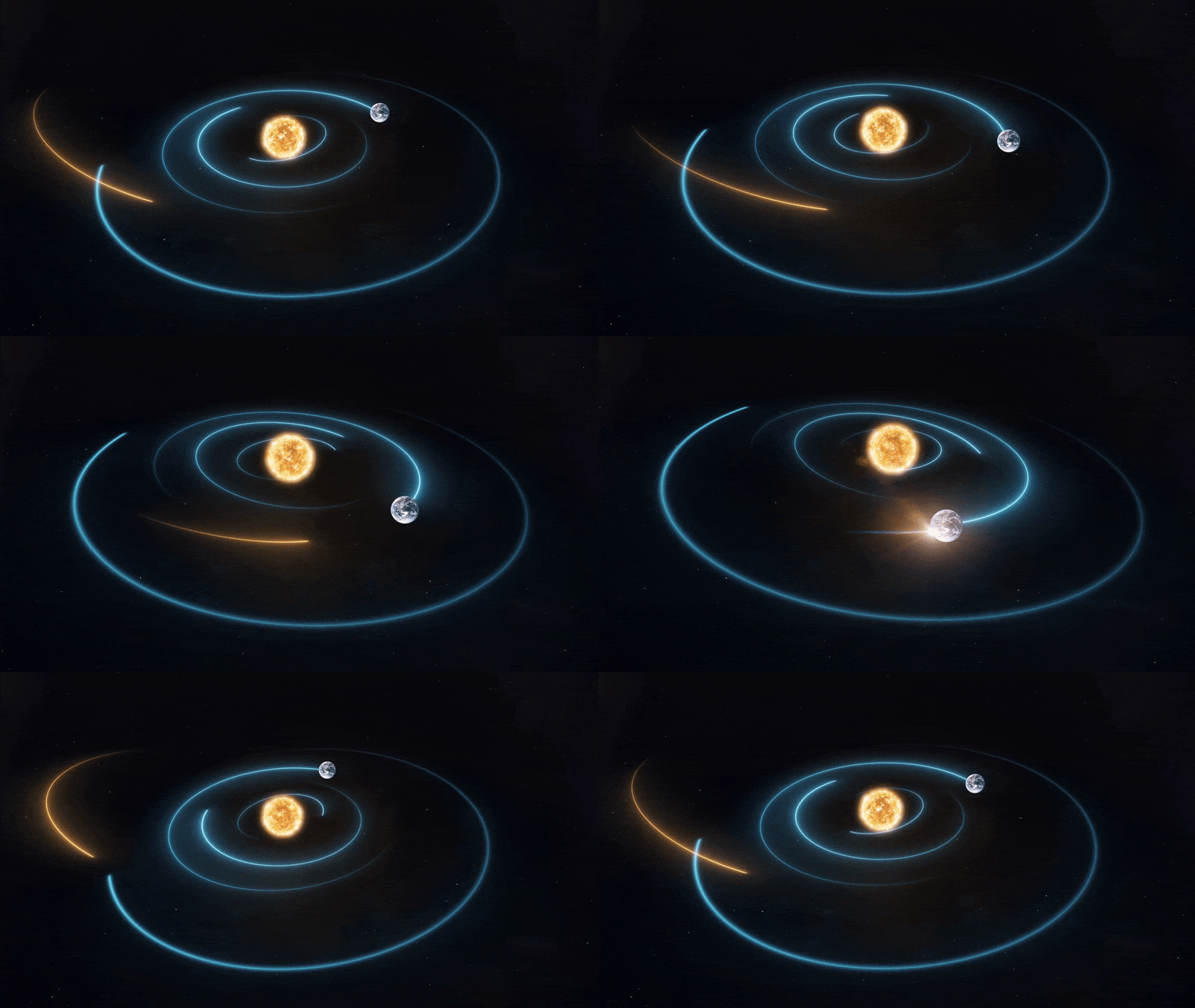
The ATLAS system, now with telescopes in the southern hemisphere, scans the entire dark sky daily, enhancing NASA’s ability to detect asteroid threats as part of its planetary defense strategy.
The NASA-funded Asteroid Terrestrial-impact Last Alert System (ATLAS)—a state-of-the-art asteroid detection system operated by the University of Hawai‘i (UH) Institute for Astronomy (IfA) for the agency’s Planetary Defense Coordination Office (PDCO)—has reached a new milestone by becoming the first survey capable of searching the entire dark sky every 24 hours for near-Earth objects (NEOs) that could pose a future impact hazard to Earth. Now comprised of four telescopes, ATLAS has expanded its reach to the southern hemisphere from the two existing northern-hemisphere telescopes on Haleakala and Maunaloa in Hawai‘i to include two additional observatories in South Africa and Chile.

“An important part of planetary defense is finding asteroids before they find us, so if necessary, we can get them before they get us,” said Kelly Fast, Near-Earth Object Observations Program Manager for NASA’s Planetary Defense Coordination Office. “With the addition of these two telescopes, ATLAS is now capable of searching the entire dark sky every 24 hours, making it an important asset for NASA’s continuous effort to find, track, and monitor NEOs.”
Advancing Planetary Defense with Global Collaboration
UH IfA developed the first two ATLAS telescopes in Hawai‘i under a 2013 grant from NASA’s Near-Earth Objects Observations Program, now part of NASA’s PDCO, and the two facilities on Haleakala and Maunaloa, respectively, became fully operational in 2017. After several years of successful operation in Hawai‘i, IfA competed for additional NASA funds to build two more telescopes in the southern hemisphere. IfA sought partners to host these telescopes, and selected the South African Astronomical Observatory (SAAO) in South Africa and a multi-institutional collaboration in Chile. The ATLAS presence augments already substantial astronomical capability in both countries.
Each of the four ATLAS telescopes can image a swath of sky 100 times larger than the full moon in a single exposure. The completion of the two final telescopes, which are located at Sutherland Observing Station in South Africa and El Sauce Observatory in Chile, enable ATLAS to observe the night sky when it is daytime in Hawai‘i.
Preparing Earth for Potential Asteroid Threats
To date, the ATLAS system has discovered more than 700 near-Earth asteroids and 66 comets, along with detection of 2019 MO and 2018 LA, two very small asteroids that actually impacted Earth. The system is specially designed to detect objects that approach very close to Earth – closer than the distance to the Moon, about 240,000 miles or 384,000 kilometers away. On January 22, ATLAS-Sutherland in South Africa discovered its first NEO, 2022 BK, a 100-meter (330-foot) asteroid that poses no threat to Earth.
The addition of the new observatories to the ATLAS system comes at a time when the agency’s Planetary Defense efforts are on the rise. NASA’s Double Asteroid Redirection Test (DART)—the world’s first full-scale mission to test a technology for defending Earth against potential asteroid impacts—launched November 24, 2021 on a SpaceX Falcon 9 rocket from Space Launch Complex 4 East at Vandenberg Space Force Base in California. DART will deflect a known asteroid, which is not a threat to Earth, to slightly change the asteroid’s motion in a way that can be accurately measured using ground-based telescopes.
Additionally, work on the agency’s Near-Earth Object Surveyor space telescope (NEO Surveyor) is underway after receiving authorization to move forward into Preliminary Design, known as Key Decision Point- B. Once complete, the infrared space telescope will expedite the agency’s ability to discover and characterize most of the potentially hazardous NEOs, including those that may approach Earth from the daytime sky.
“We have not yet found any significant asteroid impact threat to Earth, but we continue to search for that sizable population we know is still to be found. Our goal is to find any possible impact years to decades in advance so it can be deflected with a capability using technology we already have, like DART,” said Lindley Johnson, planetary defense officer at NASA Headquarters. “DART, NEO Surveyor, and ATLAS are all important components of NASA’s work to prepare Earth should we ever be faced with an asteroid impact threat.”
The University of Hawai‘i ATLAS is funded through a grant from the Near-Earth Object Observations Program administered by NASA’s PDCO. The Johns Hopkins Applied Physics Lab manages the DART mission for NASA’s PDCO as a project of the agency’s Planetary Missions Program Office (PMPO). NEO Surveyor is being developed by NASA’s Jet Propulsion Laboratory in Southern California and the University of Arizona and managed by NASA’s PMPO with program oversight by the PDCO. NASA established the PDCO in 2016 to manage the agency‘s ongoing efforts in Planetary Defense.
Never miss a breakthrough: Join the SciTechDaily newsletter.
Follow us on Google and Google News.
3 Comments
Good start from a Risk Management Perspective.
Here are some thoughts for consideration.
1. The Four Telescopes two in each hemisphere are Planet Based. How about placing Teescopes wih a 360 degree observational capability in Space ,at Points L1 to L5 with Night Vision Capability Incorporated? All these technologies exst.
2. I suspect Cats can see in the dark. Even in the dark some cats can see better than others. Black Cats have realy fascinating eyes, dont they. Wonder why Black Cats are Black!
3. Have you ever wondered why Planetary Objects rotate on their axis and also rotate around other Planetary Objects, which in turn Rotate around other Planetary known, Unknown and undertermined Stuff in the Galaxy and the Galaxies rotate around Other known , unknown, Indeterminable aand undetermined objacts we have named black holes?
Can getting a better understanding of these events and observations, enable us to predict and handle not just Near Earth Objects in Our Solar System and not Near Earth Objects (NEO) but FarEarth Objects approaching the Solar Systemv with much greater finnesse like capturing the same and landing it on the naerby stony solar system companions? Who knows what elements we may find on a examination of these visitors from unknown parts of the Universe!
I Wonder how many scientists play Snooker! Extend the thinking to Solar System defense system from just a Planetary defense System Guys!
Views expressed are personal and not binding on anyone.
Scientists are spending money an time on exorbitant projects to prevent collision of asteroids with Earth. What about spending equal time and money on prevention of pollution? Both lead to the annihilation of the humans.
Hey how about you start tracking Alphabet,Google,Meta world satellites they are part of a global rape enterprise(Epstein Island) with the aid of 5g internet being able to map the globe with land sonar. Spectrum,Google Fiber uses Branch Head UPs to gain access to peoples routes and invaded the privacy and use wifi and Bluetooth signals to simulate real events through electric signals. Some people are being implanted with experimental devices to simulate rape or preparation to be raped(meta world,Epstein island). Thanks for your time the government don’t seem to care. Have a wonderful day. They are in Rhode Island at 21 Boston Street. People are dead because 9f this