
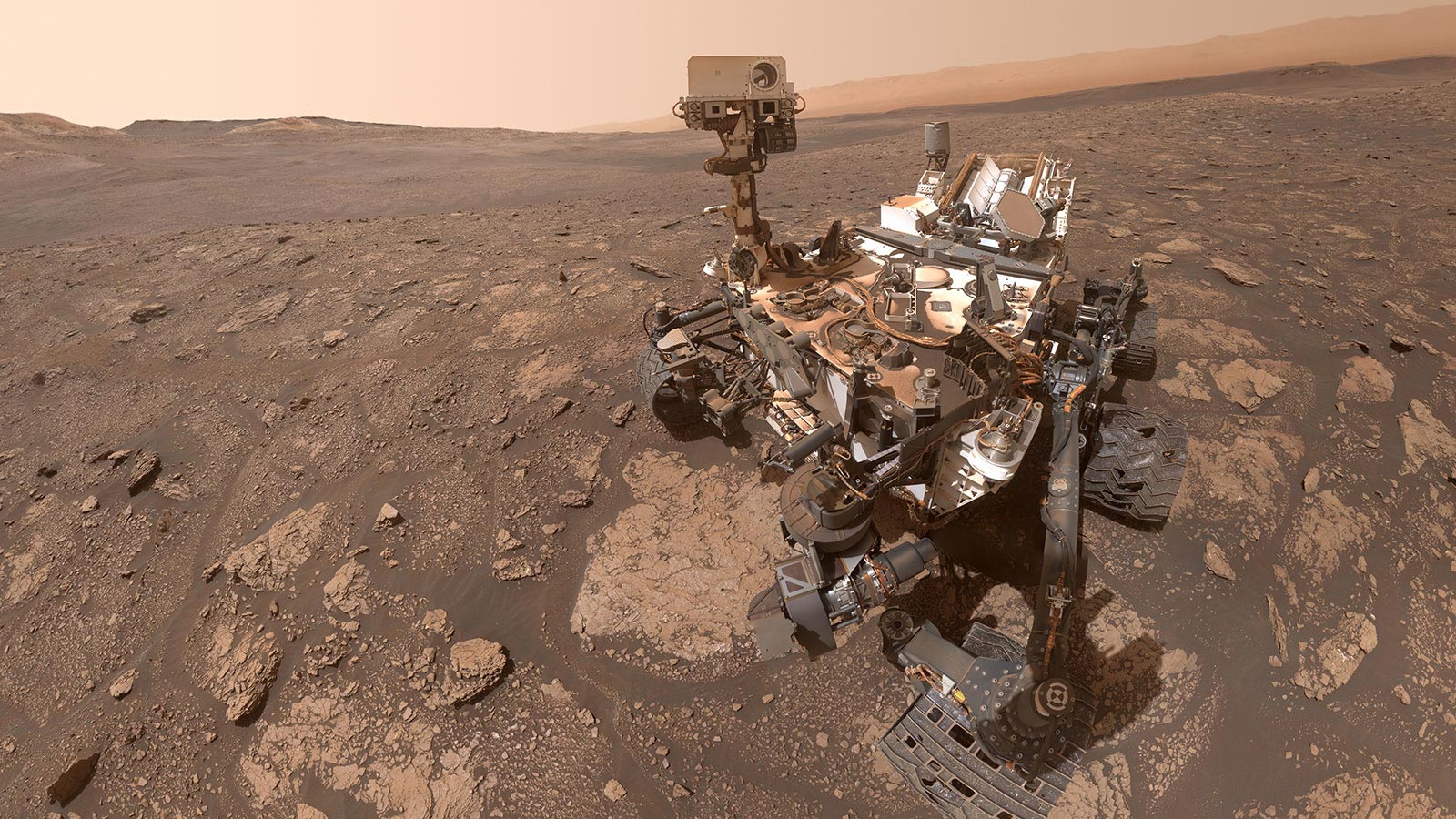
The Mars rover has drilled three samples of rock in this clay-enriched region since first arriving in July.
NASA’s Curiosity Mars rover has a new selfie. This latest is from a location named “Mary Anning,” after a 19th-century English paleontologist whose discovery of marine-reptile fossils was ignored for generations because of her gender and class. The rover has been at the site since this past July, taking and analyzing drill samples.
Made up of 59 pictures stitched together by imaging specialists, the selfie was taken on October 25, 2020 – the 2,922nd Martian day, or sol, of Curiosity’s mission.
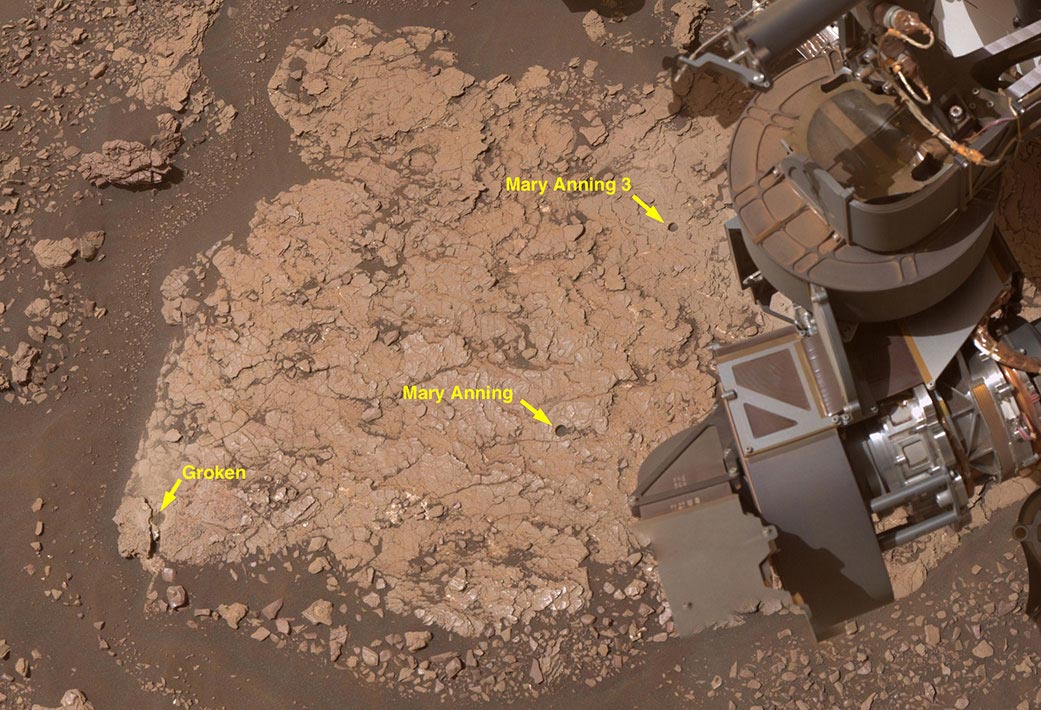
Scientists on the Curiosity team thought it fitting to name the sampling site after Anning because of the area’s potential to reveal details about the ancient environment. Curiosity used the rock drill on the end of its robotic arm to take samples from three drill holes called “Mary Anning,” “Mary Anning 3,” and “Groken,” this last one named after cliffs in Scotland’s Shetland Islands. The robotic scientist has conducted a set of advanced experiments with those samples to extend the search for organic (or carbon-based) molecules in the ancient rocks.
Since touching down in Gale Crater in 2012, Curiosity has been ascending Mount Sharp to search for conditions that might once have supported life. This past year, the rover has explored a region of Mount Sharp called Glen Torridon, which likely held lakes and streams billions of years ago. Scientists suspect this is why a high concentration of clay minerals and organic molecules was discovered there.
It will take months for the team to interpret the chemistry and minerals in the samples from the Mary Anning site. In the meantime, the scientists and engineers who have been commanding the rover from their homes as a safety precaution during the coronavirus pandemic have directed Curiosity to continue its climb of Mount Sharp. The rover’s next target of exploration is a layer of sulfate-laden rock that lies higher up the mountain. The team hopes to reach it in early 2021.
NASA’s Jet Propulsion Laboratory, a division of Caltech in Pasadena, California, leads the Curiosity mission. Curiosity took the selfie using a camera called the Mars Hand Lens Imager (MAHLI), located on the end of its robotic arm. MAHLI was built by Malin Space Science Systems in San Diego.
Never miss a breakthrough: Join the SciTechDaily newsletter.
Follow us on Google and Google News.
7 Comments
Não consideram interessante, uma fotografia do CURIOSITY, FEITA POR ALGUM FOTÓGRAFO. O Rouver tem um parceiro só para lhe fazer fotografias? Nunca vi nas fotos dois pares de rastos,
Também é curioso ao longo destes anos, umas fotos mostram este coberto de pó, e noutras completamente limpo. Será as tempestades que lhe tiram o pó?
Ou serão negócios de ilusão.
Why would you write nonsense like “whose discovery of marine-reptile fossils were ignored for generations because of her gender and class”? She was famous in her lifetime. Certainly gender was an issue (eg prevented her from joining the Geological Society), but another hurdle for her was her religion (she was an English Separatist, not Anglican). Certainly she deserved more due credit in her lifetime than she got, but to say “ignored for generations” is simply false and only demonstrates your own ignorance of her actual life. Instead of using her as a prop in a political-cultural template, why don’t you care enough about her to educate yourself just a little, about the real person? I learned about her as a young (male) budding amateur paleontologist, and at least by then (50 years ago) her foundational contribution was clearly acknowledged. I suspect I had read more about her by the age of 10 then you’re bothering to learn about her whilst writing professionally for a “science” site.
Thank you very much, Peter, for your comment. I appreciate the correction.
Peter has a point, but there might be more to it. I’m around Peter’s age, and my introduction to paleontology included an account of Anning making her first discovery. I’ve noticed, though, that Anning is much less well known to people 10-30 years younger than me.
At some point the focus on ancient animals got shifted from discovery and learning to simply the size and scariness of the creatures, and not just Anning but all of the early scientists were erased from children’s literature on the subject. And that led to the assumption of, “well, it was the nineteenth century, so obviously no women were in the field”.
So Anning has been erased, but she’s been erased relatively recently — recently enough that people who themselves learned about her as children are acting on restoring her to popular history. I’m delighted NASA is participating in those efforts.
After reading this article, I searched for Mary Anning’s life history and found this interesting piece: https://ucmp.berkeley.edu/history/anning.html
I Thank Hale, Peter and Kit for their thought provoking contributions. I am from India. My email is [email protected]
How did he take a selfie like that . It looks like someone took that picture. Because in the frame you don’t see the camera attached to the body of the rover????
Very interesting article, especially the photographs. I too am a paleontologist but I don’t concentrate much on who did what, rather it’s what the photographs show and what they are telling me about Planet Mars. Everyone will have their own opinion and no two paleontologists always think alike. While I enjoyed the comments by my colleagues, I am more interested in the geology of Mars, it’s past history and what the current status of the Planet is. These pictures are more telling than all the words NASA has published.