
Close Menu
    Facebook X (Twitter) Instagram
    SciTechDaily
    • Biology
    • Chemistry
    • Earth
    • Health
    • Physics
    • Science
    • Space
    • Technology
    Facebook X (Twitter) Pinterest YouTube RSS
    SciTechDaily
    Home»Space»NASA’s Curiosity Rover Discovers Bedrock with High Levels of Silica
    Space

    NASA’s Curiosity Rover Discovers Bedrock with High Levels of Silica

    By Whitney Clavin, Jet Propulsion LaboratoryJuly 24, 2015No Comments4 Mins Read
    Facebook Twitter Pinterest Telegram LinkedIn WhatsApp Email Reddit
    Share
    Facebook Twitter LinkedIn Pinterest Telegram Email Reddit
    Curiosity Rover Inspects Unusual Bedrock on Mars
    A rock outcrop dubbed “Missoula,” near Marias Pass on Mars, is seen in this image mosaic taken by the Mars Hand Lens Imager on NASA’s Curiosity rover. Pale mudstone (bottom of outcrop) meets coarser sandstone (top) in this geological contact zone, which has piqued the interest of Mars scientists. Credit: NASA/JPL-Caltech/MSSS

    After almost three years on Mars, NASA’s Curiosity Mars Rover continues to amaze. This time Curiosity has discovered a target unlike anything it has studied before – bedrock with surprisingly high levels of silica. Silica is a rock-forming compound containing silicon and oxygen, commonly found on Earth as quartz.

    This area lies just downhill from a geological contact zone the rover has been studying near “Marias Pass” on lower Mount Sharp.

    In fact, the Curiosity team decided to back up the rover 46 meters (151 feet) from the geological contact zone to investigate the high-silica target dubbed “Elk.” The decision was made after they analyzed data from two instruments, the laser-firing Chemistry & Camera (ChemCam) and Dynamic Albedo of Neutrons (DAN), which show elevated amounts of silicon and hydrogen, respectively. High levels of silica in the rock could indicate ideal conditions for preserving ancient organic material, if present, so the science team wants to take a closer look.

    “One never knows what to expect on Mars, but the Elk target was interesting enough to go back and investigate,” said Roger Wiens, the principal investigator of the ChemCam instrument from the Los Alamos National Laboratory in New Mexico. ChemCam is coming up on its 1,000th target, having already fired its laser more than 260,000 times since Curiosity landed on Mars August 6, 2012, Universal Time (evening of August 5, Pacific Time).
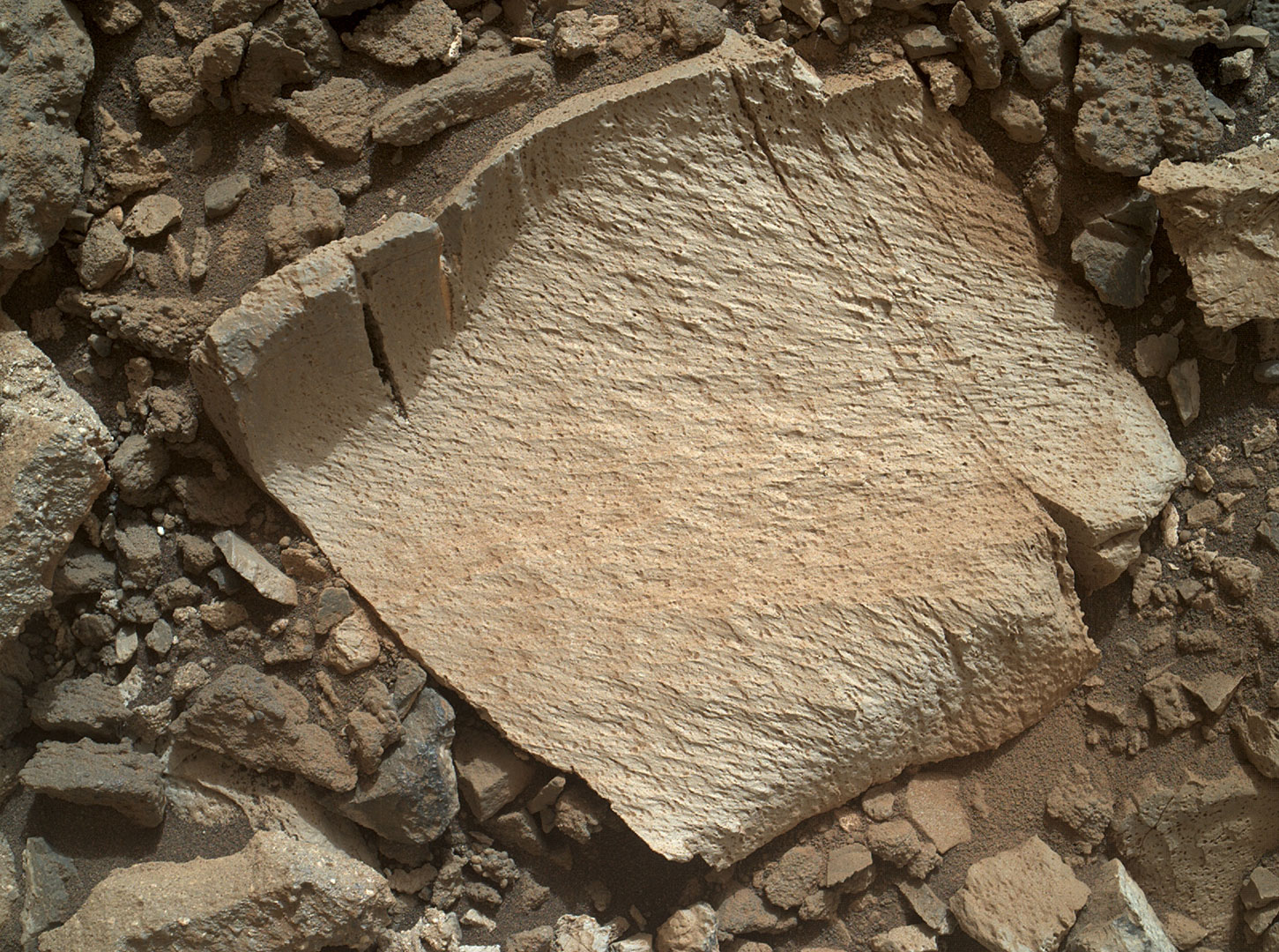
    Image of Lamoose Rock on Mars
    A rock fragment dubbed “Lamoose” is shown in this picture taken by the Mars Hand Lens Imager (MAHLI) on NASA’s Curiosity rover. Like other nearby rocks in a portion of the “Marias Pass” area of Mt. Sharp, Mars, it has unusually high concentrations of silica. The high silica was first detected in the area by the Chemistry & Camera (ChemCam) laser spectrometer. This rock was targeted for follow-up study by the MAHLI and the arm-mounted Alpha Particle X-ray Spectrometer (APXS). Credit: NASA/JPL-Caltech/MSSS

    In other news, an engineering test on the rover’s sample-collecting drill on July 18 is aiding the analysis of intermittent short circuits in the drill’s percussion mechanism, in preparation for using the drill in the area where the rover has been working for the past two months. The latest test did not result in any short circuits, so the team plans to continue with more tests, performed on the science targets themselves.

    Before Curiosity began further investigating the high-silica area, it was busy scrutinizing the geological contact zone near Marias Pass, where a pale mudstone meets darker sandstone.

    “We found an outcrop named Missoula where the two rock types came together, but it was quite small and close to the ground. We used the robotic arm to capture a dog’s-eye view with the MAHLI camera, getting our nose right in there,” said Ashwin Vasavada, the mission’s project scientist at NASA’s Jet Propulsion Laboratory in Pasadena, California. MAHLI is short for Mars Hand Lens Imager.

    The rover had reached this area after a steep climb up a 20-foot (6-meter) hill. Near the top of the climb, the ChemCam instrument fired its laser at the target Elk, and took a spectral reading of its composition.

    “ChemCam acts like eyes and ears of the rover for nearby objects,” said Wiens.

    The rover had moved on before the Elk data were analyzed, so a U-turn was required to obtain more data. Upon its return, the rover was able to study a similar target, “Lamoose,” up close with the MAHLI camera and the arm-mounted Alpha Particle X-ray Spectrometer (APXS).

    Curiosity has been working on Mars since early August 2012. It reached the base of Mount Sharp last year after fruitfully investigating outcrops closer to its landing site and then trekking to the mountain. The main mission objective now is to examine successively higher layers of Mount Sharp.

    Never miss a breakthrough: Join the SciTechDaily newsletter.
    Follow us on Google and Google News.

    Astronomy Curiosity Rover Mars NASA Planetary Science
    Share. Facebook Twitter Pinterest LinkedIn Email Reddit

    Related Articles

    Mineralogy of Martian Soil Is Similar to Soils of Volcanic Origin in Hawaii

    Curiosity Rover Photographs Diverse Rocks

    Curiosity Prepares to Take Its First Scoop of Soil for Analysis

    Curiosity Finds Ancient Streambed on Mars

    NASA’s Curiosity Prepares for Use of Its Arm and Tools

    Curiosity Sends Back Radioed Words and New Telephoto View of Mars

    NASA’s Curiosity Readies for First Drive on Mars

    Color HiRISE Image of Curiosity Rover on Mars

    First 360-Degree Color Panorama From NASA’s Curiosity Mars Rover

    Leave A Reply Cancel Reply

    • Facebook
    • Twitter
    • Pinterest
    • YouTube

    Don't Miss a Discovery

    Subscribe for the Latest in Science & Tech!

    Trending News

    Scientists Warn That This Common Pet Fish Can Wreck Entire Ecosystems

    Scientists Make Breakthrough in Turning Plastic Trash Into Clean Fuel Using Sunlight

    This Popular Supplement May Interfere With Cancer Treatment, Scientists Warn

    Scientists Finally Solved One of Water’s Biggest Mysteries

    Could This New Weight-Loss Pill Disrupt the Entire Market? Here’s What You Should Know About Orforglipron

    Earth’s Crust Is Tearing Open in Africa, and It Could Form a New Ocean

    Breakthrough Bowel Cancer Trial Leaves Patients Cancer-Free for Nearly 3 Years

    Natural Compound Shows Powerful Potential Against Rheumatoid Arthritis

    Follow SciTechDaily
    • Facebook
    • Twitter
    • YouTube
    • Pinterest
    • Newsletter
    • RSS
    SciTech News
    • Biology News
    • Chemistry News
    • Earth News
    • Health News
    • Physics News
    • Science News
    • Space News
    • Technology News
    Recent Posts
    • Ancient Roman Ship Coating Reveals Secrets Hidden for 2,200 Years
    • Enormous Prehistoric Insects Puzzle Scientists
    • College Student Identifies Bizarre New Carnivorous Dinosaur Three Times Older Than T. rex
    • The Most Effective Knee Arthritis Treatments Aren’t What You Expect
    • Scientists Develop Bioengineered Chewing Gum That Could Help Fight Oral Cancer
    Copyright © 1998 - 2026 SciTechDaily. All Rights Reserved.
    • Science News
    • About
    • Contact
    • Editorial Board
    • Privacy Policy
    • Terms of Use

    Type above and press Enter to search. Press Esc to cancel.