
Close Menu
    Facebook X (Twitter) Instagram
    SciTechDaily
    • Biology
    • Chemistry
    • Earth
    • Health
    • Physics
    • Science
    • Space
    • Technology
    Facebook X (Twitter) Pinterest YouTube RSS
    SciTechDaily
    Home»Space»NASA’s Imaging X-Ray Polarimetry Explorer (IXPE) Celebrates 1 Year of Exploring the Cosmos
    Space

    NASA’s Imaging X-Ray Polarimetry Explorer (IXPE) Celebrates 1 Year of Exploring the Cosmos

    By Hannah Maginot, NASADecember 10, 2022No Comments2 Mins Read
    Facebook Twitter Pinterest Telegram LinkedIn WhatsApp Email Reddit
    Share
    Facebook Twitter LinkedIn Pinterest Telegram Email Reddit
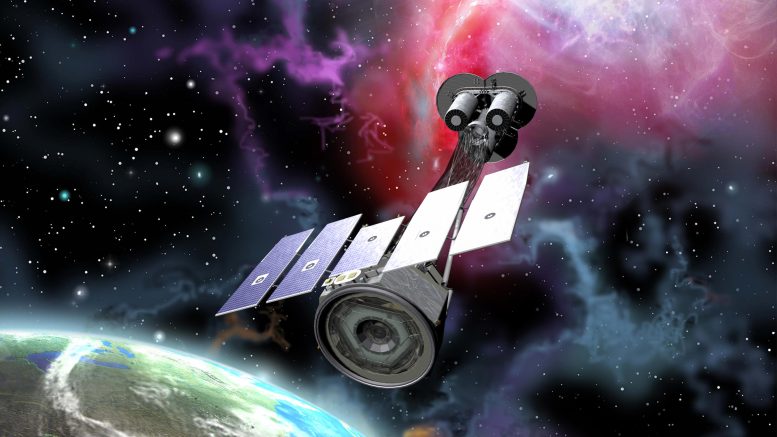
    IXPE in Earth Orbit
    Artist’s representation of IXPE in Earth orbit. Credit: NASA

    NASA’s Imaging X-ray Polarimetry Explorer (IXPE) lit up the early morning sky one year ago as it started its journey into space. The satellite was launched on December 9, 2021, atop a SpaceX Falcon 9 rocket from NASA’s Kennedy Space Center in Florida.

    IXPE is the first satellite dedicated to measuring the polarization of X-rays from a variety of cosmic sources, such as black holes and neutron stars. Polarization is a property of light that gives scientists important information about cosmic objects. Before IXPE, X-ray polarization was rarely measured in space. In just one year, IXPE has conducted measurements no telescope has ever been able to make before.

    SpaceX Falcon 9 Rocket Launches NASA IXPE
    A SpaceX Falcon 9 rocket launches with NASA’s Imaging X-ray Polarimetry Explorer (IXPE) spacecraft onboard from Launch Complex 39A, Thursday, December 9, 2021, at NASA’s Kennedy Space Center in Florida. The IXPE spacecraft is the first satellite dedicated to measuring the polarization of X-rays from a variety of cosmic sources, such as black holes and neutron stars. Launch occurred at 1 a.m. EST. Credit: NASA/Joel Kowsky

    Here’s a look at some of IXPE’s accomplishments in its first year of operation:

    • IXPE unlocked the surprising secrets of Cassiopeia A, a famous exploded star.
    • Findings from IXPE’s observation of neutron star Hercules X-1 shocked scientists.
    • IXPE revealed the shape and orientation of hot matter around the black hole in the Cygnus X-1 system.
    • Thanks to IXPE, scientists confirmed that magnetars have ultra-strong magnetic fields and are highly polarized.
    • NASA’s IXPE helped solve a 40-year mystery around particle acceleration in a blazar, an active black hole that has a jet pointed toward Earth.

    For IXPE, things are just getting started. Its baseline mission duration is two years, so with at least one more year of exploration to go, the satellite is poised to make more exciting discoveries about the intricacies of X-ray polarization. Happy first anniversary, IXPE!

    Never miss a breakthrough: Join the SciTechDaily newsletter.
    Follow us on Google and Google News.

    Astronomy Astrophysics IXPE NASA
    Share. Facebook Twitter Pinterest LinkedIn Email Reddit

    Related Articles

    NASA Cracks 30-Year X-ray Mystery With Blazing Black Hole Light Show

    NASA’s X-Ray Explorer Unveils Black Hole’s Hidden Layers

    Exploring the Invisible Sky With IXPE’s Revolutionary X-Ray Technology

    NASA’s IXPE Uses Vela Pulsar Wind Nebula as an Extreme Astrophysics Laboratory

    Astrophysicists Solve 40-Year-Old Black Hole Jet Mystery With NASA’s IXPE

    Surprising Results From NASA’s IXPE Help Unlock the Secrets of Famous Exploded Star

    NASA’s IXPE Mission Checks Out X-Rays From Extreme Cosmic Objects

    See the First Stunning Image From NASA’s New X-Ray Observatory

    NASA IXPE Observatory’s First Stunning Image: The Glowing Remains of an Exploded Star

    Leave A Reply Cancel Reply

    • Facebook
    • Twitter
    • Pinterest
    • YouTube

    Don't Miss a Discovery

    Subscribe for the Latest in Science & Tech!

    Trending News

    Scientists Uncover Promising New Strategy To Stop Parkinson’s in Its Tracks

    Experts Reveal the Surprising Cancer Link Behind a Common Vitamin

    This Strange “Golden Orb” Found 2 Miles Deep Stumped Scientists for Years

    Giant “Last Titan” Dinosaur Discovered in Thailand Was Bigger Than 9 Elephants

    This “Longevity Gene” May Protect the Brain From Aging and Dementia

    Common Cleaning Chemical Could Triple Your Risk of a Dangerous Liver Disease

    Scientists Discover Bizarre 100-Million-Year-Old Insect With Giant Claws

    Scientists Discover “Good” Gut Microbes That Could Protect Against Autism and ADHD

    Follow SciTechDaily
    • Facebook
    • Twitter
    • YouTube
    • Pinterest
    • Newsletter
    • RSS
    SciTech News
    • Biology News
    • Chemistry News
    • Earth News
    • Health News
    • Physics News
    • Science News
    • Space News
    • Technology News
    Recent Posts
    • Tea or Coffee? Your Daily Choice Could Affect Osteoporosis Risk
    • Scientists Discover Brain Pathway That May Slow Parkinson’s Disease – but Only in Women
    • Vitamin C May Fight Cancer in a Surprising Way
    • Light-Matter Particles Could Revolutionize AI Computing
    • Scientists Warn Many Insects May Not Survive a Warming World
    Copyright © 1998 - 2026 SciTechDaily. All Rights Reserved.
    • Science News
    • About
    • Contact
    • Editorial Board
    • Privacy Policy
    • Terms of Use

    Type above and press Enter to search. Press Esc to cancel.