
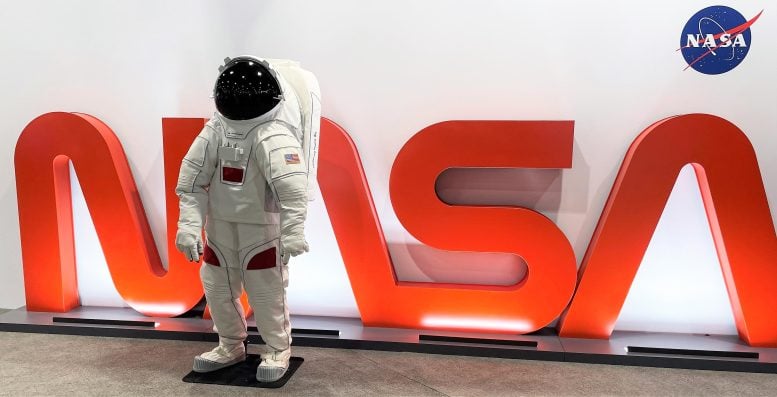
NASA is partnering with Collins Aerospace to develop a next-generation spacesuit, offering improved mobility, efficiency, and durability while catering to a diverse range of astronaut sizes.
A next-generation spacesuit – in effect an astronaut’s personal spaceship – will advance NASA’s spacewalking capabilities in low Earth orbit and at the International Space Station.
Collins Aerospace, working with partners ILC Dover and Oceaneering, is designing and building a new suit for NASA. Designed to fit the diverse astronaut corps size range and provide a broader range of motion, the suit will incorporate new technology that is more efficient and durable, and requires less maintenance, than the current suit design used by NASA astronauts on the space station.
“NASA’s partnership with Collins Aerospace represents the future of space exploration and the strength of American innovation. This next-generation spacesuit will make it easier for every NASA astronaut to conduct critical spacewalks in low Earth orbit,” said NASA Administrator Bill Nelson. “NASA’s collaboration with our commercial partners is pushing the boundaries of space technology to enable humanity to safely and comfortably work in space for the benefit of people on Earth.”
For more than 40 years, NASA astronauts have performed spacewalks outside the space station for maintenance and upgrades while wearing the Extravehicular Mobility Unit (EMU) spacesuit design that debuted during the Space Shuttle Program in the 1980s. While the spacesuit has far exceeded its planned design lifespan, NASA needs advanced spacewalk capabilities to achieve its exploration goals.
“Though the current EMU is incredible and has been an absolute workhorse for the Shuttle and Space Station Programs, NASA needs a new spacesuit for use on the space station. With a new spacesuit, we can address some of the current obsolescence issues with the EMU and take advantage of all the new technologies that are available to us now that weren’t available 50 years ago, such as improved mobility and technological innovations in life support systems,” said Lara Kearney, manager of NASA’s Extravehicular Activity and Human Surface Mobility program.
Features of the Next-Generation Spacesuit
Collins Aerospace’s next-generation spacesuit is designed to be easier to maintain and uses advanced life support components such as oxygen supply, carbon dioxide scrubbing, electrical power, heat dissipation, and ventilation. A liquid cooling and ventilation garment, designed to improve upon the tried-and-true EMU suit, will be worn under the spacesuit to assist astronauts with regulating body temperature during spacewalks.
To accommodate the diverse physical characteristics of NASA astronauts, the spacesuit will fit a wide range of sizes and be equipped with a high-mobility upper torso for maximum range of motion. The torso will be adjustable to provide a better fit for astronauts, one that can be altered in flight. The spacesuit is designed using fewer parts and will include easy-to-use features, minimizing astronaut training hours and reducing maintenance procedures.
Supporting NASA’s Broader Exploration Goals
Collins Aerospace was chosen from the agency’s Exploration Extravehicular Activity Services (xEVAS) contract solicitation, which enables selected vendors to compete for task orders for missions. Additional task orders will be used to provide a full suite of services for NASA’s spacewalking needs during the period of performance through 2034. Through the contract, NASA also selected Axiom Space to develop new spacesuits for astronauts to wear during the Artemis III mission, which will land humans on the surface of the Moon for the first time in more than 50 years as part of the agency’s lunar exploration efforts. Both vendors will compete for future spacewalking and moonwalking services task orders. By partnering with industry, NASA is helping to build a strong commercial space industry where the agency is one of many customers.
With this new suit and system, NASA is another step closer to a replacement for the current design used by NASA astronauts for decades during space shuttle and space station missions. A new suit will support continued station maintenance and operations as NASA and its international partners live and work aboard the microgravity laboratory to advance scientific knowledge for the benefit of people on Earth and demonstrate new technologies for future human and robotic missions. Such research lays the groundwork for a long-term presence at future commercial destinations in low Earth orbit and at the Moon through the Artemis missions, which will set up a long-term presence at the Moon for science and exploration.
Never miss a breakthrough: Join the SciTechDaily newsletter.
Follow us on Google and Google News.