
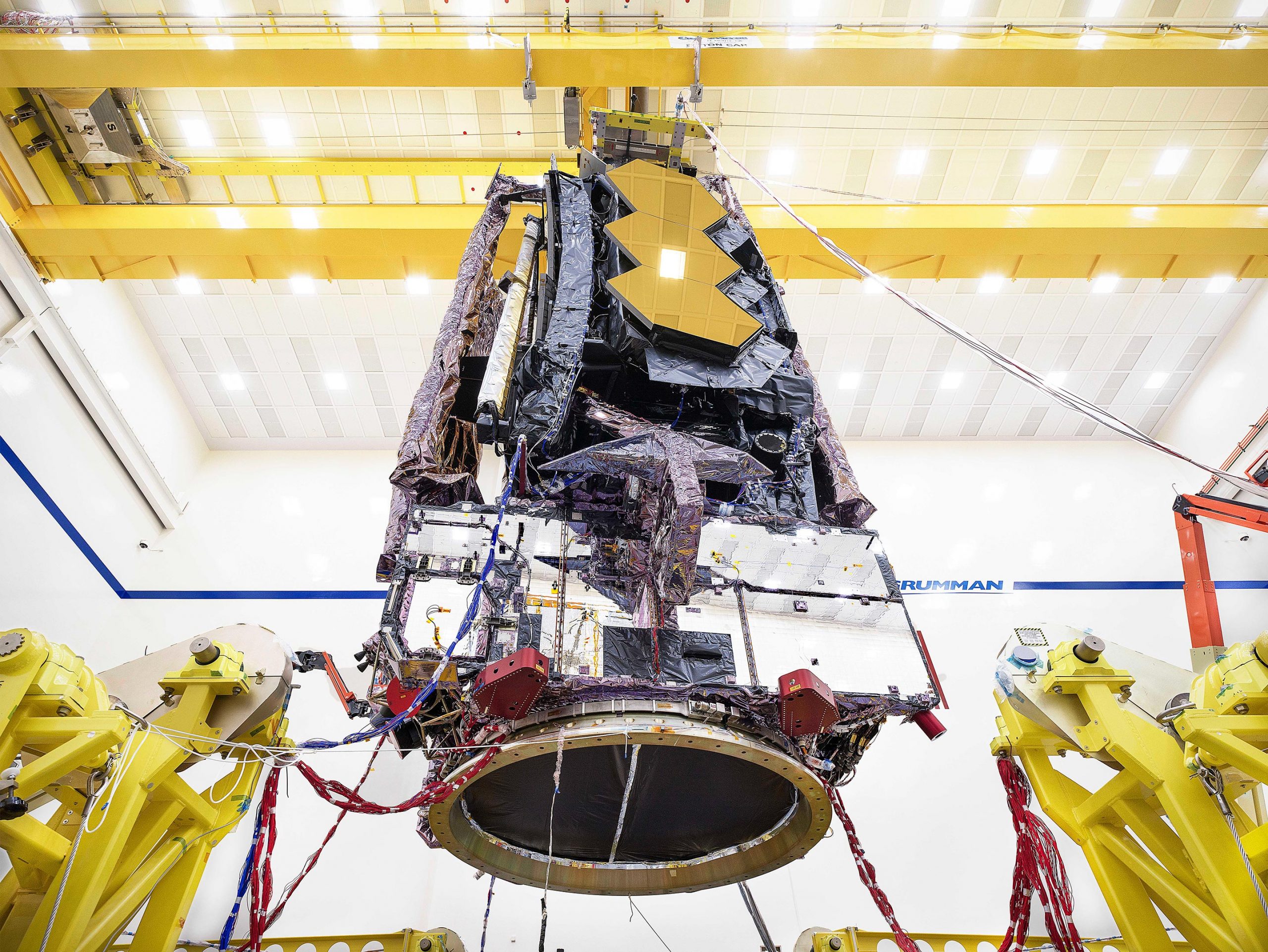
With the completion of its latest series of milestone tests, NASA’s James Webb Space Telescope has now survived all of the harsh conditions associated with a rocket launch to space.
Webb’s recent tests have validated that the fully assembled observatory will endure the deafening noise, and the jarring shakes, rattles, and vibrations that the observatory will experience during liftoff. Known as “acoustic” and “sine-vibration” testing, NASA has worked carefully with its international partners to match Webb’s testing environment precisely to what Webb will experience both on launch day, and when operating in orbit.

Though each component of the telescope has been rigorously tested during development, demonstrating that the assembled flight hardware is able to safely pass through a simulated launch environment is a significant achievement for the mission. Completed in two separate facilities within Northrop Grumman’s Space Park in Redondo Beach, California, these tests represent Webb’s final two, in a long series of environmental tests before Webb is shipped to French Guiana for launch.
The next environment Webb will experience is space.
“The successful completion of our observatory environmental tests represent a monumental milestone in the march to launch. Environmental testing demonstrates Webb’s ability to survive the rocket ride to space, which is the most violent portion of its trip to orbit approximately a million miles from earth. The multinational group of individuals responsible for the execution of the acoustic and vibration test is composed of an outstanding and dedicated group of folks who are typical of the entire Webb team,” said Bill Ochs, Webb project manager for NASA Goddard Space Flight Center in Greenbelt, Maryland.
Testing began by first encapsulating the entire telescope in a mobile clean room built to shield it from the outside world. Technicians then carefully guided it to a nearby acoustic testing chamber where it was intentionally blasted by sound pressure levels above 140 decibels, with a spectrum tuned to the specific signature of the Ariane 5 rocket it will ride to space. During the tests nearly 600 individual channels of motion data were carefully observed and recorded. Typical acoustic and vibration tests measure approximately 100 channels of data, but the complex size and shape of the observatory required considerably more measurement to ensure success. The data was then thoroughly analyzed and marked as a complete success.
To safely move the James Webb Space Telescope between testing facilities, engineers enclose it within a special mobile clean room often referred to as a clamshell. The crawl between buildings can take hours and requires the raising of telephone lines to allow Webb to pass underneath. Webb’s recent tests have validated that the fully assembled observatory will endure the deafening noise, and the jarring shakes, rattles and vibrations that the observatory will endure during liftoff. Known as “acoustic” and “sine-vibration” testing, NASA has worked carefully with its international partners to match Webb’s testing environment precisely to what Webb will experience both on launch day, and when operating in orbit. Credit: NASA’s Goddard Space Flight Center
Upon successful completion of its final acoustics tests, Webb was again packed and transported to a separate facility to simulate the low frequency vibrations that occur during liftoff. While inside Webb was placed on a specialized shaker table capable of precise vertical and horizontal acceleration. Where acoustic testing simulates the high-frequency dynamics of launch, vibration testing covers the lower frequencies experienced. With the combination of the two the entire mechanical environment Webb will experience during launch is accounted for.
“The testing team is an international consortium of structural dynamics experts who are the lead engineers for each piece of hardware on the observatory. The team members are located throughout the USA and Europe, spanning across 9 time zones! They are extremely dedicated to support testing at all hours and days to provide their expertise,” said Sandra Irish, Webb Mechanical Systems Structures Engineer Lead for NASA’s Goddard Space Flight Center in Greenbelt, Maryland. “Through the team’s dedication, hard work, and just pure excitement in being a part of this complex test, it was a complete success! I have known these individuals for many years and it’s been an honor to work with each one of them.”
Webb is now scheduled to move forward into the last full extension of its iconic primary mirror and sunshield followed by a full systems evaluation before being encapsulated in a specialized shipping container for transport to South America. Deploying the observatory after experiencing a simulated launch environment is the best way to replicate the true series of events the observatory will experience during launch, and when performing its complex deployment sequence in space. Initial analysis suggests the observatory passed through observatory level acoustic and vibration testing successfully, but the full verification of flight worthiness will occur after Webb has successfully completed final deployment tests.
Engineers and technicians continue to follow augmented personal safety procedures due to the COVID-19 situation, which is causing significant impact and disruption globally. The team has resumed near-full operations and are now preparing for the final phase of testing prior to shipment to the launch site.
The James Webb Space Telescope is the world’s largest, most powerful, and complex space science telescope ever built. In addition to the groundbreaking science expected from it after launch, Webb has required an improvement in the testing infrastructure and processes involved in validating large complex spacecraft for a life in space. Various facilities around the country had to be enlarged and upgraded to confidently test and prepare a machine as large as Webb for liftoff. Lessons learned from previous space telescope development were invested into Webb, and future space telescopes will be built upon the same collective knowledge. Thousands of scientists, engineers, and technicians contributed to build, test, and integrate Webb. In total, 258 companies, agencies, and universities participated – 142 from the United States, 104 from 12 European nations, and 12 from Canada.
Webb is NASA’s next great space science observatory, which will help in solving the mysteries of our solar system, looking beyond to distant worlds around other stars, and probing the mystifying structures and origins of our universe. Webb is an international program led by NASA, along with its partners ESA (European Space Agency) and the Canadian Space Agency.
Never miss a breakthrough: Join the SciTechDaily newsletter.
Follow us on Google and Google News.