

Juno’s latest discoveries have pulled back the veil on Jupiter’s harsh atmosphere and the fiery volcanic world of Io.
The spacecraft detected warm lava flows beneath Io’s crust and uncovered how heat flows like a cosmic radiator across its surface. Meanwhile, Juno’s radio signals revealed chilling new details about Jupiter’s polar temperatures, while long-term tracking of massive cyclones around the pole showed them drifting and bouncing off each other in bizarre ways.
New Discoveries Beneath Jupiter’s Clouds and Io’s Surface
NASA’s Juno spacecraft has uncovered striking new details about Jupiter and its volcanic moon, Io. By looking beneath Jupiter’s dense cloud cover and deep into Io’s surface, scientists have developed a more detailed model of the fast-moving jet stream that surrounds Jupiter’s north pole. At the same time, they’ve achieved a first: mapping the subsurface temperature of Io, revealing important clues about its internal structure and ongoing volcanic activity.
The findings were presented on April 29 during a news briefing at the European Geosciences Union General Assembly in Vienna.
“Everything about Jupiter is extreme. The planet is home to gigantic polar cyclones bigger than Australia, fierce jet streams, the most volcanic body in our solar system, the most powerful aurora, and the harshest radiation belts,” said Scott Bolton, principal investigator of Juno at the Southwest Research Institute in San Antonio. “As Juno’s orbit takes us to new regions of Jupiter’s complex system, we’re getting a closer look at the immensity of energy this gas giant wields.”
Made with data from the JIRAM instrument aboard NASA’s Juno, this animation shows the south polar region of Jupiter’s moon Io during a December 27, 2024, flyby. The bright spots are locations with higher temperatures caused by volcanic activity; the gray areas resulted when Io left the field of view. Credit: NASA/JPL/SwRI/ASI – JIRAM Team (A.M.)
Juno’s Microwave Radiometer Shines on Io
Although Juno’s Microwave Radiometer (MWR) was designed to study Jupiter’s deep atmosphere, the mission team also directed it at Io, teaming it with data from the Jovian Infrared Auroral Mapper (JIRAM) for a more complete view of the moon’s fiery interior.
“The Juno science team loves to combine very different datasets from very different instruments and see what we can learn,” said Shannon Brown, a Juno scientist at NASA’s Jet Propulsion Laboratory in Southern California. “When we incorporated the MWR data with JIRAM’s infrared imagery, we were surprised by what we saw: evidence of still-warm magma that hasn’t yet solidified below Io’s cooled crust. At every latitude and longitude, there were cooling lava flows.”

Io’s Surface Works Like a Cosmic Radiator
The data suggests that about 10% of the moon’s surface has these remnants of slowly cooling lava just below the surface. The result may help provide insight into how the moon renews its surface so quickly as well as how as well as how heat moves from its deep interior to the surface.
“Io’s volcanoes, lava fields, and subterranean lava flows act like a car radiator,” said Brown, “efficiently moving heat from the interior to the surface, cooling itself down in the vacuum of space.”
Looking at JIRAM data alone, the team also determined that the most energetic eruption in Io’s history (first identified by the infrared imager during Juno’s December 27, 2024, Io flyby) was still spewing lava and ash as recently as March 2. Juno mission scientists believe it remains active today and expect more observations on May 6, when the solar-powered spacecraft flies by the fiery moon at a distance of about 55,300 miles (89,000 kilometers).
Measuring Jupiter’s Chilling Polar Temperatures
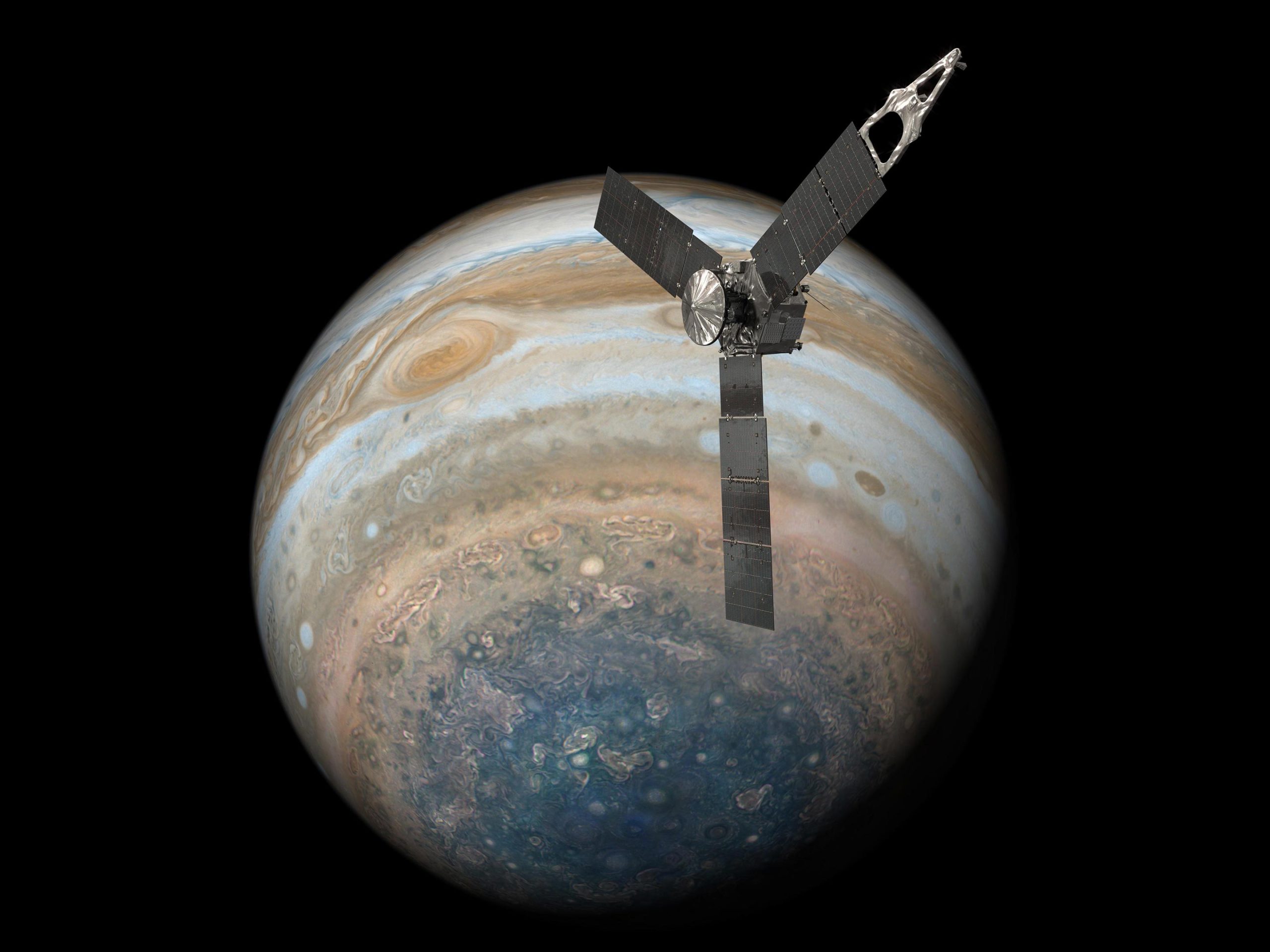
On its 53rd orbit (February 18, 2023), Juno began radio occultation experiments to explore the gas giant’s atmospheric temperature structure. With this technique, a radio signal is transmitted from Earth to Juno and back, passing through Jupiter’s atmosphere on both legs of the journey. As the planet’s atmospheric layers bend the radio waves, scientists can precisely measure the effects of this refraction to derive detailed information about the temperature and density of the atmosphere.
So far, Juno has completed 26 radio occultation soundings. Among the most compelling discoveries: the first-ever temperature measurement of Jupiter’s north polar stratospheric cap reveals the region is about 11 degrees Celsius cooler than its surroundings and is encircled by winds exceeding 100 mph (161 kph).
Cyclones at the Top of the Gas Giant
The team’s recent findings also focus on the cyclones that haunt Jupiter’s north. Years of data from the JunoCam visible light imager and JIRAM have allowed Juno scientists to observe the long-term movement of Jupiter’s massive northern polar cyclone and the eight cyclones that encircle it. Unlike hurricanes on Earth, which typically occur in isolation and at lower latitudes, Jupiter’s are confined to the polar region.
By tracking the cyclones’ movements across multiple orbits, the scientists observed that each storm gradually drifts toward the pole due to a process called “beta drift” (the interaction between the Coriolis force and the cyclone’s circular wind pattern). This is similar to how hurricanes on our planet migrate, but Earthly cyclones break up before reaching the pole due to the lack of warm, moist air needed to fuel them, as well as the weakening of the Coriolis force near the poles. What’s more, Jupiter’s cyclones cluster together while approaching the pole, and their motion slows as they begin interacting with neighboring cyclones.
“These competing forces result in the cyclones ‘bouncing’ off one another in a manner reminiscent of springs in a mechanical system,” said Yohai Kaspi, a Juno co-investigator from the Weizmann Institute of Science in Israel. “This interaction not only stabilizes the entire configuration, but also causes the cyclones to oscillate around their central positions, as they slowly drift westward, clockwise, around the pole.”
The new atmospheric model helps explain the motion of cyclones not only on Jupiter, but potentially on other planets, including Earth.
Juno’s Perilous Yet Rewarding Journey Continues
“One of the great things about Juno is that its orbit is ever-changing, which means we get a new vantage point each time as we perform a science flyby,” said Bolton. “In the extended mission, that means we’re continuing to go where no spacecraft has gone before, including spending more time in the strongest planetary radiation belts in the solar system. It’s a little scary, but we’ve built Juno like a tank and are learning more about this intense environment each time we go through it.”
More About Juno
Juno is a NASA spacecraft designed to explore Jupiter’s atmosphere, magnetic field, and deep internal structure, providing unprecedented insight into the largest planet in our solar system. Managed by NASA’s Jet Propulsion Laboratory (JPL)—a division of Caltech in Pasadena, California—the mission is led by principal investigator Scott Bolton of the Southwest Research Institute in San Antonio, Texas.
Juno is part of NASA’s New Frontiers Program, which supports high-priority solar system exploration missions and is managed at NASA’s Marshall Space Flight Center in Huntsville, Alabama, for the Science Mission Directorate in Washington, D.C.
The spacecraft itself was built and is operated by Lockheed Martin Space in Denver. Among Juno’s suite of cutting-edge scientific instruments is the Jovian InfraRed Auroral Mapper (JIRAM), which was funded by the Italian Space Agency. Numerous other research institutions across the United States contributed additional instruments, making Juno a highly collaborative international mission.
Since arriving at Jupiter in 2016, Juno has delivered stunning data and imagery, revealing the gas giant’s dynamic atmosphere, deep storms, powerful auroras, and mysterious core, all while enduring some of the harshest radiation conditions in the solar system.
Never miss a breakthrough: Join the SciTechDaily newsletter.
Follow us on Google and Google News.