

Recent analysis from NASA’s Lunar Reconnaissance Orbiter reveals that ice deposits on the moon are more widespread than previously understood, extending to latitudes of at least 77 degrees south.
This discovery, crucial for future lunar missions, suggests that these ice deposits could potentially support human life and rocket fuel production. The new findings also provide detailed maps and insights into the specific lunar regions where ice is most likely to be found, based on their environmental conditions and topography.
Extensive Lunar Ice Deposits
According to a new analysis of data from NASA’s LRO (Lunar Reconnaissance Orbiter) mission, deposits of ice in lunar dust and rock (regolith) are more extensive than previously thought. Ice would be a valuable resource for future lunar expeditions. Water could be used for radiation protection and supporting human explorers, or broken into its hydrogen and oxygen components to make rocket fuel, energy, and breathable air.
Prior studies found signs of ice in the larger permanently shadowed regions (PSRs) near the lunar South Pole, including areas within Cabeus, Haworth, Shoemaker, and Faustini craters. In the new work, “We find that there is widespread evidence of water ice within PSRs outside the South Pole, towards at least 77 degrees south latitude,” said Dr. Timothy P. McClanahan of NASA’s Goddard Space Flight Center in Greenbelt, Maryland, and lead author of a paper on this research published October 2 in the Planetary Science Journal.
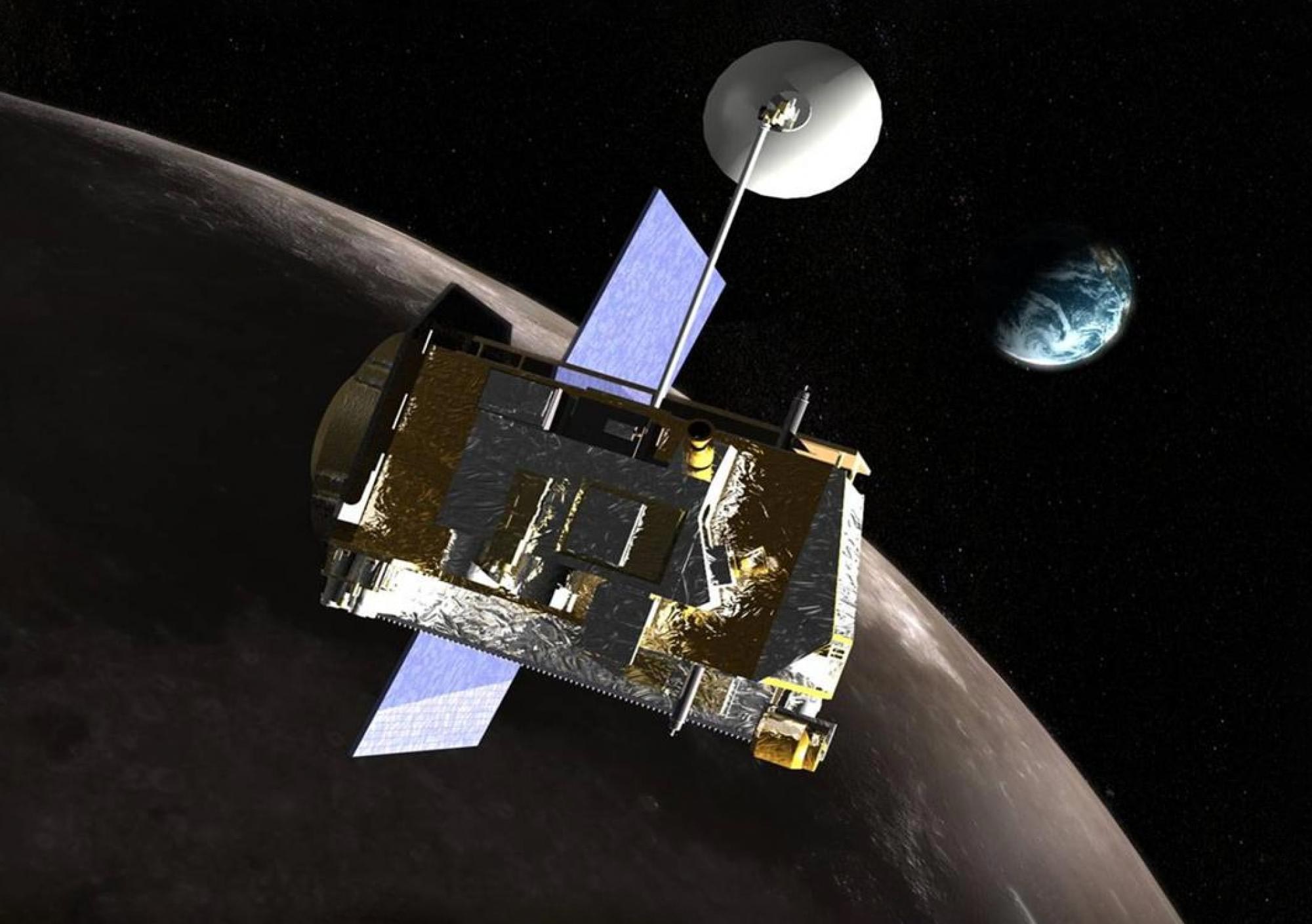
New Insights From Lunar Reconnaissance
The study further aids lunar mission planners by providing maps and identifying the surface characteristics that show where ice is likely and less likely to be found, with evidence for why that should be. “Our model and analysis show that greatest ice concentrations are expected to occur near the PSRs’ coldest locations below 75 Kelvin (-198°C or -325°F) and near the base of the PSRs’ poleward-facing slopes,” said McClanahan.
“We can’t accurately determine the volume of the PSRs’ ice deposits or identify if they might be buried under a dry layer of regolith. However, we expect that for each surface 1.2 square yards (square meter) residing over these deposits there should be at least about five more quarts (five more liters) of ice within the surface top 3.3 feet (meter), as compared to their surrounding areas,” said McClanahan. The study also mapped where fewer, smaller, or lower-concentration ice deposits would be expected, occurring primarily in warmer, periodically illuminated areas.
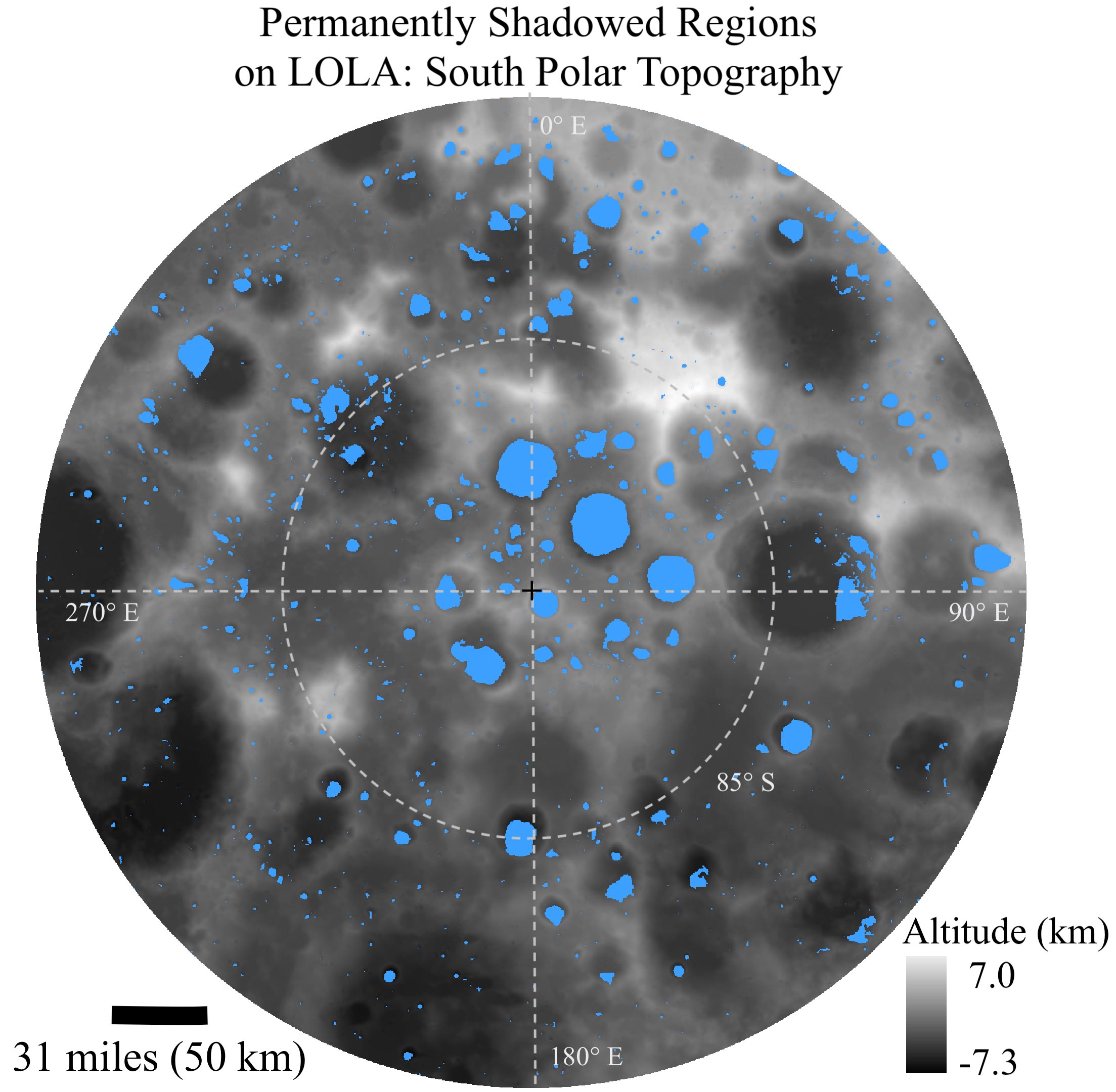
Ice Formation and Preservation on the Moon
Ice could become implanted in lunar regolith through comet and meteor impacts, released as vapor (gas) from the lunar interior, or be formed by chemical reactions between hydrogen in the solar wind and oxygen in the regolith. PSRs typically occur in topographic depressions near the lunar poles. Because of the low Sun angle, these areas haven’t seen sunlight for up to billions of years, so are perpetually in extreme cold.
Ice molecules are thought to be repeatedly dislodged from the regolith by meteorites, space radiation, or sunlight and travel across the lunar surface until they land in a PSR where they are entrapped by extreme cold. The PSR’s continuously cold surfaces can preserve ice molecules near the surface for perhaps billions of years, where they may accumulate into a deposit that is rich enough to mine. Ice is thought to be quickly lost on surfaces that are exposed to direct sunlight, which precludes their accumulation.
The team used LRO’s Lunar Exploration Neutron Detector (LEND) instrument to detect signs of ice deposits by measuring moderate-energy, “epithermal” neutrons. Specifically, the team used LEND’s Collimated Sensor for Epithermal Neutrons (CSETN) that has a fixed 18.6-mile (30-kilometer) diameter field-of-view. Neutrons are created by high-energy galactic cosmic rays that come from powerful deep-space events such as exploding stars, that impact the lunar surface, break up regolith atoms, and scatter subatomic particles called neutrons.
The neutrons, which can originate from up to about a 3.3-foot (meter’s) depth, ping-pong their way through the regolith, running into other atoms. Some get directed into space, where they can be detected by LEND. Since hydrogen is about the same mass as a neutron, a collision with hydrogen causes the neutron to lose relatively more energy than a collision with most common regolith elements. So, where hydrogen is present in regolith, its concentration creates a corresponding reduction in the observed number of moderate-energy neutrons.
Neutron Detection and Hydrogen Concentration Analysis
“We hypothesized that if all PSRs have the same hydrogen concentration, then CSETN should proportionally detect their hydrogen concentrations as a function of their areas. So, more hydrogen should be observed towards the larger-area PSRs,” said McClanahan.
The model was developed from a theoretical study that demonstrated how similarly hydrogen-enhanced PSRs would be detected by CSETNs fixed-area field-of-view. The correlation was demonstrated using the neutron emissions from 502 PSRs with areas ranging from 1.5 square miles (4 km2) to 417 square miles (1079 km2) that contrasted against their surrounding less hydrogen-enhanced areas. The correlation was expectedly weak for the small PSRs but increased towards the larger-area PSRs.
Reference: “Evidence for Widespread Hydrogen Sequestration within the Moon’s South Pole Cold Traps” by T. P. McClanahan, A. M. Parsons, T. A. Livengood, J. J. Su, G. Chin, D. Hamara, K. Harshman and R. D. Starr, 2 October 2024, The Planetary Science Journal.
DOI: 10.3847/PSJ/ad5b55
The research was sponsored by the LRO project science team, NASA’s Goddard Space Flight Center’s Artificial Intelligence Working Group, and NASA grant award number 80GSFC21M0002. The study was conducted using NASA’s LRO Diviner radiometer and Lunar Orbiter Laser Altimeter instruments. The LEND instrument was developed by the Russian Space Agency, Roscosmos by its Space Research Institute (IKI). LEND was integrated to the LRO spacecraft at the NASA Goddard Space Flight Center. LRO is managed by NASA’s Goddard Space Flight Center in Greenbelt, Maryland, for the Science Mission Directorate at NASA Headquarters in Washington.
Never miss a breakthrough: Join the SciTechDaily newsletter.
Follow us on Google and Google News.
1 Comment
Memo 2410080331
NASA’s Lunar Reconnaissance Orbiter has revealed vast deposits of ice hidden throughout the moon. The moon is a treasure trove of natural resources for the future of mankind. Many useful resources have been estimated through scientific analysis.
Scientific estimation is based on the existence of the desired resources on the moon. This is an analysis of data from a spacecraft that flew from a collapsed star to a spacecraft and hit by a neutron on the moon’s surface, and more facts emerge when this process undergoes a theoretical re-analysis of msbase.qpeoms. Huh.
The collapse of a neutron star is a collapse of one zsp, and the spacecraft is scattered throughout the universe
It is a vast amount of unit, of which the neutron is smolas.
NASA’s analysis data shows whether a neutron accidentally hits the moon and ice deposits in the moon’s dust and rocks (legolis) exist. Uh-huh.
Source 1.
Neutrons, which can occur at depths of up to about 3.3 feet (meters), pass through the Legolis and move like ping pong and collide with other atoms. Some head into space and can be detected at LEND. Hydrogen is about the same mass as neutrons, so when it collides with hydrogen, it loses relatively more energy than when neutrons collide with the most common Legolis element. Therefore, when there is hydrogen in the Legolis, the hydrogen concentration causes a corresponding decrease in the number of intermediate energy neutrons observed.
Extensive ice deposits found on the moon can provide water and fuel materials to support future astronaut missions, and new research maps these resources beyond traditional polar regions.
Recent analyses of NASA’s Lunar Reconnaissance Orbiter show that lunar ice deposits are more widespread than previously thought, extending to at least 77 degrees south latitude.
This discovery, which is important for future lunar exploration, suggests that these ice deposits could potentially support human life and rocket fuel production. The new findings also provide detailed maps and insights into certain lunar regions where ice is most likely to be found based on environmental conditions and topography.
According to the data analysis, ice deposits on the moon’s dust and rocks (legolis) are more extensive than previously thought. Ice will be a valuable resource for future moon missions. Water can be used for radiation protection and supporting human explorers, or it can break down into hydrogen and oxygen to create rocket fuel, energy, and breathable air.
Previous studies have found ice traces in the larger permanent shadow area (PSR) near the moon’s south pole, including inside the Cabeus, Haworth, Shoemaker, and Faustini craters. The new study has found extensive evidence of water ice outside the south pole, within the PSR at least 77 degrees south latitude.
Neutrons are generated by high-energy galactic cosmic rays from powerful deep-space events such as exploding stars, which collide with the lunar surface, break down the Legolis atoms, and scatter subatomic particles called neutrons.
Neutron detection and hydrogen concentration analysis
“We hypothesized that if all PSRs have the same hydrogen concentration, then CSETN should detect the hydrogen concentration proportionally as a function of area. Therefore, more hydrogen should be observed toward the larger area of PSR.
The model was developed in a theoretical study that showed how hydrogen-enhanced PSRs are similarly detected in the CSETN fixed-region field of view. This correlation was demonstrated using neutron emissions from 502 PSRs with regions ranging from 1.5 square miles (4 km2) to 417 square miles (1079 km2), compared with the surrounding less hydrogen-enhanced regions. This correlation was weak for smaller PSRs as expected but increased with larger regions of PSRs.
ㅡㅡㅡㅡㅡㅡㅡㅡㅡㅡㅡㅡ
Source 1.
https://scitechdaily.com/nasas-lunar-reconnaissance-orbiter-reveals-extensive-ice-deposits-hidden-across-the-moon/
NASA’s Lunar Reconnaissance Orbiter Reveals Massive Ice Deposits Hidden All Over the Moon