
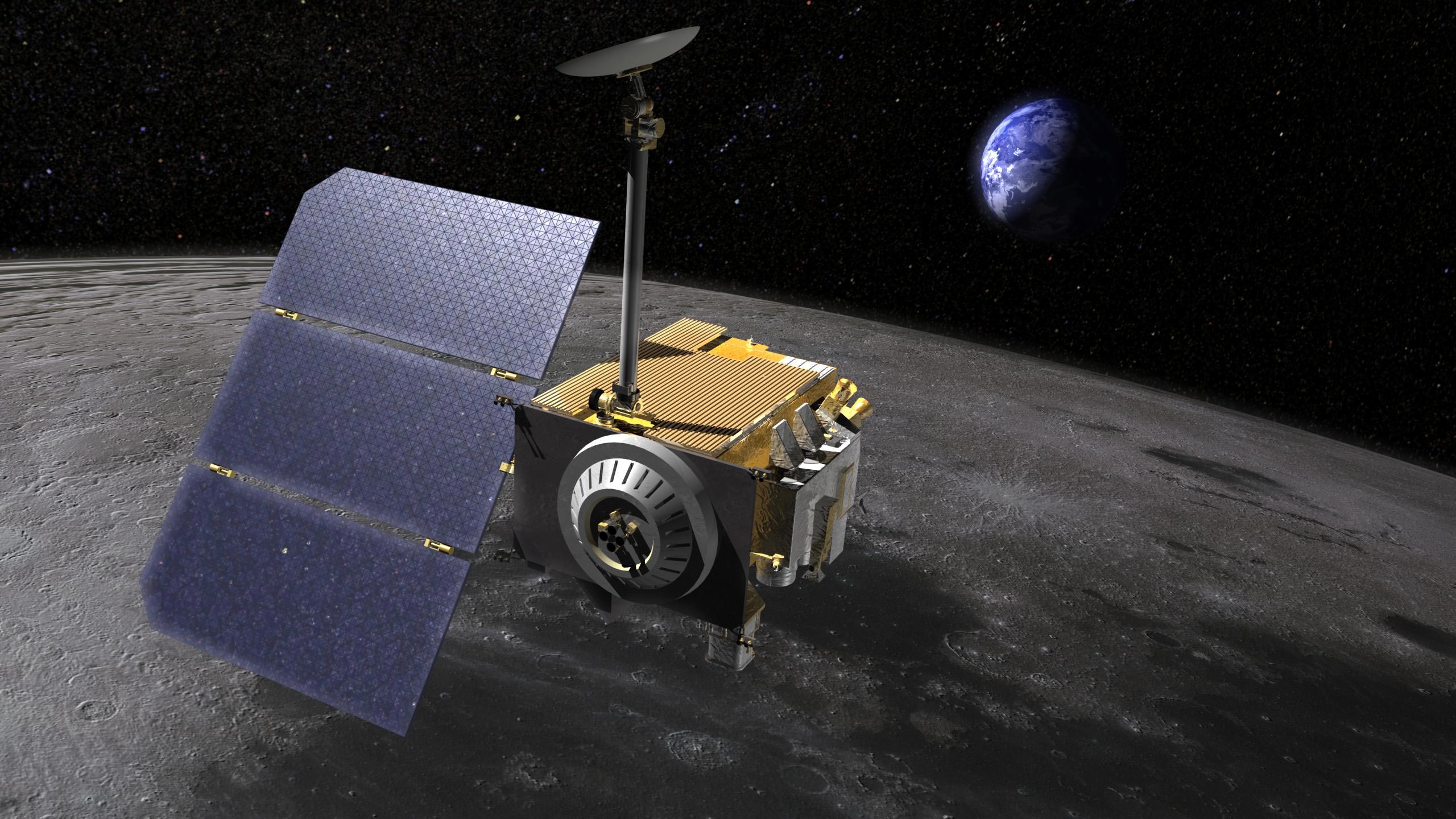
Scientists found shaded lunar pits with stable temperatures around 63 °F, ideal for future lunar exploration.
Scientists have discovered shaded locations within pits on the Moon that always hover around a comfortable 63 °F (about 17 °C). The NASA-funded researchers used data from NASA’s Lunar Reconnaissance Orbiter (LRO) spacecraft and computer modeling.
The pits, and caves to which they may lead, would make thermally stable sites for lunar exploration missions. Their comfortable temperatures are in stark contrast to areas at the Moon’s surface, which heat up to around 260 °F (about 127 °C) during the day and cool to minus 280 °F (about minus 173 °C) at night. Lunar exploration remains a part of NASA’s goal to explore and understand the unknown in space, to inspire and benefit humanity.
Potential for Shelters and Protection
Since pits were first discovered on the Moon in 2009, scientists wondered if they led to caves that could be explored or used as shelters. Besides for the more stable temperatures, the pits or caves could also offer some protection from cosmic rays, solar radiation, and micrometeorites.
“About 16 of the more than 200 pits are probably collapsed lava tubes,” said Tyler Horvath, a doctoral student in planetary science at the University of California, Los Angeles, who led the new research, recently published in the journal Geophysical Research Letters.

Stability and Exploration Prospects
“Lunar pits are a fascinating feature on the lunar surface,” said LRO Project Scientist Noah Petro of NASA’s Goddard Space Flight Center in Greenbelt, Maryland. “Knowing that they create a stable thermal environment helps us paint a picture of these unique lunar features and the prospect of one day exploring them.”
Lava tubes, which are also found on Earth, form when molten lava flows beneath a field of cooled lava or a crust forms over a river of lava, leaving a long, hollow tunnel. If the ceiling of a solidified lava tube collapses, it opens a pit that can lead into the rest of the cave-like tube.
Two of the most prominent lunar pits have visible overhangs that clearly lead to caves or voids, and there is strong evidence that another’s overhang may also lead to a large cave.
“Humans evolved living in caves, and to caves we might return when we live on the Moon,” said David Paige, a co-author of the paper who leads the Diviner Lunar Radiometer Experiment aboard LRO that made the temperature measurements used in the study.
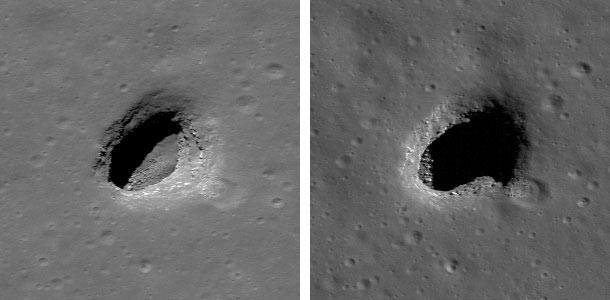
Horvath processed data from Diviner – a thermal camera – to find out if the temperature within the pits was different from those on the surface.
Focusing on a roughly cylindrical 328-foot (100-meter)–deep depression about the length and width of a football field in an area of the Moon known as the Mare Tranquillitatis, Horvath and his colleagues used computer modeling to analyze the thermal properties of the rock and lunar dust and to chart the pit’s temperatures over time.
Stable Temperatures in Mare Tranquillitatis Pit
The results revealed that temperatures within the permanently shadowed reaches of the pit fluctuate only slightly throughout the lunar day, remaining quite stable at around 63 °F or 17 °C. If a cave extends from the bottom of the pit, as images taken by LRO’s Lunar Reconnaissance Orbiter Camera suggest, it too would have this relatively comfortable temperature.
The team, which included University of California, Los Angeles (UCLA) professor of planetary science David Paige and Paul Hayne of the University of Colorado Boulder, believes the shadowing overhang is responsible for the steady temperature, limiting how hot things gets during the day and preventing heat from radiating away at night.
A day on the Moon lasts about 15 Earth days, during which the surface is constantly bombarded by sunlight and is frequently hot enough to boil water. Brutally cold nights also last about 15 Earth days.
Reference: “Thermal and Illumination Environments of Lunar Pits and Caves: Models and Observations From the Diviner Lunar Radiometer Experiment” by Tyler Horvath, Paul O. Hayne and David A. Paige, 8 July 2022, Geophysical Research Letters.
DOI: 10.1029/2022GL099710
NASA’s Lunar Reconnaissance Orbiter project, Extended Mission 4 funded the research. LRO is managed by NASA’s Goddard Space Flight Center in Greenbelt, Maryland, for the Science Mission Directorate at NASA Headquarters in Washington. Launched on June 18, 2009, LRO has collected a treasure trove of data with its seven powerful instruments, making an invaluable contribution to our knowledge about the Moon. University of California, Los Angeles, and NASA’s Jet Propulsion Laboratory in Pasadena, California built and developed Diviner.
NASA is returning to the Moon with commercial and international partners to expand human presence in space and bring back new knowledge and opportunities.
Never miss a breakthrough: Join the SciTechDaily newsletter.
Follow us on Google and Google News.
3 Comments
Why would anyone want to live on the moon????????
You say “NASA is returning to the Moon with commercial and international partners to expand human presence in space and bring back new knowledge and opportunities. Just because knowledge is “new” is not a reason to spend huge money to acquire it.
And we can’t pay for the many opportunities to do productive things on earth. There is no ongoing way to a practical matter to use the moon’s so called opportunities. So to call them opportunities is not a reason to continue to REQUIRE FUTURE GENERATIONS SOMEDAY TO HAVE TO COME TO GRIPS WITH THE DEBT we are giving them THAT WILL PREVENT THEM FROM BEING ABLE TO AVAIL THEMSELVES OF MANY OPPORTUNITIES ON THIS EARTH.
Wow, what’s purpose of that comment?
By the way, I know they can’t measure it (yet), but what’s the temp of this hole during lunar night? Assume it’s gonna be uninhabitable at that temp…
I gave presentations to The Mars Society in 2019 and 2020 about using a Lunar lava tube as a low construction site for a human base. From there begin mining the regolith, build rails, train sets, then build telescopes to place in special railcars. Thank you, Douglas D Shull