
Close Menu
    Facebook X (Twitter) Instagram
    SciTechDaily
    • Biology
    • Chemistry
    • Earth
    • Health
    • Physics
    • Science
    • Space
    • Technology
    Facebook X (Twitter) Pinterest YouTube RSS
    SciTechDaily
    Home»Space»NASA’s Lunar Orbiter Captures Impact Site of Failed HAKUTO-R Moon Lander
    Space

    NASA’s Lunar Orbiter Captures Impact Site of Failed HAKUTO-R Moon Lander

    By NASA's Goddard Space Flight CenterMay 29, 2023No Comments3 Mins Read
    Facebook Twitter Pinterest Telegram LinkedIn WhatsApp Email Reddit
    Share
    Facebook Twitter LinkedIn Pinterest Telegram Email Reddit
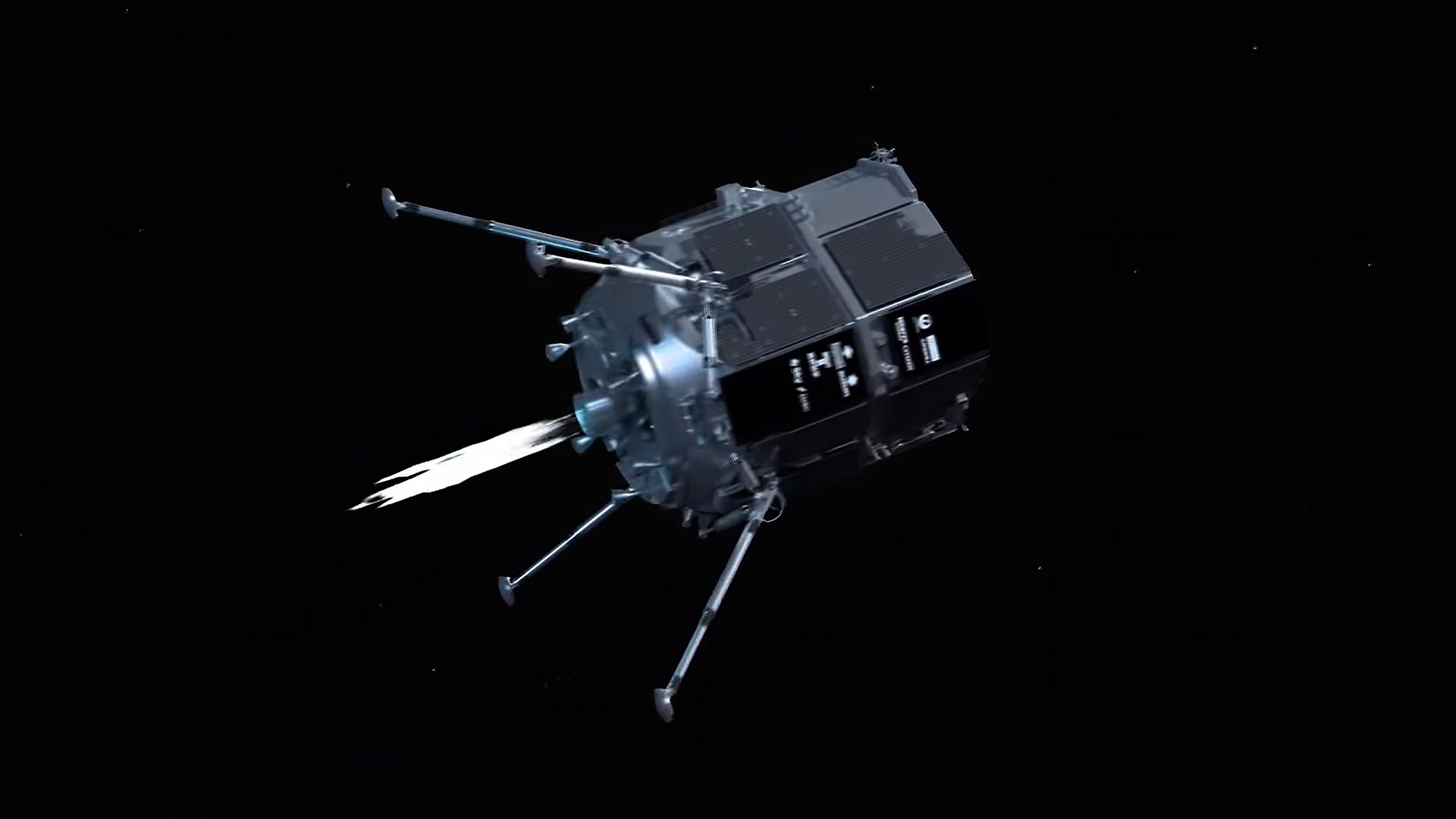
    HAKUTO-R Mission 1
    The Series 1 Lander was optimized for light weight, small size and reliability. Although the lander did not complete a soft landing, the cause has been identified and improvements are being incorporated into Mission 2 and Mission 3. Credit: ispace

    The HAKUTO-R Mission 1 lunar lander, launched by ispace in December 2022, failed to land safely on the Moon. In April 2023, NASA’s Lunar Reconnaissance Orbiter detected unusual surface changes and debris near the intended landing site, suggesting potential remnants of the unsuccessful landing. Further analysis is planned to verify these findings.

    The ispace HAKUTO-R Mission 1 lunar lander was launched on December 11, 2022, a privately funded spacecraft planned to land on the lunar surface. After a several-month journey to the Moon, the spacecraft started a controlled descent to the surface to land near Atlas crater. The ispace team announced the following day that an anomaly occurred, and the HAKUTO-R Mission 1 lunar lander had not safely touched down on the surface.
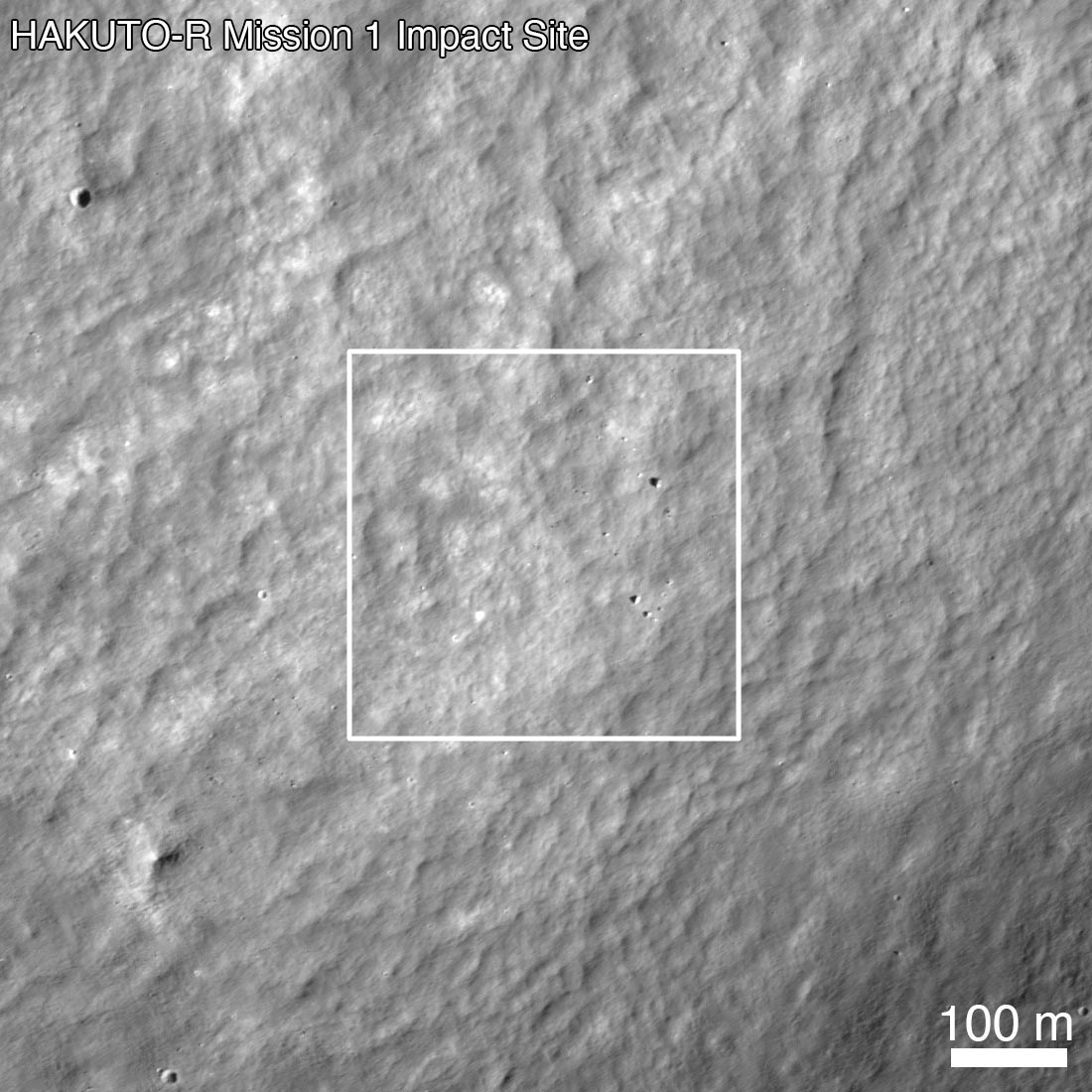
    HAKUTO R Mission 1 Lunar Lander Site
    HAKUTO-R Mission 1 lunar lander site, as seen by the Lunar Reconnaissance Orbiter Camera (LROC) on April 26, 2023, the day after the attempted landing. The scale bar is 100 m across. LROC NAC image M1437131607R. Credit: NASA’s Goddard Space Flight Center/Arizona State University
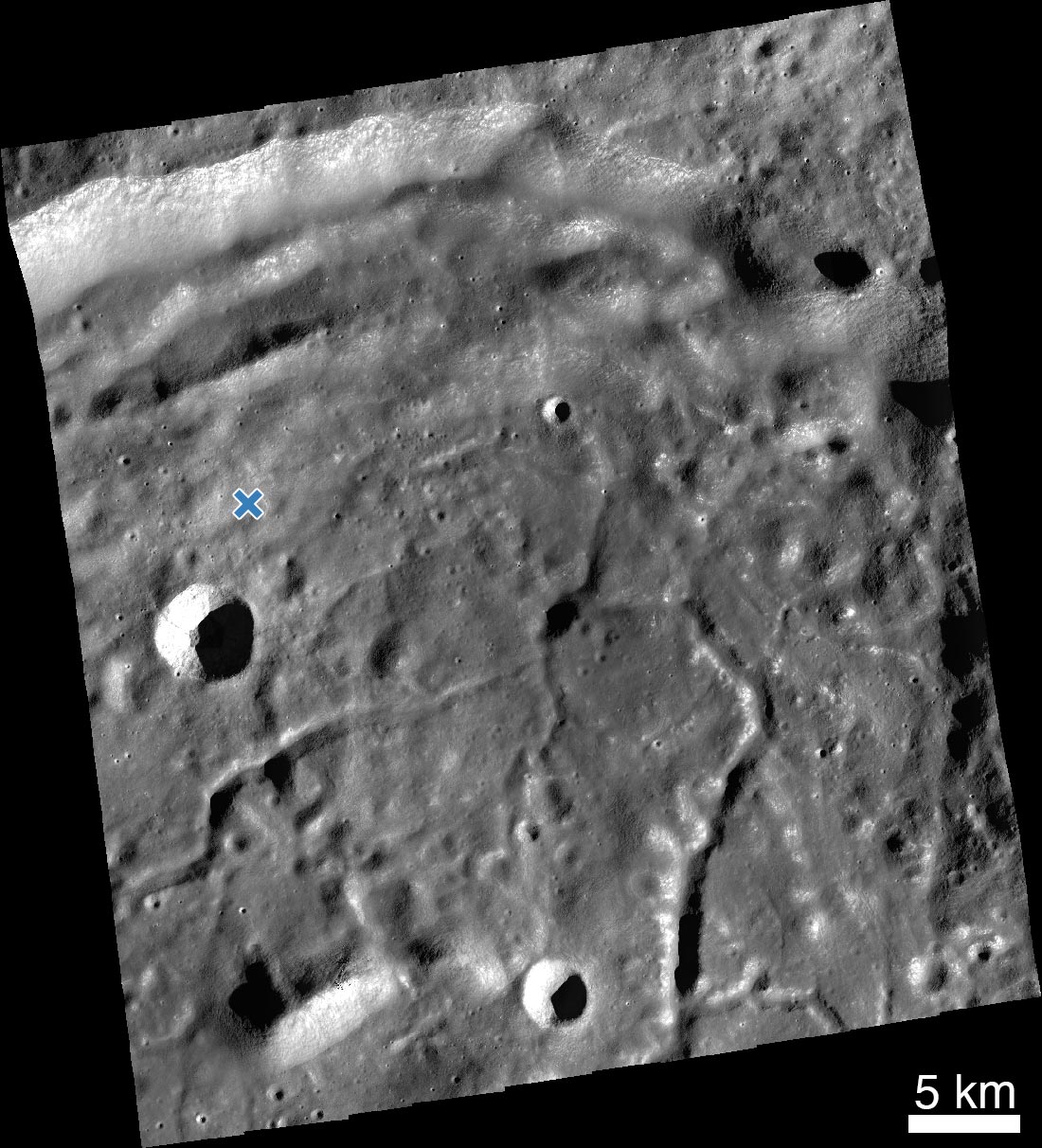
    HAKUTO-R Mission 1 Lunar Lander Site LROC
    LROC Narrow Angle Camera mosaic of the HAKUTO-R Mission 1 lunar lander site made from the following image pairs: M1437138630L/R, 1437131607L/R, M1437124584L/R, 1437117561L/R, M1437110537L/R. Credit: NASA’s Goddard Space Flight Center/Arizona State University

    On April 26, 2023, NASA’s Lunar Reconnaissance Orbiter (LRO) spacecraft acquired 10 images around the landing site with its Narrow Angle Cameras. The images covered a region roughly 40 km by 45 km (about 25 miles by 28 miles). Using an image acquired before the landing attempt, the LRO Camera science team began searching for the lander.
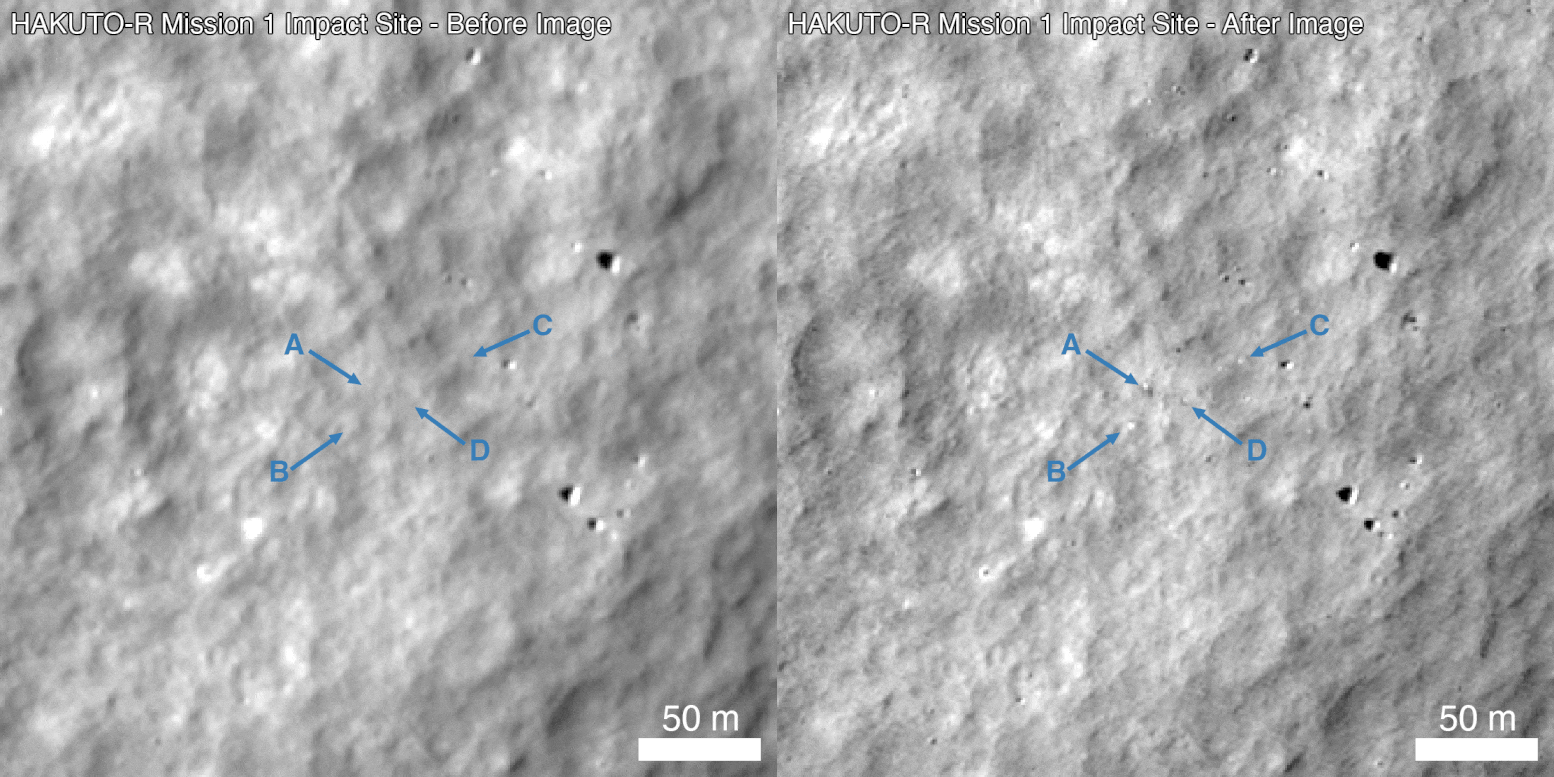
    HAKUTO-R Mission 1 Lunar Lander Site
    Before (M192675639R) and after (M1437131607R) comparison of the impact site. Arrow A points to a prominent surface change with higher reflectance in the upper left and lower reflectance in the lower right (opposite of nearby surface rocks along the right side of the frame). Arrows B, C, and D point to other changes around the impact site. The scale bar in the lower right is 50m across. Credit: NASA’s Goddard Space Flight Center/Arizona State University

    From the temporal image pair, the LRO Camera team identified an unusual surface change near the nominal landing site. The image shows at least four prominent pieces of debris and several small changes (47.581 degrees North latitude, 44.094 degrees East longitude). The central feature in the image above shows several bright pixels in the upper left and several dark pixels in the lower right. This is the opposite of nearby boulders, suggesting that this could be a small crater or different parts of the lander body. This site will be further analyzed over the coming months as LRO has the opportunity to make additional observations of the site under various lighting conditions and viewing angles.
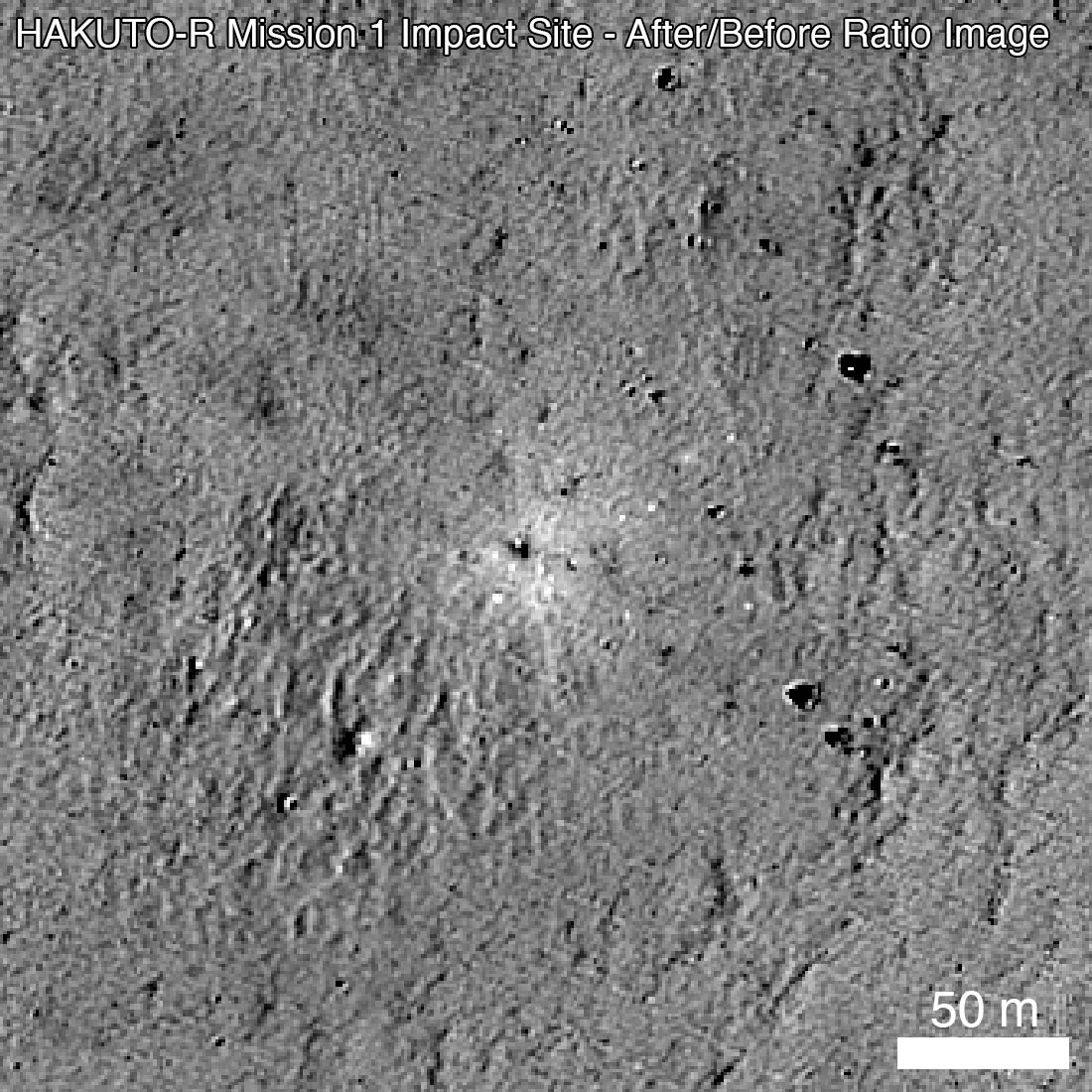
    HAKUTO-R Mission 1 Lunar Lander Site Before After Ratio
    Ratio image created by dividing the after (M1437131607R) and before (M192675639R) images. The impact created an area of higher reflectance, approximately 60-80 m across. The scale bar in the lower right is 50m across. Credit: NASA’s Goddard Space Flight Center/Arizona State University

    Lunar Reconnaissance Orbiter is managed by NASA’s Goddard Space Flight Center in Greenbelt, Maryland, for the Science Mission Directorate at NASA Headquarters in Washington. Launched on June 18, 2009, LRO has collected a treasure trove of data with its seven powerful instruments, making an invaluable contribution to our knowledge about the Moon.

    Never miss a breakthrough: Join the SciTechDaily newsletter.
    Follow us on Google and Google News.

    Moon NASA NASA Goddard Space Flight Center NASA's Lunar Reconnaissance Orbiter Popular
    Share. Facebook Twitter Pinterest LinkedIn Email Reddit

    Related Articles

    NASA Spots Fresh Lunar Impact From Crashed Moon Mission

    NASA Discovers Evidence of Mysterious Network of Caves on the Moon [Video]

    NASA’s Lunar Reconnaissance Orbiter Spots Japan’s SLIM Lander on the Moon

    NASA’s Lunar Reconnaissance Orbiter Spots Chandrayaan-3 Landing Site on Moon

    NASA Spacecraft Finds Pits on the Moon That Always Hover Around a Comfortable Temperature

    Jaw Dropping 4K Views of the Moon Apollo 13 Astronauts Saw on Their Perilous Journey Around the Farside

    Majority of Lunar Ice Deposits Are Likely Billions of Years Old – But Some May Be Much More Recent

    New Research on Lunar Ice Deposits Examines When and How It Got There

    NASA LRO Spacecraft Reveals Geological Activity on the Moon’s Surface

    Leave A Reply Cancel Reply

    • Facebook
    • Twitter
    • Pinterest
    • YouTube

    Don't Miss a Discovery

    Subscribe for the Latest in Science & Tech!

    Trending News

    Why Popular Diabetes Drugs Like Ozempic Don’t Work for Everyone: The “Genetic Glitch”

    Scientists Stunned After Finding Plant Thought Extinct for 60 Years

    Scientists Discover Tiny New Spider That Hunts Prey 6x Its Size

    Natural Component From Licorice Shows Promise for Treating Inflammatory Bowel Disease

    Scientists Warn: Popular Sweetener Linked to Dangerous Metabolic Effects

    Monster Storms on Jupiter Unleash Lightning Beyond Anything on Earth

    Scientists Create “Liquid Gears” That Spin Without Touching

    The Simple Habit That Could Help Prevent Cancer

    Follow SciTechDaily
    • Facebook
    • Twitter
    • YouTube
    • Pinterest
    • Newsletter
    • RSS
    SciTech News
    • Biology News
    • Chemistry News
    • Earth News
    • Health News
    • Physics News
    • Science News
    • Space News
    • Technology News
    Recent Posts
    • Ancient Bacteria Turned a DNA System Into a Cell Skeleton
    • Researchers Finally Solve 50-Year-Old Blood Group Mystery
    • Scientists Discover “Molecular Switch” That Fuels Alzheimer’s Brain Inflammation
    • Hidden Ocean Currents Revealed in Stunning Detail by AI
    • Trees Emit Tiny Lightning Flashes During Storms and Scientists Finally Prove It
    Copyright © 1998 - 2026 SciTechDaily. All Rights Reserved.
    • Science News
    • About
    • Contact
    • Editorial Board
    • Privacy Policy
    • Terms of Use

    Type above and press Enter to search. Press Esc to cancel.