
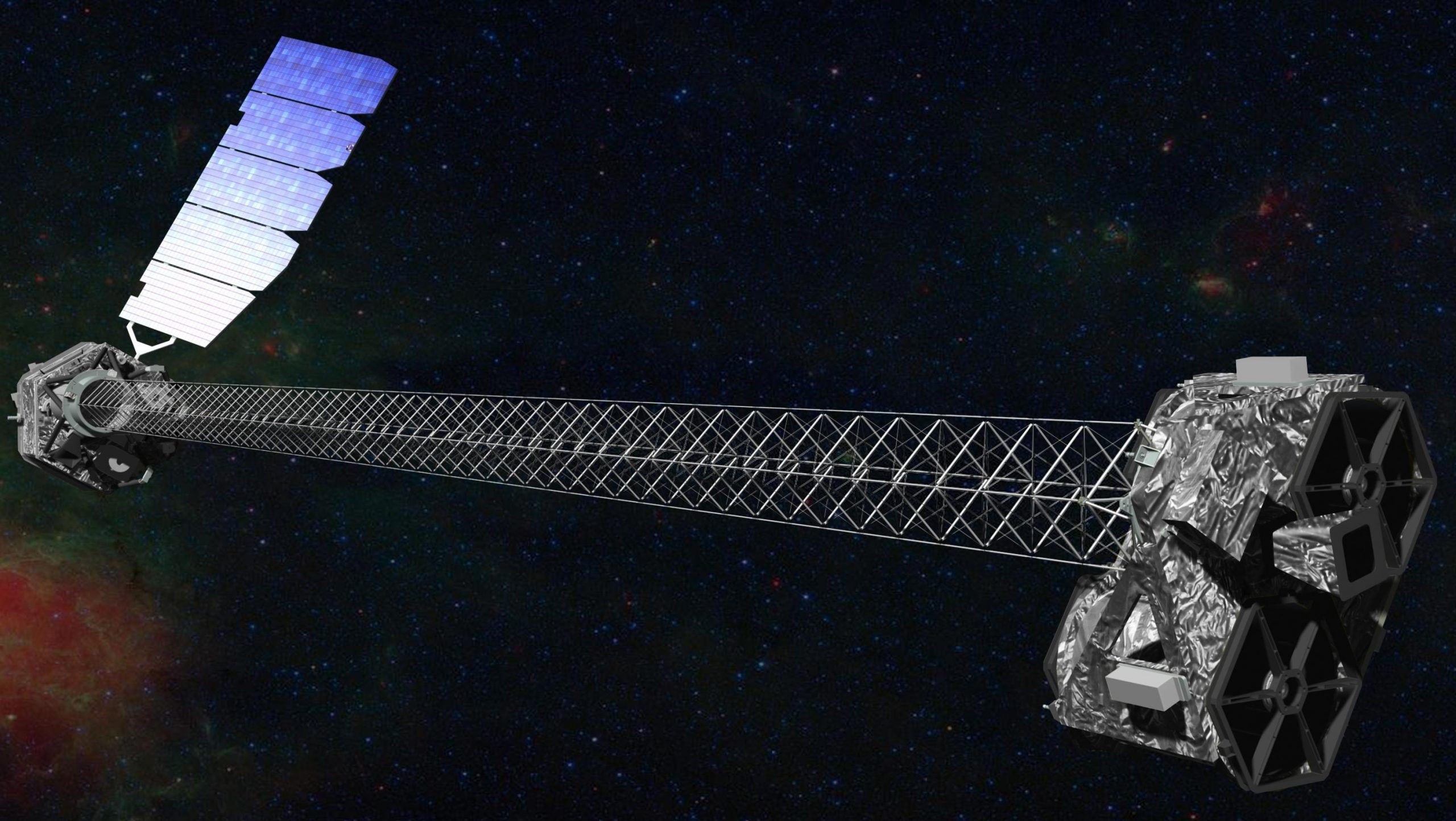
The first batch of data from NASA’s NuSTAR is now publicly available, providing data on observations obtained during the first two months of the mission (July – August 2012).
NASA’s Nuclear Spectroscopic Telescope Array, or NuSTAR, is giving the wider astronomical community a first look at its unique X-ray images of the cosmos. The first batch of data from the black-hole hunting telescope is publicly available today, August 29, via NASA’s High Energy Astrophysics Science Archive Research Center, or HEASARC.
“We are pleased to present the world with NuSTAR’s first look at the sky in high-energy X-rays with a true focusing telescope,” said Fiona Harrison, the mission’s principal investigator at the California Institute of Technology, Pasadena.
The images, taken from July to August 2012, shortly after the spacecraft launched, comprise an assortment of extreme objects, including black holes near and far. The more distant black holes are some of the most luminous objects in the universe, radiating X-rays as they ferociously consume surrounding gas. One type of black hole in the new batch of data is a blazar, which is an active, supermassive black hole pointing a jet toward Earth. Systems known as X-ray binaries, in which a compact object such as a neutron star or black hole feeds off a stellar companion, are also in the mix, along with the remnants of stellar blasts called supernovas.
The data set only contains complete observations. Data will be released at a later date for those targets still being observed.
“Astronomers can use these data to better understand the capabilities of NuSTAR and design future observing proposals. The first opportunity will be this fall, for joint observations with XMM-Newton,” said Karl Forster of Caltech, who is leading the effort to package the data for the public.
The European Space Agency’s XMM-Newton X-ray telescope, like NASA’s Chandra X-ray Observatory, complements NuSTAR. While XMM-Newton and Chandra see lower-energy X-ray light, NuSTAR is the first telescope capable of focusing high-energy X-ray light, allowing for more detailed images than were possible before.
Astronomers can compare data sets from different missions using HEASARC, which gives them a broader understanding of an object of interest. NuSTAR’s high-energy observations help scientists bridge a gap that existed previously in X-ray astronomy, and will lead to new revelations about the bizarre and energetic side of our universe.
Other NASA missions with data available via HEASARC include Chandra, Fermi, Swift, Cosmic Background Explorer (COBE), Wilkinson Microwave Anisotropy Probe (WMAP), and many more.
The HEASARC is a service of the Astrophysics Science Division at NASA’s Goddard Space Flight Center in Greenbelt, Maryland, and the High Energy Astrophysics Division of the Smithsonian Astrophysics Observatory in Cambridge, Massachusetts. HEASARC holdings include data obtained by NASA’s high-energy astronomy missions observing in the extreme-ultraviolet, X-ray, and gamma-ray bands, as well as data from missions, balloons, and ground-based facilities that have studied the relic cosmic microwave background. HEASARC is online at http://heasarc.gsfc.nasa.gov.
NuSTAR is a Small Explorer mission led by Caltech and managed by NASA’s Jet Propulsion Laboratory, Pasadena, California, for NASA’s Science Mission Directorate in Washington. The spacecraft was built by Orbital Sciences Corporation, Dulles, Virginia. Its instrument was built by a consortium including Caltech; JPL; the University of California, Berkeley; Columbia University, New York; NASA’s Goddard Space Flight Center, Greenbelt, Md.; the Danish Technical University in Denmark; Lawrence Livermore National Laboratory, Livermore, California; ATK Aerospace Systems, Goleta, California, and with support from the Italian Space Agency (ASI) Science Data Center.
NuSTAR’s mission operations center is at UC Berkeley, with ASI providing its equatorial ground station located at Malindi, Kenya. The mission’s outreach program is based at Sonoma State University, Rohnert Park, California. NASA’s Explorer Program is managed by Goddard. JPL is managed by Caltech for NASA.
For more information, visit http://www.nasa.gov/nustar and http://www.nustar.caltech.edu/.
Never miss a breakthrough: Join the SciTechDaily newsletter.
Follow us on Google and Google News.