
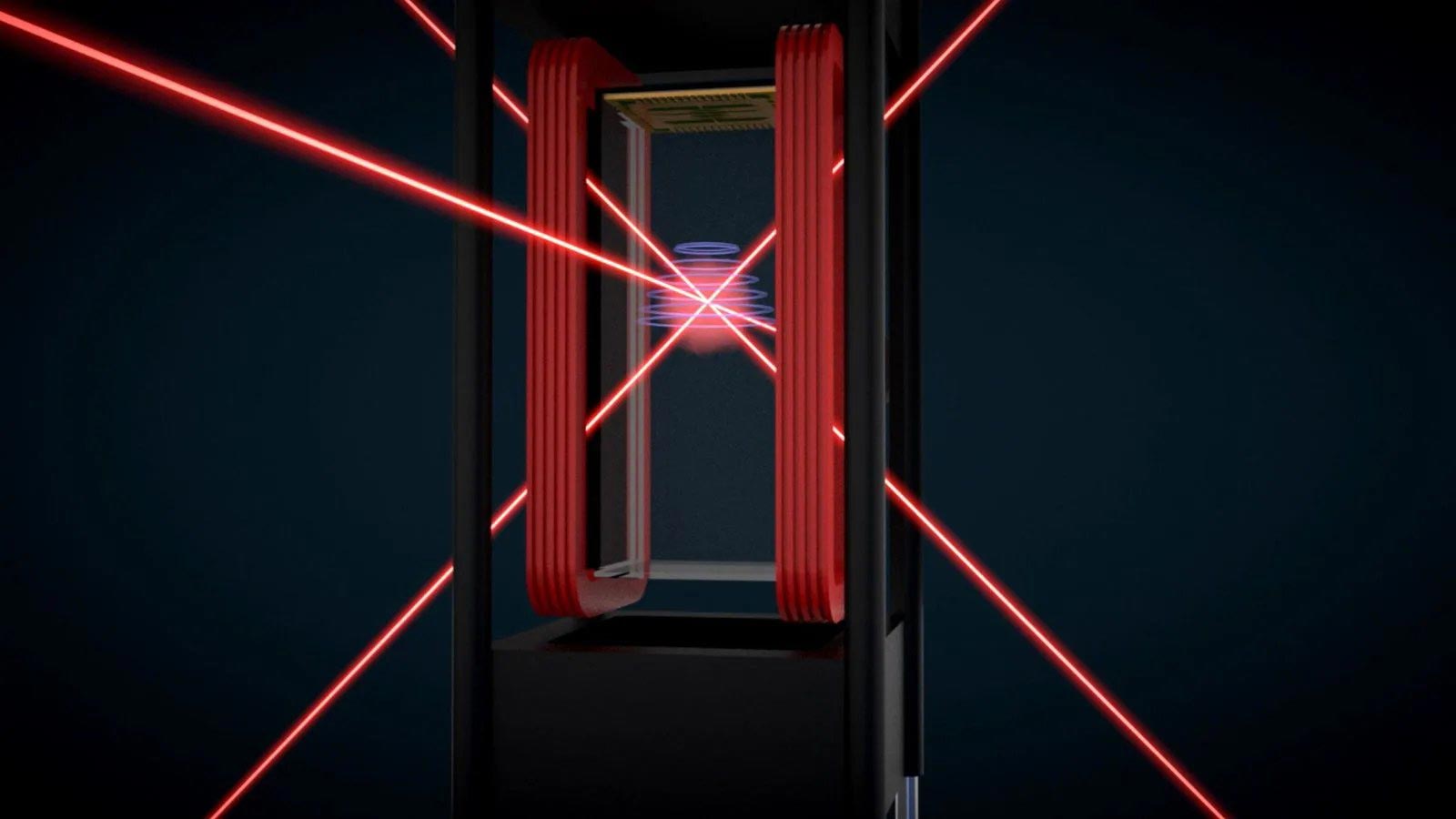
The International Space Station is now home to an even more capable quantum laboratory, where NASA cools atoms to nearly absolute zero to study one of the strangest states of matter known.
Astronauts aboard the International Space Station have activated NASA’s newly upgraded Cold Atom Lab, a unique research facility that helps scientists investigate the fundamental nature of matter while advancing the next generation of quantum technologies. Taking advantage of the station’s microgravity environment, the laboratory can perform experiments that cannot be achieved on Earth.
Quantum science focuses on the smallest building blocks of nature, including atoms, electrons, and individual particles of light. Although atoms are often pictured as tiny solid spheres, they can also behave like waves, exist in multiple places at once, and even pass through one another under the right conditions.
About the size of a minifridge and controlled remotely from Earth, the Cold Atom Lab cools atoms to temperatures below minus 459 degrees Fahrenheit (minus 237 degrees Celsius). At temperatures just above absolute zero, the atoms combine into a Bose-Einstein condensate (BEC), an unusual state of matter sometimes called the fifth state after solids, liquids, gases, and plasma. Even though a BEC is much larger than individual particles, it still follows the strange rules of quantum mechanics. The microgravity of low Earth orbit also allows these matter waves to grow larger than they can on Earth.
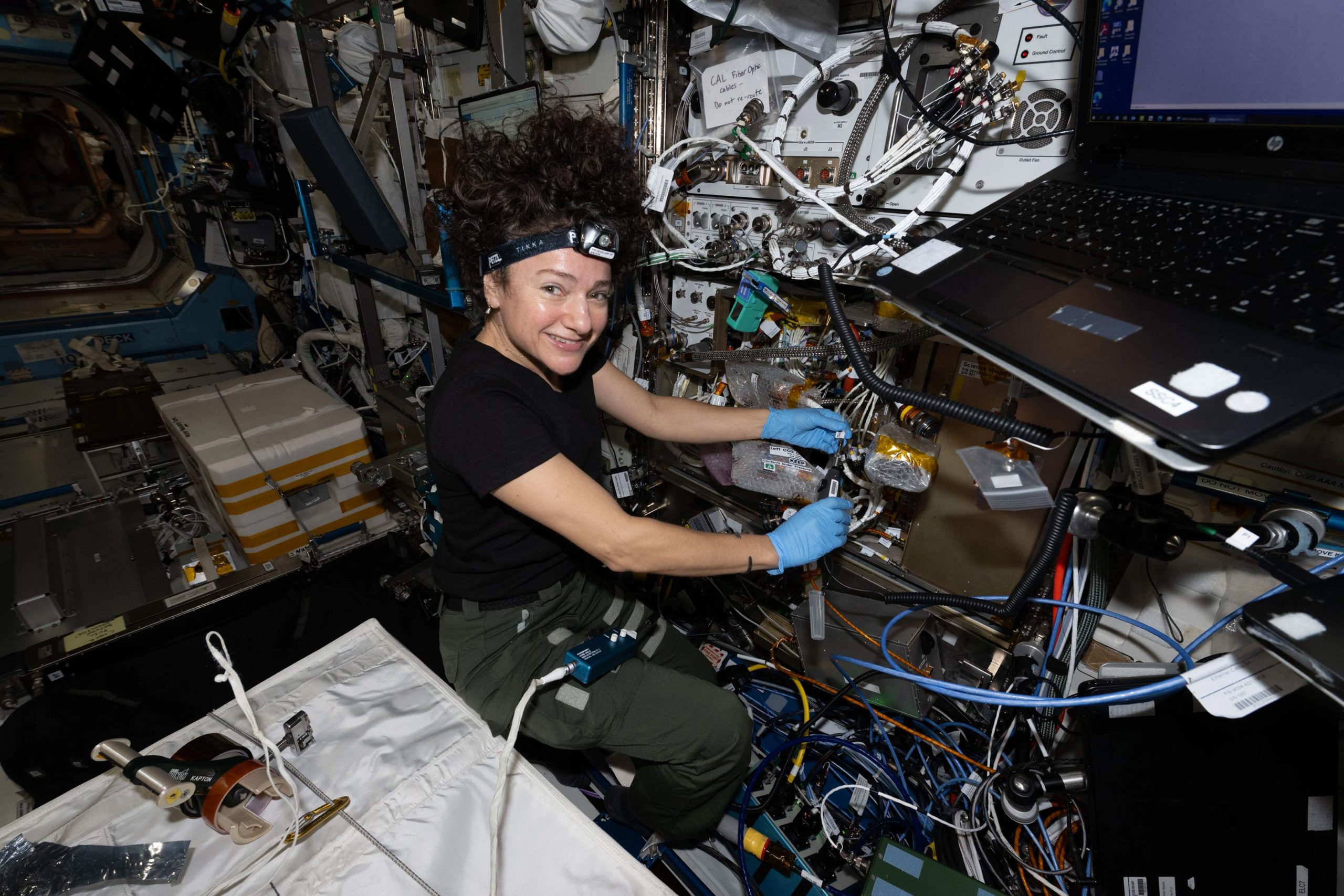
“At the coldest temperatures, matter behaves drastically different from anything we have experienced,” said Jason Williams, project scientist for Cold Atom Lab at NASA’s Jet Propulsion Laboratory in Southern California, which built the facility. “The wavelike nature of matter dominates, and ultracold matter can behave in ways that are not only unexpected, but that also enable extremely precise measurements of time, gravity, and motion. The lab has lots of tools — especially with this latest upgrade — to let us probe the nature of the universe.”
The facility currently supports five international research teams investigating fundamental physics. It also serves as a testing ground for quantum technologies that could eventually be used for Earth science missions and future space exploration.
How NASA’s Cold Atom Lab Works
The core of the Cold Atom Lab is its science module, a sophisticated collection of instruments. A newly upgraded version of this module arrived at the space station on April 11 aboard a Commercial Resupply Services mission, expanding the range of experiments scientists can perform.
Each experiment begins by heating a strip of rubidium or potassium metal to as high as 750 °F (400 °C), producing a gas inside a vacuum chamber. Scientists then fire lasers tuned to specific frequencies at the gas. The lasers remove energy from the atoms by slowing them down, dramatically lowering their temperature. After laser cooling is complete, a magnetic trap captures the atoms. Additional cooling techniques reduce their energy even further until the cloud of atoms is nearly motionless, allowing researchers to maximize the time it can be studied in microgravity.
Laboratories on Earth can also create ultracold gases, but the International Space Station provides major advantages. In orbit, scientists can observe quantum gases for longer periods and at even lower temperatures. The low-gravity environment also allows larger matter waves to form and interact with gravity for longer durations. To make these experiments possible, NASA condensed an atom physics laboratory that would normally fill an entire room of lasers, mirrors, and equipment into a single rack aboard the space station.
“As the first project to create Bose-Einstein condensates in orbit, we’re demonstrating that we can make quantum technology work reliably in space,” said Ethan Elliott, deputy project scientist for Cold Atom Lab at JPL. “In the previous century, there was a quantum revolution that led to lasers, cellphones, and MRIs for medical imaging. We’re performing quantum 2.0 — direct manipulation of large quantum states — and we hope for similar gains in quantum tech by advancing this science in orbit.”
New Upgrade Expands Quantum Research
This latest improvement marks the fourth upgrade since the Cold Atom Lab was installed aboard the International Space Station in 2018. Among the most significant changes is a redesigned magnetic trap that lets scientists alter the shape of quantum gas clouds, making it possible to investigate new properties of the atoms. Engineers also introduced redesigned metal strips that provide improved sources for creating those gas clouds.
“It’s the closest thing we have to controlling the boundary of the quantum world,” said Kamal Oudrhiri, project manager of Cold Atom Lab at JPL, referring to those low temperatures. “This new upgrade pushes that boundary even further.”
Oudrhiri said the improvements also “demonstrates NASA’s ability to maintain U.S. leadership in space-based quantum technologies while maturing future quantum instruments, such as matter-wave interferometers for fundamental physics missions, positioning, navigation, timing, and gravity sensing of Earth, the Moon, and beyond.”
Advancing Science in Space
The Cold Atom Lab is managed by Caltech in Pasadena, while NASA’s Jet Propulsion Laboratory designed, built, and continues to operate the facility. The project is sponsored by the Biological and Physical Sciences division within NASA’s Science Mission Directorate in Washington.
The division uses the unique conditions of space to carry out scientific investigations that cannot be performed on Earth. By studying biological and physical processes in these extreme environments, researchers gain the knowledge needed to support future deep space exploration while also producing discoveries and technologies that can benefit life on Earth.
Never miss a breakthrough: Join the SciTechDaily newsletter.
Follow us on Google and Google News.
2 Comments
“The microgravity of low Earth orbit also allows these matter waves to grow larger than they can on Earth.” As a lone senior lay American investigator/discoverer with a fourth radiant gravity demonstration uploaded to my ad-free video channel about a year ago (https://odysee.com/@charlesgshaver:d/5Gravity:c) and due to complete a fifth original gravity experiment soon (e.g., “6Gravity: Disproving Time Dilation”), quoting the article, I can see so-called “matter waves” growing larger in microgravity as additional proof of the radiant pulsing angular lines of attractive force nature of gravity. Again, for some, I find it’s radiant lines of gravity force, not a duality of particles and waves, that accounts for the scattering of dots in the classic double-slit experiments. Now, not only am I trying to remedy a two century old error from being perpetuated here on earth, I’m also trying to keep it confined to the earth itself. If professional researchers really want to: “…probe the nature of the universe.” then t they probably should start with understanding the true nature of gravity.
Memo 2607020444_Source 1. Reinterpretation【()】
Source 1.
https://scitechdaily.com/nasas-orbiting-quantum-lab-pushes-deeper-into-the-unknown/
1.
_NASA’s Orbiting Quantum Lab Pushes Deeper into Unknown Territory
_NASA’s upgraded Cryogenic Atom Lab has been reactivated on the International Space Station.
_This lab utilizes the unique environment of space to study the bizarre behavior of cryogenic atoms. With this latest improvement, scientists are now able to conduct new quantum experiments that are impossible on Earth.
【 () Could it be? With this research, the local scarcity principle (cpls(*) interpretation is applied to the performance of James Webb’s lenses, potentially solidifying the credibility of James Webb? Hmm. 1438.
^^^&& No matter how hard you try, isn’t this just information from space debris that has arrived at L2 around the Lagrange? My conjecture 1 is that the James Webb information observed from Lagrange points on other exoplanets may be different. Heh. 0449.
1.)
Cosmology has been developed through samples 1, 2, 3, and 4 within this cpls(*) domain, and it is similar to the lens effect where actual cosmic principles are reduced and observed trapped within the human brain. Heh. 2607030437.
2.) This is NASA’s advanced quantum experiment; the reported content is transmitted through a real-time space network for big data analysis through experiment-observation synchronization, 0452.
3.) It becomes almost identical to deep learning interpretation, an AI big data collection method that understands the fundamental properties of the universe and directly applies and utilizes collected data from the James Webb astronomical observation. 0439. Heh. 0443.
】
1-1.
The International Space Station is now equipped with a much more advanced quantum laboratory, where NASA studies one of the strangest known states of matter by cooling atoms to near absolute zero.
Astronauts aboard the International Space Station have activated NASA’s newly upgraded cold atom laboratory.
This laboratory is a unique research facility that helps scientists explore the fundamental nature of matter and advance next-generation quantum technology. Utilizing the space station’s microgravity environment, this laboratory can perform experiments that are impossible on Earth.
1-2.
Quantum science focuses on nature’s smallest components, such as atoms, electrons, and light particles. While atoms are often described as small, solid spheres, they can behave like waves, exist in multiple places simultaneously, and, under the right conditions, pass through each other.
1-3. About the size of a mini-refrigerator and remotely controlled from Earth, the cryogenic atomic laboratory cools atoms to below -459 degrees Fahrenheit (-237 degrees Celsius). At temperatures just above absolute zero, atoms combine into Bose-Einstein condensates (BECs), which are sometimes referred to as the fifth state of matter, following solid, liquid, gas, and plasma.
Although BECs are much larger than individual particles, they still follow the peculiar laws of quantum mechanics. Furthermore, the microgravity environment in low Earth orbit allows these matter waves to grow larger than they do on Earth.
2.
“At cryogenic temperatures, matter behaves completely differently from anything we have ever experienced,” said Jason Williams, a project scientist at the Cryogenic Atomic Laboratory at NASA’s Jet Propulsion Laboratory in Southern California. “The wave nature of matter is dominant, and cryogenic matter not only behaves in unexpected ways but also allows for the measurement of time, gravity, and motion with great precision. This laboratory, particularly through this latest upgrade, is now equipped with a variety of tools to explore the nature of the universe.”
2-1.
Currently, this facility supports five international research teams studying fundamental physics. It also serves as a testing ground for quantum technologies that can be utilized in Earth science missions and future space exploration.
2-2. How does NASA’s Cold Atom Laboratory work?
The core of the Cold Atom Laboratory is a science module composed of sophisticated instrumentation. A newly upgraded version of this module arrived at the International Space Station on April 11 via a commercial resupply mission, expanding the range of experiments that scientists can perform.
2-3.
Each experiment begins by heating pieces of rubidium or potassium metal to up to 400°C (750°F), a process that generates gas inside the vacuum chamber. Scientists irradiate this gas with a laser tuned to a specific frequency. The laser slows down the atoms, removing their energy and rapidly lowering their temperature. Once laser cooling is complete, the atoms are captured using magnetic traps. By using additional cooling techniques to further lower the energy of the atomic cloud to a near-stationary state, researchers can study the atomic cloud for as long as possible in a microgravity environment.
========
B1.
While cryogenic gases can be created in laboratories on Earth, the International Space Station offers several significant advantages. In orbit, scientists can observe quantum gases for longer periods and at much lower temperatures.
Additionally, thanks to the low-gravity environment, larger matter waves are formed, allowing them to interact with gravity for longer durations. To make these experiments possible, NASA has compressed an atomic physics laboratory—enough to fill an entire room with lasers, mirrors, and equipment—into a single rack on the space station.
2.
“As the first project to generate Bose-Einstein condensates in orbit, we are demonstrating that quantum technology can operate reliably in space,” said Ethan Elliott, Associate Scientist at JPL’s Cold Atom Lab.
2-1.
“In the last century, there was a quantum revolution that gave birth to lasers, mobile phones, and MRI for medical imaging. We are implementing Quantum 2.0—technology that directly manipulates massive quantum states—and by advancing this science in orbit, we expect to achieve similar results in the field of quantum technology.”
2-2. New Upgrades Expand the Scope of Quantum Research.
These latest improvements are the fourth upgrade since the Cold Atom Lab was installed on the International Space Station in 2018. One of the most significant changes is a redesigned magnetic trap that allows scientists to alter the shape of quantum gas clouds, enabling them to study new properties of atoms. Additionally, engineers have introduced new metal strips that are more effective at generating gas clouds.
“That is the closest we have come to controlling the boundaries of the quantum world,” said Kamal Oudrich, project manager at JPL’s Cold Atomic Research Laboratory, referring to the cryogenic environment. “This new upgrade will further expand those boundaries.”
2-3.
Oudrich stated that these improvements “demonstrate NASA’s ability to maintain U.S. leadership in space-based quantum technology while advancing future quantum instruments for fundamental physics missions, such as matter-wave interferometers, position measurement, navigation, time measurement, and gravity sensing on Earth, the Moon, and beyond.”
3. Advancement of Space Science
The Cold Atomic Research Laboratory is managed by the California Institute of Technology (Caltech), with NASA’s Jet Propulsion Laboratory (JPL) responsible for its design, construction, and operation. The project is sponsored by the Division of Biological and Physical Sciences within NASA’s Science Mission Directorate in Washington.
3-1.
This division utilizes the unique environment of space to conduct scientific research that is impossible on Earth. By studying biological and physical processes in these extreme environments, researchers gain the knowledge needed to support future deep space exploration, while simultaneously developing discoveries and technologies that can benefit life on Earth.