
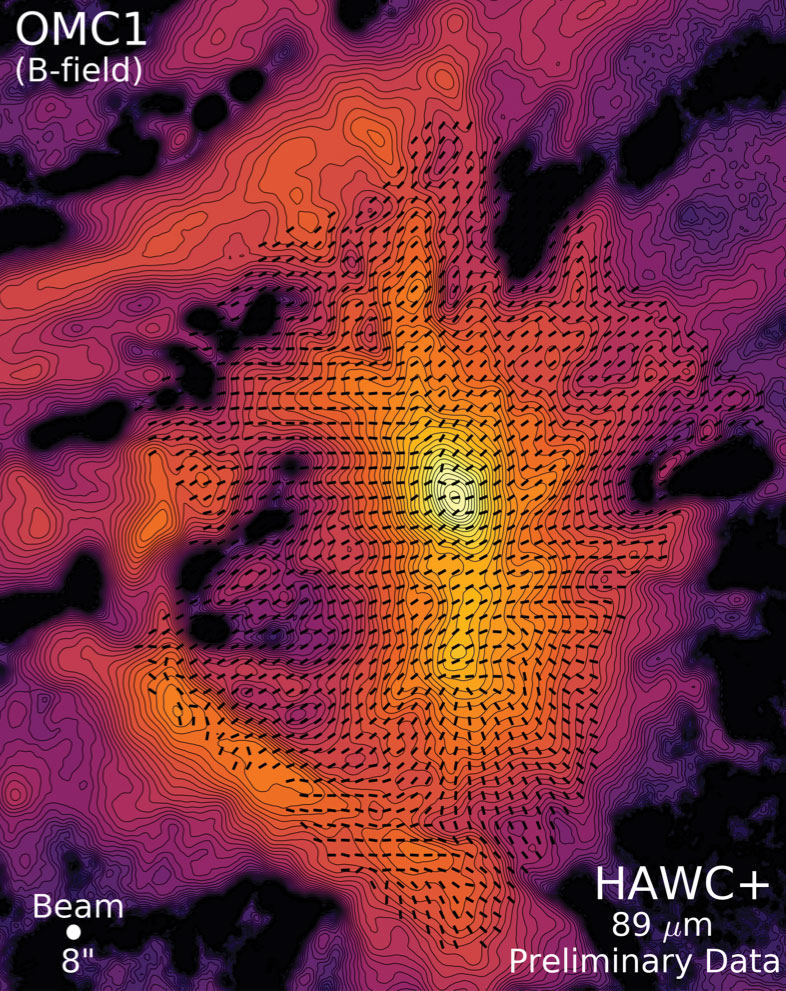
NASA’s Stratospheric Observatory for Infrared Astronomy, SOFIA, is preparing for its 2018 observing campaign, which will include observations of celestial magnetic fields, star-forming regions, comets, Saturn’s giant moon Titan and more.
This will be the fourth year of full operations for SOFIA, with observations planned between February 2018 and January 2019. Research flights will be conducted primarily from SOFIA’s home base at NASA’s Armstrong Flight Research Center. Highlights from these observations include:
- The observatory’s newest instrument, the High-resolution Airborne Wideband Camera-Plus, called HAWC+, will continue research with its polarimeter, a device that measures the alignment of incoming light waves. These investigations will help researchers understand how magnetic fields affect the rate at which interstellar clouds condense to form new stars.
- One such program will use the instrument to understand the impact magnetic fields have on stars forming inside a dark cloud, a stellar nursery filled with dust and molecules, called L1448.
- The HAWC+ instrument will also be used in a joint research program with the Atacama Large Millimeter/submillimeter Array to trace magnetic fields to better understand how planets form.
- Another program using the HAWC+ instrument will help astronomers better understand how energetic, active black holes contribute to the most luminous, distant galaxies. These observations will help them learn whether the luminosity of these active black holes is driven by star formation or accretion of material onto the central black hole.
- Researchers will continue to search for methane on Mars. SOFIA will conduct observations during the same Martian season that the Curiosity Rover previously detected the gas to better understand how methane levels change with the Red Planet’s seasons.
- Another team of researchers is planning to study comet 46P/Writanen as it passes close to the Earth, to search for clues in the comet’s dust that may help better understand the evolution of the early solar system.
In June and July, SOFIA will return to Christchurch, New Zealand, to study objects that are best viewed from the Southern Hemisphere, including neighboring galaxies the Large and Small Magellanic Clouds. Observations planned while operating from there include:
- Researchers will create a large-scale map of the biggest star-forming region in the Large Magellanic Cloud, 30 Doradus, (also known as the Tarantula Nebula.) This map will be used as a template for understanding bursts of star formation that are the origin of a large part of the stars in all galaxies.
- The HAWC+ instrument will be onboard SOFIA for its first observations from the Southern Hemisphere, to study magnetic fields in star-forming regions and around black holes in the Large and Small Magellanic Clouds.
- Researchers will utilize SOFIA’s mobility to study the atmosphere of Saturn’s moon Titan by studying its shadow as it passes in front of a star during an eclipse-like event called an occultation. These occultation observations are part of an effort to monitor changes in Titan’s atmosphere over time now that the Cassini spacecraft’s mission has ended.
SOFIA is a Boeing 747SP jetliner modified to carry a 100-inch diameter telescope. It is a joint project of NASA and the German Aerospace Center, DLR. NASA’s Ames Research Center in California’s Silicon Valley manages the SOFIA program, science and mission operations in cooperation with the Universities Space Research Association headquartered in Columbia, Maryland, and the German SOFIA Institute (DSI) at the University of Stuttgart. The aircraft is based at NASA’s Armstrong Flight Research Center’s Hangar 703, in Palmdale, California.
Never miss a breakthrough: Join the SciTechDaily newsletter.
Follow us on Google and Google News.