
Close Menu
    Facebook X (Twitter) Instagram
    SciTechDaily
    • Biology
    • Chemistry
    • Earth
    • Health
    • Physics
    • Science
    • Space
    • Technology
    Facebook X (Twitter) Pinterest YouTube RSS
    SciTechDaily
    Home»Space»Magnetic Fields May Help Solve Mysteries at the Center of Our Galaxy That We Can’t Explain With Gravity
    Space

    Magnetic Fields May Help Solve Mysteries at the Center of Our Galaxy That We Can’t Explain With Gravity

    By NASAJune 8, 2020No Comments5 Mins Read
    Facebook Twitter Pinterest Telegram LinkedIn WhatsApp Email Reddit
    Share
    Facebook Twitter LinkedIn Pinterest Telegram Email Reddit
    Composite Sagittarius A
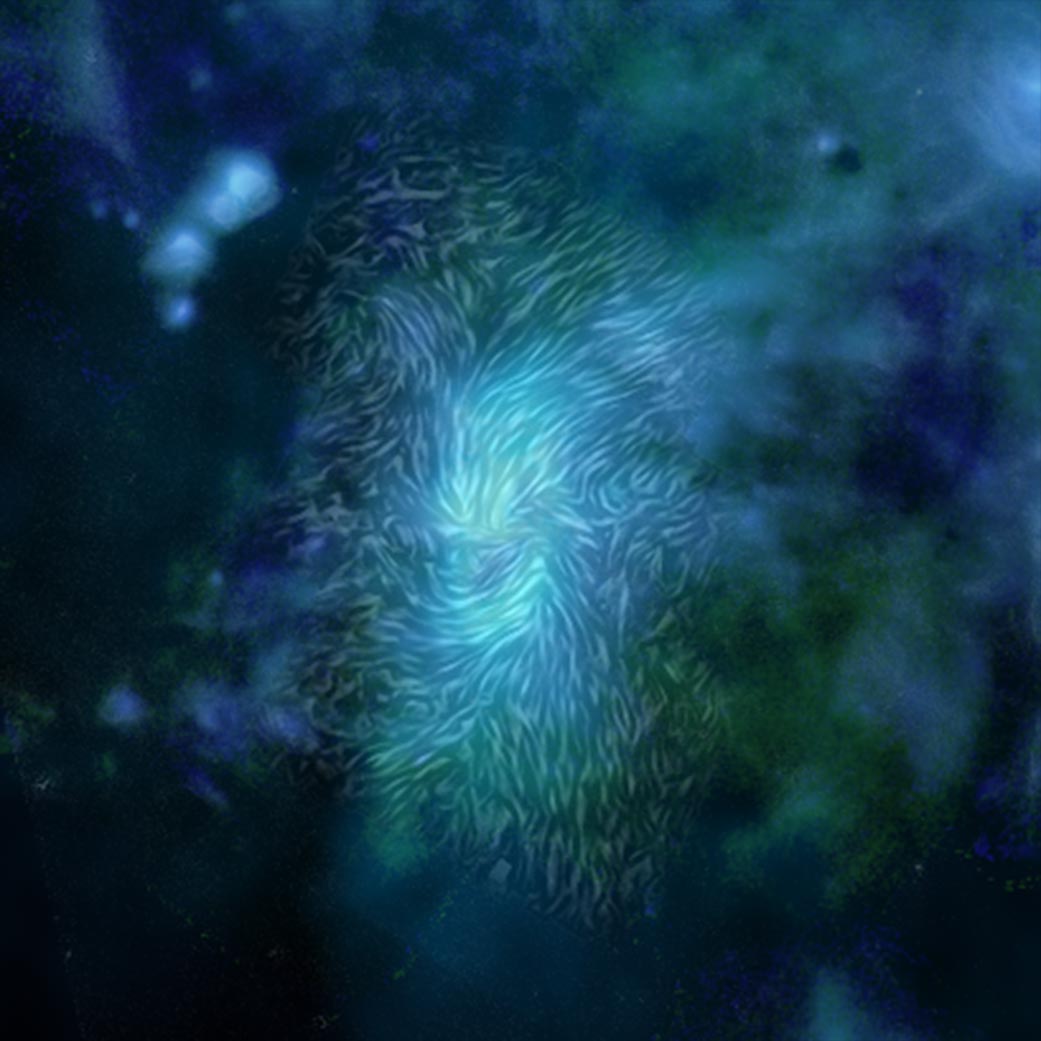
    A composite image of the central region of our Milky Way galaxy, known as Sagittarius A. SOFIA found that magnetic fields, shown as streamlines, are strong enough to control the material moving around the black hole, even in the presence of enormous gravitational forces. This can help answer long-standing, fundamental questions about the galactic center region: why the star formation rate is significantly lower than expected and why our galaxy’s black hole is quieter than those in other galaxies. SOFIA data is shown in green (37 microns) and dark blue (25 and 53 microns). The light blue is from Herschel Space Observatory (70 microns) and the gray is from the Hubble Space Telescope. Credit: NASA/SOFIA/L. Proudfit; ESA/Herschel; Hubble Space Telescope

    The area around the supermassive black hole at the center of our Milky Way galaxy is dominated by gravity, but it’s not the only force at play. According to new research from NASA’s airborne telescope, the Stratospheric Observatory for Infrared Astronomy, or SOFIA, magnetic fields may be strong enough to control material moving around the black hole. 

    The research, presented this week at a meeting of the American Astronomical Society, could help answer longstanding mysteries about why our black hole is relatively quiet compared to others, and why the formation of new stars in our galaxy’s core is lower than expected. 

    Using its newest infrared instrument to study celestial dust grains, which align perpendicular to magnetic field lines, SOFIA was able to produce detailed maps of our galactic center, showing the behavior of these otherwise invisible magnetic fields around the black hole.

    “There are still aspects of our galaxy’s black hole that we can’t explain with gravity alone,” said Joan Schmelz, SOFIA senior science advisor and director at the Universities Space Research Association, in Columbia Maryland. “Magnetic fields may be able to help solve these mysteries.”

    Scientists have often relied on gravity to explain their results because measuring celestial magnetic fields is extremely challenging. But the data from SOFIA now compel scientists to consider their role. Magnetic fields control the plasma of the solar atmosphere, called the corona, because the pressure created by magnetic fields is greater than the pressure created by heat, or thermal pressure. In the Sun’s corona, the dominance of magnetic pressure creates dramatic loops and powerful flares. The research team is using SOFIA’s data to study the pressure created by magnetic fields at the center of our galaxy. They found that the magnetic pressure is greater than the thermal pressure created by gas in the region, and therefore may be strong enough to control matter in a way that’s similar to the solar corona.

    More research is needed to understand magnetic fields’ role at the center of our galaxy and how these strong forces fit in with gravity. However, these preliminary results can enhance our understanding of at least two long-standing, fundamental questions about star formation and black hole activity in our galactic center region. Even though there’s plenty of raw material to form stars, the star formation rate is significantly lower than expected. Additionally, our black hole is relatively quiet compared to those at the centers of many other galaxies. The strong magnetic field could explain both — it could keep the black hole from swallowing the matter it needs to form jets and also suppress the birth of stars.
    High-Resolution Airborne Wideband Camera-Plus
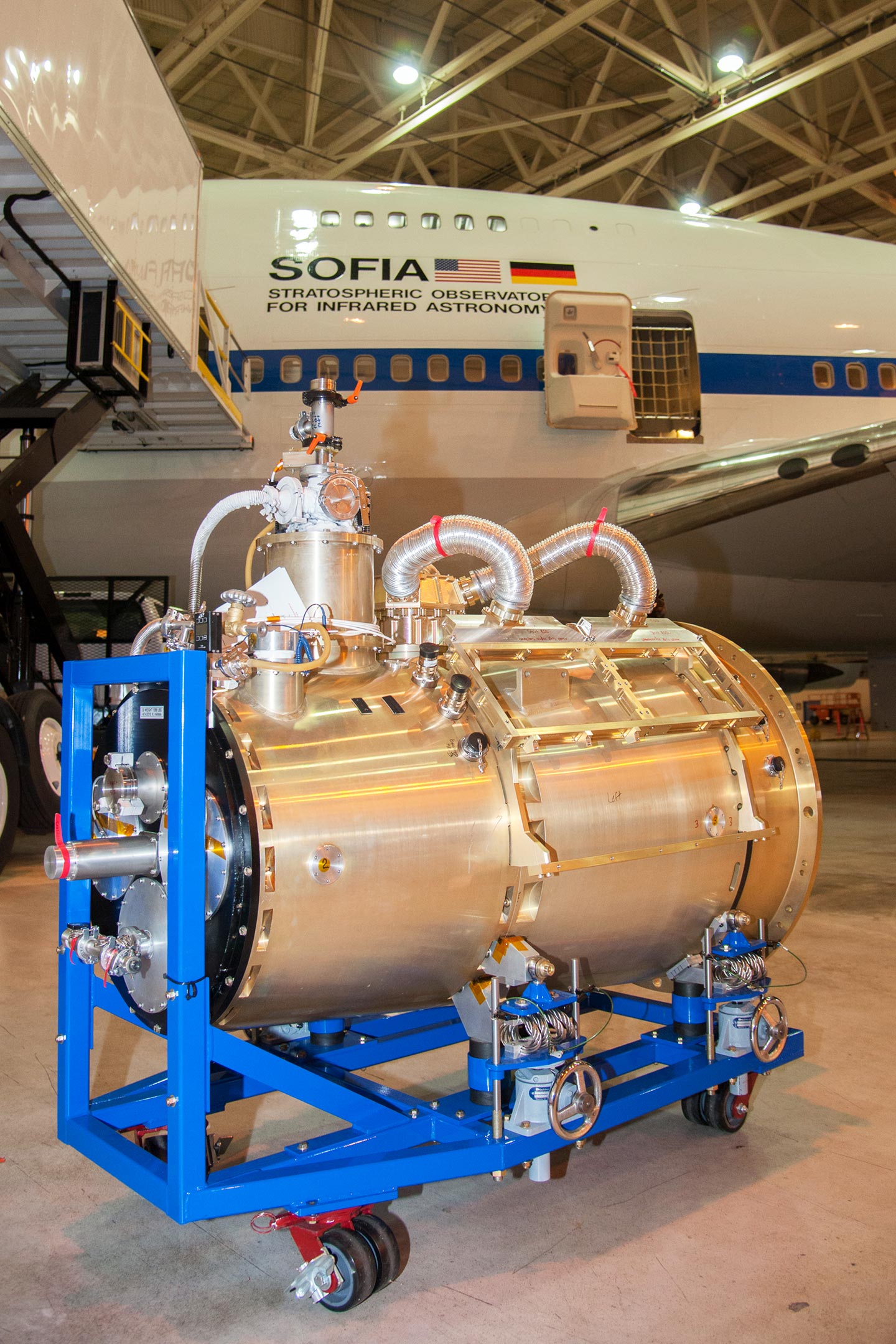
    A new instrument, an infrared camera called the High-resolution Airborne Wideband Camera-Plus (HAWC+), was installed on the Stratospheric Observatory for Infrared Astronomy, SOFIA, in 2017. This is the only currently operating astronomical camera that makes images using far-infrared light, allowing studies of low-temperature early stages of star and planet formation. HAWC+ includes a polarimeter, a device that measures the alignment of incoming light waves. With the polarimeter, HAWC+ can map magnetic fields in star forming regions and in the environment around the supermassive black hole at the center of the Milky Way galaxy. Credit: SOFIA Science Center, NASA’s Ames Research Center

    Studying magnetic fields in the far reaches of the galaxy and beyond requires remote observations by telescopes like SOFIA. Flying at an altitude of 45,000 feet, above 99% of the Earth’s water vapor, SOFIA is able to capture a unique view of the infrared universe, while landing after each flight so that it can be upgraded with the latest technology. For this result, SOFIA used the High-resolution Airborne Wideband Camera-Plus, or HAWC+ instrument, which was built at NASA’s Jet Propulsion Laboratory in Pasadena, California, to study magnetic fields. 

    “The data provide the most detailed look yet at the magnetic fields surrounding our galaxy’s central black hole,” said David Chuss, a coauthor of the paper at Villanova University in Pennsylvania. “The HAWC+ instrument has improved the resolution by a factor of 10 and increased the sensitivity, which represents a revolutionary step forward.”

    NASA SOFIA
    SOFIA soars over the snow-covered Sierra Nevada mountains with its telescope door open during a test flight. SOFIA is a modified Boeing 747SP aircraft. Credit: NASA/Jim Ross

    SOFIA, the Stratospheric Observatory for Infrared Astronomy, is a Boeing 747SP jetliner modified to carry a 106-inch diameter telescope. It is a joint project of NASA and the German Aerospace Center, DLR. NASA’s Ames Research Center in California’s Silicon Valley manages the SOFIA program, science and mission operations in cooperation with the Universities Space Research Association headquartered in Columbia, Maryland, and the German SOFIA Institute (DSI) at the University of Stuttgart. The aircraft is maintained and operated from NASA’s Armstrong Flight Research Center Building 703, in Palmdale, California.

    Never miss a breakthrough: Join the SciTechDaily newsletter.
    Follow us on Google and Google News.

    Astronomy Astrophysics Milky Way NASA SOFIA
    Share. Facebook Twitter Pinterest LinkedIn Email Reddit

    Related Articles

    Hypervelocity Escape: NASA Spots Mysterious Object Moving at 1 Million Miles per Hour

    HAWC+ Reveals Magnetic Chaos Hidden Within the Whirlpool Galaxy

    Shedding Light on a Galactic Mystery That Has Long Puzzled Scientists

    Mystery As Hubble Finds Milky Way Raids Intergalactic ‘Bank Accounts’

    NASA’s SOFIA Set To Study New Frontiers in the Solar System and Beyond

    Hubble Discovers Two Dwarf Galaxies Moving into the Milky Way

    Astronomers Reveal the Rotation of the Hot Gas Around the Milky Way

    Planck Space Telescope Reveals the Magnetic Field Lines of the Milky Way

    Hubble Reveals the First Visual Evidence of Changes in the Milky Way

    Leave A Reply Cancel Reply

    • Facebook
    • Twitter
    • Pinterest
    • YouTube

    Don't Miss a Discovery

    Subscribe for the Latest in Science & Tech!

    Trending News

    Popular Supplement Ingredient Linked to Shorter Lifespan in Men

    Scientists May Have Found a Way To Repair Nerve Damage in Multiple Sclerosis

    “Totally Unexpected” – Scientists Discover Pancreatic Cancer’s Fatal Addiction

    A Strange Quantum Effect May Explain One of Biology’s Greatest Mysteries

    James Webb Telescope Reveals the Universe’s Hidden Cosmic Web in Stunning Detail

    Scientists Identify Simple Supplement That Greatly Reduces Alzheimer’s Damage

    You May Have a Dangerous Type of Cholesterol Even if Your Tests Look Normal

    Your Blood Pressure Reading Could Be Wrong Because of One Simple Mistake

    Follow SciTechDaily
    • Facebook
    • Twitter
    • YouTube
    • Pinterest
    • Newsletter
    • RSS
    SciTech News
    • Biology News
    • Chemistry News
    • Earth News
    • Health News
    • Physics News
    • Science News
    • Space News
    • Technology News
    Recent Posts
    • Scientists Discover Testosterone Could Actually Protect Against Deadly Brain Cancer
    • Mediterranean Diet May Activate Secret Anti-Aging Proteins Inside Your Cells
    • Scientists Reveal That Eating Almonds Every Day Could Transform Your Gut, Metabolism, and Appetite
    • Researchers Found a Surprisingly Realistic Way To Mine Asteroids for Mars
    • Europe Just Unveiled a Serious Rival to SpaceX’s Starship
    Copyright © 1998 - 2026 SciTechDaily. All Rights Reserved.
    • Science News
    • About
    • Contact
    • Editorial Board
    • Privacy Policy
    • Terms of Use

    Type above and press Enter to search. Press Esc to cancel.