
Astronomers from NASA’s Stratospheric Observatory for Infrared Astronomy, SOFIA, Northwestern University, and the University of Maryland were on hand at the 231st meeting of the American Astronomical Society in Washington, D.C., to discuss new scientific results describing how their studies of dust grain polarization and celestial magnetic fields are leading to a better understanding of star formation, theories about how gas cools in the interstellar medium, and how magnetic fields are creating stellar winds around black holes.
The science results were obtained using SOFIA, a highly modified Boeing 747SP jetliner fitted with a 100-inch (2.5-meter) infrared telescope. SOFIA is an international partnership between NASA and the German Aerospace Center (DLR).
The flying observatory has a suite of seven different instruments – cameras and spectrometers – that are flown into the stratosphere to altitudes as high as 45,000 feet (13.7 km) on missions up to 10 hours in duration. This altitude puts the observatory above more than 99 percent of the Earth’s water vapor that blocks infrared wavelengths from reaching the ground. SOFIA’s ability to study mid- and far-infrared wavelengths (28-320 microns) provides data that cannot be obtained by any other current astronomical facility on the ground or in space, including those now under development.
“SOFIA’s unique suite of instruments provides researchers with the ability to gain new insights into the infrared universe,” said Kimberly Ennico Smith, SOFIA project scientist at NASA Ames Research Center in Mountain View, California. “We are now seeing results from the most recent instrument to come on line, the new High-resolution Airborne Wideband Camera (HAWC+), as well as the upgraded German Receiver for Astronomy at Terahertz Frequencies (GREAT/upGREAT). These tools are expanding our knowledge about how stars form, the impact of magnetic fields on these processes, and the chemical compounds that are the raw material for new stars.”
B-G Andersson • USRA/SOFIA
SOFIA/HAWC+ Polarization in the Envelope IRC+10216
Astronomers assume that the polarization maps that we observe with instruments, such as HAWC+, trace magnetic fields in space. To understand the polarization in detail, astronomers need to understand which grains contribute to the polarization, which do not, and under what conditions. One theory about how these grains behave is known as the Radiative Alignment Torque (RAT) theory. Andersson presented the results of two recent tests supporting the RAT theory.
Fabio Santos • Northwestern University
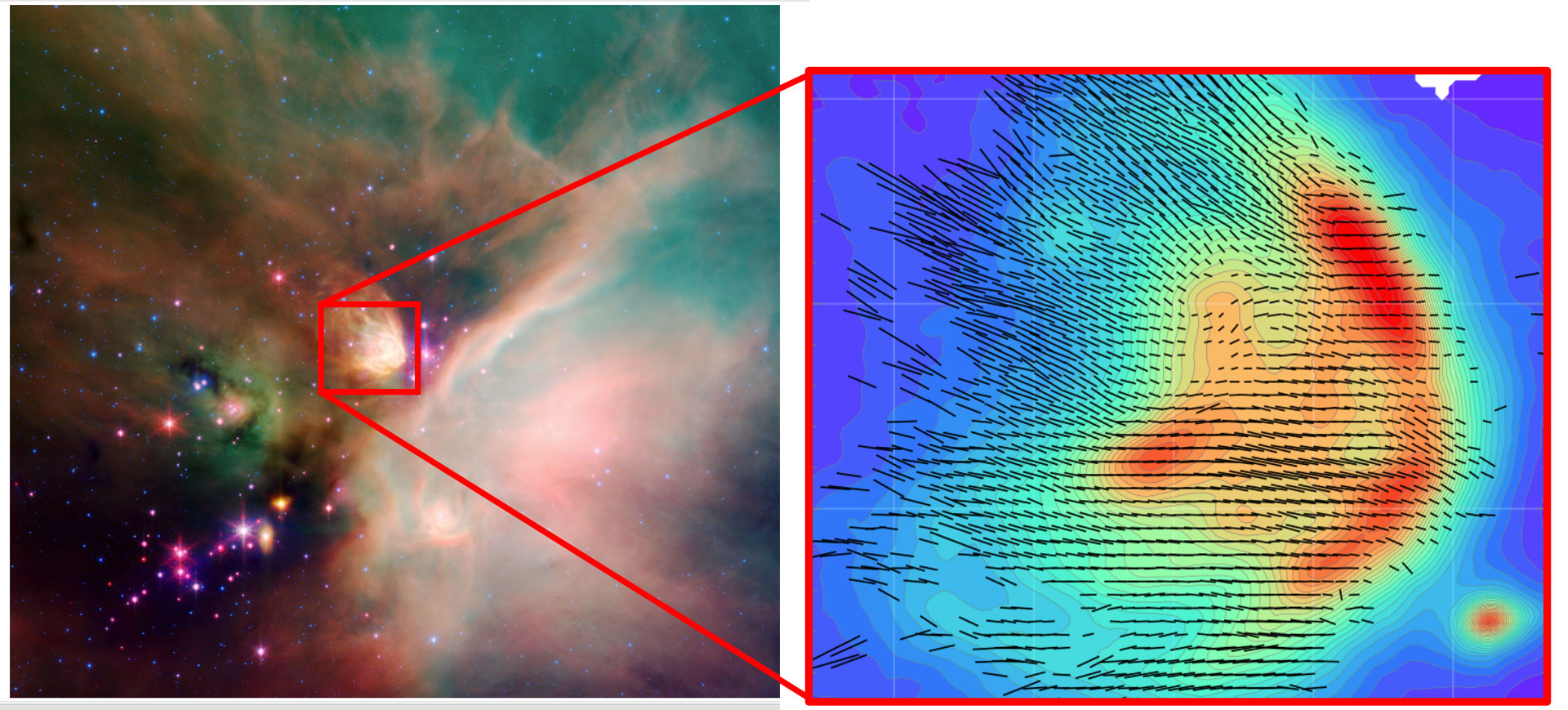
HAWC+/SOFIA Observations of Rho Oph A: Far-Infrared Polarization Spectrum Scientists have observed one of the closest star-forming regions to our Solar System, known as Rho Ophiuchi, located approximately 424 light-years away. In the central parts of the cloud, known as Rho Oph A, several young stars are currently being formed, some of which will probably become stars with planetary systems much like our Sun. With HAWC+, researchers at Northwestern University have observed for the first time that systematic variations of the far-infrared polarization spectrum exist within an interstellar cloud.
Enrique Lopez-Rodriguez • USRA/SOFIA
A Far-Infrared View of Active Galactic Nuclei with SOFIA/HAWC+
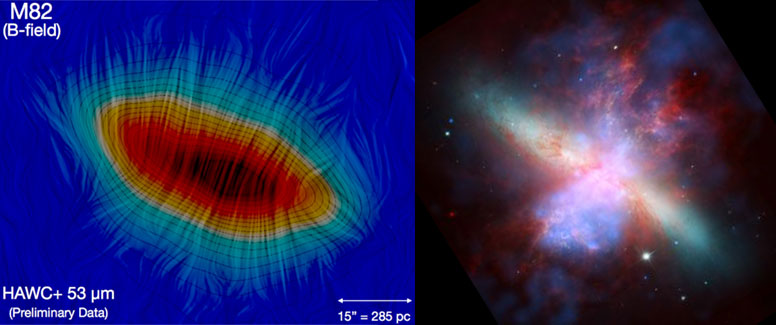
HAWC+ has opened a new window to explore active galactic nuclei (AGN) and starburst galaxies, providing the best angular resolution and polarimetric capability within the 50-220 micron range. Lopez-Rodriguez presented preliminary results of AGN and starburst galaxies observed with the far-infrared polarimeter HAWC+ onboard SOFIA. These observations of NGC 1068 at 53 microns have shown, for the first time, a magnetized arm along the spiral inner arm of the galaxy.

Elizabeth Tarantino • University of Maryland – College Park
Characterizing the Multi-Phase Origin of the [CII] Emission in M101 and NGC 6946 with GREAT
The interstellar medium (ISM) found between stars is the building block from which future stars will form. A common mechanism to cool down the gas in the ISM is through radiation from singly ionized carbon. Ionized carbon radiation can arise from three phases of the ISM: molecular gas, atomic gas, and ionized gas. Unraveling which phase the ionized carbon emission comes from and how it is dependent on environment is crucial for understanding the initial stages of star formation. This separation is better done with the GREAT instrument on SOFIA, which has the unique capability to measure the far-IR ionized carbon line at high spectral resolution.
“SOFIA’s suite of new and upgraded instruments are now providing the astronomical community with unprecedented sensitivity and spatial resolution at mid- and far-infrared wavelengths,” said USRA’s Director of SOFIA Science Mission Operations Harold “Hal” Yorke. “We can now explore a wide range of science questions that cannot be examined anywhere else in the world.”
Never miss a breakthrough: Join the SciTechDaily newsletter.
Follow us on Google and Google News.