
Close Menu
    Facebook X (Twitter) Instagram
    SciTechDaily
    • Biology
    • Chemistry
    • Earth
    • Health
    • Physics
    • Science
    • Space
    • Technology
    Facebook X (Twitter) Pinterest YouTube RSS
    SciTechDaily
    Home»Technology»NASA’s X1 Robotic Exoskeleton to Help Astronauts in Space
    Technology

    NASA’s X1 Robotic Exoskeleton to Help Astronauts in Space

    By SciTechDailyOctober 15, 20121 Comment2 Mins Read
    Facebook Twitter Pinterest Telegram LinkedIn WhatsApp Email Reddit
    Share
    Facebook Twitter LinkedIn Pinterest Telegram Email Reddit
     the X1 Robotic Exoskeleton
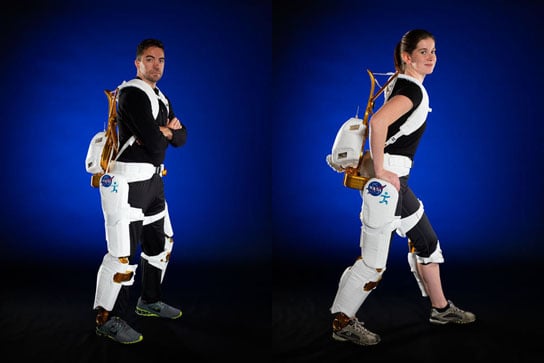
    Project Engineers Roger Rovekamp and Shelley Rea demonstrate the X1 Robotic Exoskeleton for resistive exercise, rehabilitation, and mobility augmentation in the Advanced Robotics Development Lab. Credit: Robert Markowitz

    A powered exoskeleton might help astronauts accomplish superhuman tasks in orbit. NASA’s new X1 robotic exoskeleton is a direct spinoff their space-borne Robonaut 2 project, and could help astronauts stay healthy while also allowing paraplegics to walk on Earth.

    NASA and the Florida Institute for Human and Machine Cognition (IHMC) of Pensacola, Florida, as well as engineers from Oceaneering Space Systems of Houston, have jointly developed the X1. It’s a 57–pound device that humans can wear over their body to assist or inhibit movement in leg joints.

    The inhibition mode allows astronauts to use the device as a space-based exercise machine, supplying resistance against leg movement. However, the same technology can be used in reverse on the ground, potentially helping individuals walk for the first time.

    The X1 could also become critical for the human exploration of deep space. The harness reaches to the back and shoulders, while the exoskeleton is worn over the legs. The X1 has 10 degrees of freedom, four motorized joints at the hips and knees, and six passive joints allowing for sidestepping, turning, pointing and flexing. The many joint adjustments allow the X1 to be used in a variety of different ways.

    The X1 is currently in the R&D phase, focused on design, evaluation, and improvement of the existing technology. The X1 could replace common crew exercises, which are vital to keeping astronauts healthy in microgravity environments. It also has the ability to measure, record, and stream back data to flight controllers on Earth, allowing doctors to get better feedback on the crew’s exercise regimen.

    In the future, X1 could provide a robotic power boost to astronauts as they work on the surface of distant planetary bodies. If coupled with a spacesuit, X1 could provide additional force when needed during surface exploration, improving the ability to walk in a reduced-gravity environment.

    Never miss a breakthrough: Join the SciTechDaily newsletter.
    Follow us on Google and Google News.

    Astronaut Exoskeleton NASA Robotics
    Share. Facebook Twitter Pinterest LinkedIn Email Reddit

    Related Articles

    NASA Aquatic Rover, Designed to Search for Alien Life, Goes for a Drive Under the Ice

    Listen to the Sounds of Robots That Help Shape the Future of Space Exploration

    New “Morphing” Wing Could Enable More Efficient Plane Flight

    Engineers Are Developing Robotic Spacecraft to Assist Satellite Repairs in Orbit

    Engineers Developing ‘Hedgehog’ Robots That Hop and Tumble in Microgravity

    “Windbots” – The Future Explorers of Planetary Skies?

    Ape-Like RoboSimian Robot in Development

    New Robotic Platform Could Take Space Exploration to New Heights

    Robonaut 2: A Robotic Space Station Crew Member

    1 Comment

    1. Zachary Dalby on October 8, 2023 11:14 am

      In my opinion, a full-body muscle stimulator device should be incorporated into the exoskeleton that is made of microfiber nanoelectrodes that can pulsate on cells, nerves, and muscles to stimulate muscle growth and help with the retention of muscles to eliminate muscle loss in space so human missions can last longer. This can be made with exercise equipment that also helps with maintaining more natural body movements and a more comfortable spaceflight experience so astronauts do not come back to earth with weaker bone density and muscle loss. The device can be connected to the space station and be used in intervals when needed or worn constantly in long space flight missions to increase endurance. The technological advancements with this cryptosuit are unlimited if you use it similar to the ones on earth in microgravity or in the far reaches of the universe in deep space missions.

      Reply
    Leave A Reply Cancel Reply

    • Facebook
    • Twitter
    • Pinterest
    • YouTube

    Don't Miss a Discovery

    Subscribe for the Latest in Science & Tech!

    Trending News

    Millions of People Have Osteopenia Without Realizing It – Here’s What You Need To Know

    Researchers Discover Boosting a Single Protein Helps the Brain Fight Alzheimer’s

    World-First Study Reveals Human Hearts Can Regenerate After a Heart Attack

    Why Your Dreams Feel So Real Sometimes and So Strange Other Times

    This Simple Home Device May Boost Brain Power in Adults Over 40

    Enormous Prehistoric Insects Puzzle Scientists

    Scientists Develop Bioengineered Chewing Gum That Could Help Fight Oral Cancer

    After 37 Years, the World’s Longest-Running Soil Warming Experiment Uncovers a Startling Climate Secret

    Follow SciTechDaily
    • Facebook
    • Twitter
    • YouTube
    • Pinterest
    • Newsletter
    • RSS
    SciTech News
    • Biology News
    • Chemistry News
    • Earth News
    • Health News
    • Physics News
    • Science News
    • Space News
    • Technology News
    Recent Posts
    • The Milky Way Has a Hidden Edge and Scientists Finally Mapped It
    • Scientists Stunned by New Organic Molecules Found on Mars
    • Scientists Discover Evolution’s 120-Million-Year-Old “Cheat Sheet”
    • This New “Sound Laser” Could Measure Gravity With Stunning Precision
    • Quantum Breakthrough: New Algorithm Solves “Impossible” Materials in Seconds
    Copyright © 1998 - 2026 SciTechDaily. All Rights Reserved.
    • Science News
    • About
    • Contact
    • Editorial Board
    • Privacy Policy
    • Terms of Use

    Type above and press Enter to search. Press Esc to cancel.