
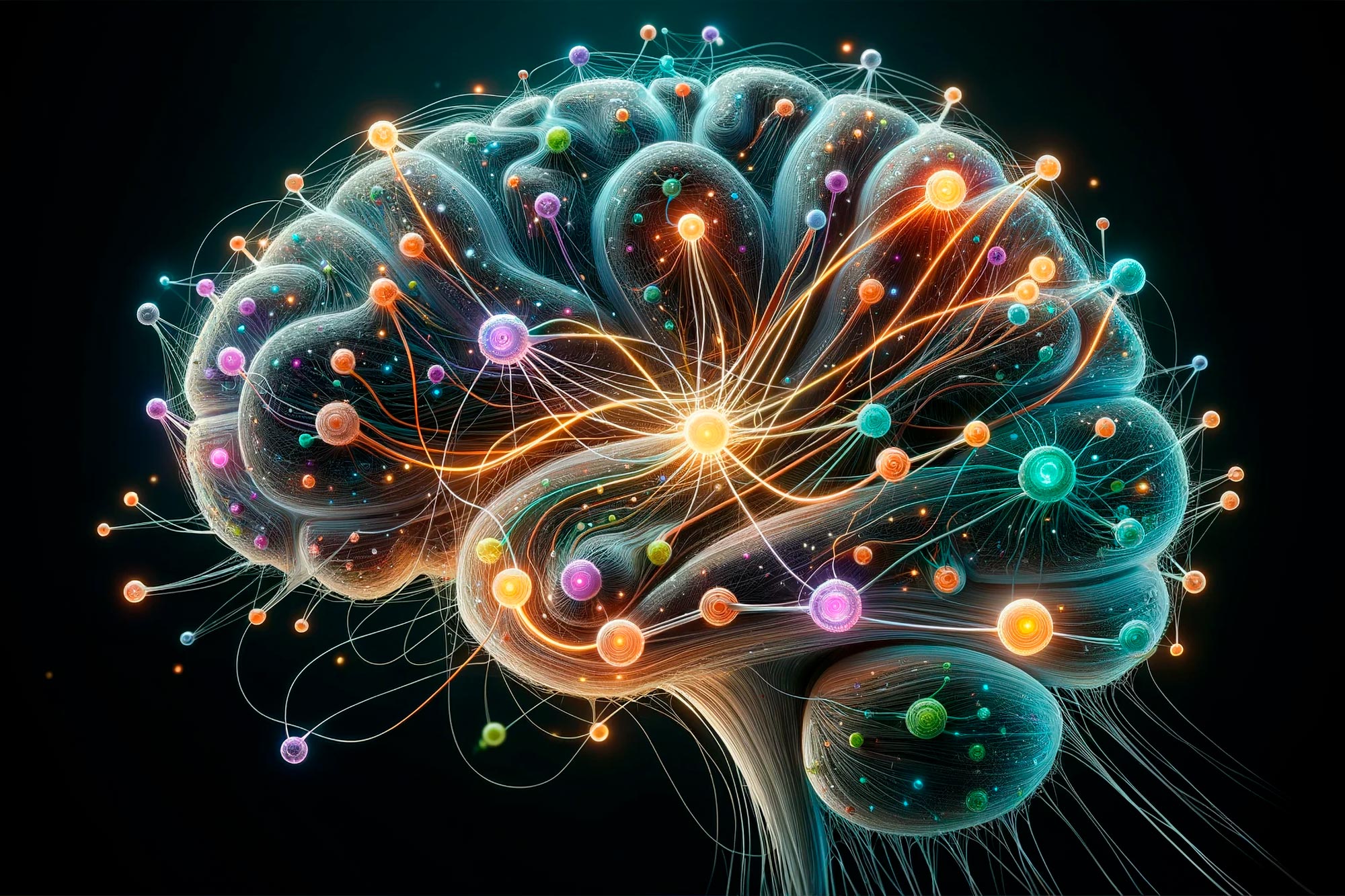
Study reveals how proteins direct nerve cell precursors to turn into specialized neurons.
Brain development is a highly orchestrated process involving numerous parallel and sequential steps. Many of these steps depend on the activation of specific genes. A team led by Christian Mayer at the Max Planck Institute for Biological Intelligence discovered that a protein called MEIS2 plays a crucial role in this process: it activates genes necessary for the formation of inhibitory projection neurons. These neurons are vital for motion control and decision-making. A MEIS2 mutation, known from patients with severe intellectual disability, was found to disrupt these processes. The study provides valuable insights into brain development and consequences of genetic mutations.
Nerve Cell Development
Nerve cells are a prime example for interwoven family relations. The specialized cells that form the brain come in hundreds of different types, all of which develop from a limited set of generalized progenitor cells – their immature ’parents’. During development, only a specific set of genes is activated in a single progenitor cell. The precise timing and combination of activated genes decide which developmental path the cell will take. In some cases, apparently identical precursor cells develop into strikingly different neurons. In others, different precursors give rise to the same nerve cell type.
The complexity is mind-blowing and not easy to disentangle in the lab. Christian Mayer and his team set out to do so nevertheless. Together with colleagues in Munich and Madrid, they now added another puzzle piece to our understanding of neuron development.
Inhibitory Cell Relations
The scientists studied the formation of inhibitory neurons that produce the neurotransmitter GABA – cells, which are known to display a broad range of diversity. In the adult brain, inhibitory neurons can act locally, or they can extend long-range axons to remote brain areas. Locally connected “interneurons” are an integral part of the cortical circuit, reciprocally linking cortical neurons. Long-range “projection neurons,” on the other hand, primarily populate subcortical regions. They contribute to motivated behavior, reward learning and decision-making. Both types, interneurons and projection neurons, originate in the same area of the developing brain. From here, the newborn neurons migrate to their final locations in the brain.
Using a barcoding approach, Christian Mayer and his team followed the family relationships between precursor cells and young inhibitory neurons. They discovered that a protein called MEIS2 plays an important role when a precursor cell ’decides’ whether it should turn into an interneuron or into a projection neuron: MEIS2 assists the cellular machinery to activate the genes that are required for a precursor cell to become a projection neuron.
A Protein With a Far-Reaching Impact
To advance this development, MEIS2 works together with another protein, known as DLX5. When MEIS2 is missing or doesn’t function correctly, the development of projection neurons is stalled and a larger fraction of precursor cells turns into interneurons instead. However, MEIS2 can’t do the job by itself. “Our experiments show that MEIS2 and DLX5 have to come together at the same time, and in the same cells,” explains Christian Mayer. “Only the combination of the two will fully activate the genes that drive projection neuron development.”
The importance of this process is underscored by previous reports on a MEIS2 variant that was found in patients with intellectual disabilities and a delayed development. Due to a small change in the MEIS2 gene, a slightly different protein is produced. The team around Christian Mayer tested this MEIS2 variant in their experiments and found that it leads to a failure to induce the specific genes needed to form projection neurons. “The inability of MEIS2 to activate the genes essential for the formation of projection neurons may contribute to neurodevelopmental disorders, such as those observed in patients with mutations in the gene encoding this protein,” says Christian Mayer.
The Complex Control by Genes
Intrigued by this discovery, the researchers delved into the mechanism by which MEIS2 activates projection neuron-specific genes. “Patients with mutations in MEIS2 suffer from a diverse range of effects, like irregularities in digits, impaired lung to brain development, or intellectual disabilities. At a first look, these symptoms have nothing in common,” relates Christian Mayer. “This shows, how important it is to understand that genes often have very different roles in different parts of the body.”
The genome has millions of non-coding regulatory elements like enhancers, promoters, and insulators. These elements don’t actually code for proteins themselves, but they act like switches, controlling when and where genes turn on and off. “Enhancers, which are part of the genome, are like interpreters in the cell. If MEIS2 and DLX5 are present together, a specific set of enhancers becomes active. It is this specific set of enhancers that induces projection neuron genes in the brain. In other parts of the body, MEIS2 interacts with other proteins to induce different sets of enhancers,” explains Christian Mayer.
Recent large-scale whole exome sequencing studies in patients have provided a systematic and highly reliable identification of risk genes for neurodevelopmental disorders. Future studies focusing on the molecular interactions between the proteins encoded by these risk genes, such as MEIS2, will pave the way for a comprehensive understanding of the biological mechanisms underlying neurodevelopmental disorders.
Reference: “Spatial enhancer activation influences inhibitory neuron identity during mouse embryonic development” by Elena Dvoretskova, May C. Ho, Volker Kittke, Florian Neuhaus, Ilaria Vitali, Daniel D. Lam, Irene Delgado, Chao Feng, Miguel Torres, Juliane Winkelmann and Christian Mayer, 25 March 2024, Nature Neuroscience.
DOI: 10.1038/s41593-024-01611-9
Never miss a breakthrough: Join the SciTechDaily newsletter.
Follow us on Google and Google News.