
Close Menu
    Facebook X (Twitter) Instagram
    SciTechDaily
    • Biology
    • Chemistry
    • Earth
    • Health
    • Physics
    • Science
    • Space
    • Technology
    Facebook X (Twitter) Pinterest YouTube RSS
    SciTechDaily
    Home»Biology»Neurotransmitter Levels in the Brain Predict Math Ability
    Biology

    Neurotransmitter Levels in the Brain Predict Math Ability

    By PLOSJuly 22, 20211 Comment3 Mins Read
    Facebook Twitter Pinterest Telegram LinkedIn WhatsApp Email Reddit
    Share
    Facebook Twitter LinkedIn Pinterest Telegram Email Reddit
    Neurotransmitter Levels Predict Math Ability
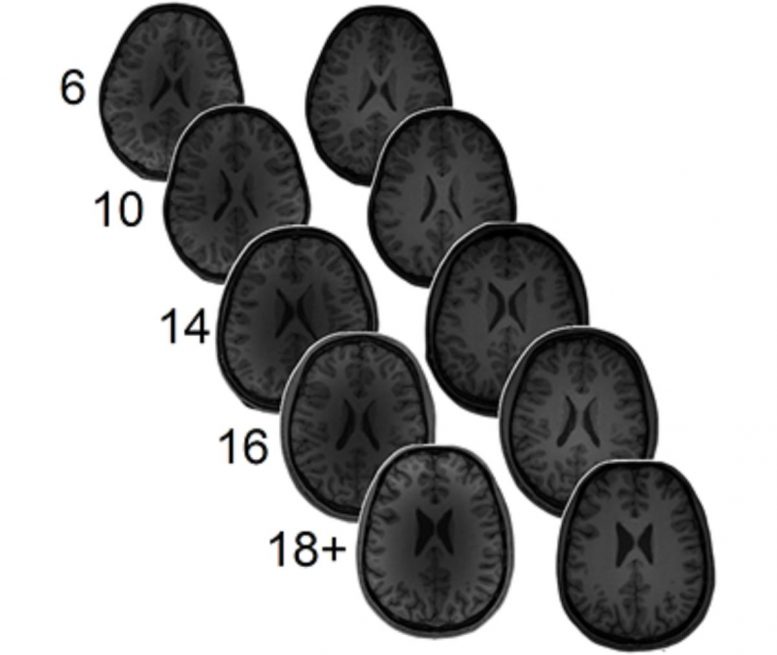
    Scanning was completed both during Time 1 and Time 2 (approximately 1.5 years later) in each of the 5 age groups (6-year-olds, 10-year-olds, 14-year-olds, 16-year-olds, and 18+-year-olds). Credit: Zacharopoulos G, et al., 2021, PLOS Biology, CC-BY 4.0

    Glutamate and GABA in the brain have reverse relationships with math ability, which switch during development.

    The neurotransmitters GABA and glutamate have complementary roles — GABA inhibits neurons, while glutamate makes them more active. Published today (July 22nd, 2021) in PLOS Biology, researchers led by Roi Cohen Kadosh and George Zacharopoulos from the University of Oxford show that levels of these two neurotransmitters in the intraparietal sulcus of the brain can predict mathematics ability. The study also found that the relationships between the two neurotransmitters and arithmetic fluency switched as children developed into adults.

    Levels of brain excitement/inhibition are thought to be related to learning, especially during critical periods. However, little is known about how they are related to complex learning that can take place over decades. To address this issue, the researchers measured the levels of GABA and glutamate in 255 people, ranging from 6-year-olds to university students. The participants also took two math achievement tests, and their performance on the arithmetic problems were correlated with the GABA and glutamate levels.

    Changing Neurotransmitter Effects From Childhood to Adulthood

    The team found that among young people, higher GABA levels in the left intraparietal sulcus of the brain (a fold in the top, left, back part of the brain) were associated with greater math fluency, while the reverse was true for glutamate. In adults, the results were almost exactly opposite; low GABA concentrations were related to greater math fluency, and again, the reverse was true for glutamate. Because the participants were tested twice about 1.5 years apart, the researchers were also able to show that neurotransmitter levels at the time of the first test could predict math achievement at the later date.

    Much of what we know about GABA, glutamate, and learning comes from rodent experiments in the lab, which cannot say anything directly about natural school-based skills such as mathematics that develop over time. This longitudinal study in humans will help researchers better understand the relationship between learning and brain plasticity, particularly during critical periods that might span years.

    Cohen Kadosh adds, “Our finding of developmental switches in the link between GABA and glutamate and academic achievement highlights a general, unknown principle of plasticity. In contrast to previous studies on humans or animals that focused on narrower developmental stages, our cross-sectional-longitudinal study suggests that the link between plasticity and brain excitation and inhibition across different stages is unlikely to be immutable. Our findings have also important implications for the development of brain-based interventional programs, which we hope to examine in the future.”

    Reference: “Predicting learning and achievement using GABA and glutamate concentrations in human development” by George Zacharopoulos, Francesco Sella, Kathrin Cohen Kadosh, Charlotte Hartwright, Uzay Emir and Roi Cohen Kadosh, 22 July 2021, PLOS Biology.
    DOI: 10.1371/journal.pbio.3001325

    The Wellcome Centre for Integrative Neuroimaging is supported by core funding from the Wellcome Trust (203139/Z/16/Z). This work was supported by the European Research Council (Learning&Achievement 338065) (RCK). The funders had no role in study design, data collection and analysis, decision to publish, or preparation of the manuscript.

    Never miss a breakthrough: Join the SciTechDaily newsletter.
    Follow us on Google and Google News.

    Brain Cell Biology Neuroscience PLOS
    Share. Facebook Twitter Pinterest LinkedIn Email Reddit

    Related Articles

    Evidence of Sleep-Dependent Brain Activity in Clearing Toxic Proteins and Preventing Alzheimer’s Disease

    Apples May Boost Brain Function, Stimulate the Production of New Brain Cells

    The Brain, in Living Color: Scientists Paint Multicolor Atlas of the Brain

    Improved Understanding of Blood-Brain Barrier Health Has Implications for a Variety of Neurological Diseases

    Bioelectric Drugs Can Repair and Prevent Defects in Developing Frog Brains

    Neuroscientists Transplant Human Neurons Into a Mouse Brain

    New Theory Says Only Brain Activity Involving ‘L5p Neurons’ Enters Conscious Awareness

    Deep Inside the Brain: Unraveling Dense Networks in the Cerebral Cortex [Video]

    Neuroscientists Show How Interactions Between Neuronal Migration and Outgrowth Shape Network Architecture

    1 Comment

    1. Neil B on July 23, 2021 2:26 am

      Having a switch on this that’s not caffeine or an energy drink would be a godsend. Switch between Urkel and Urquelle on the spot.

      Reply
    Leave A Reply Cancel Reply

    • Facebook
    • Twitter
    • Pinterest
    • YouTube

    Don't Miss a Discovery

    Subscribe for the Latest in Science & Tech!

    Trending News

    Popular Supplement Ingredient Linked to Shorter Lifespan in Men

    Scientists May Have Found a Way To Repair Nerve Damage in Multiple Sclerosis

    “Totally Unexpected” – Scientists Discover Pancreatic Cancer’s Fatal Addiction

    A Strange Quantum Effect May Explain One of Biology’s Greatest Mysteries

    James Webb Telescope Reveals the Universe’s Hidden Cosmic Web in Stunning Detail

    Scientists Identify Simple Supplement That Greatly Reduces Alzheimer’s Damage

    You May Have a Dangerous Type of Cholesterol Even if Your Tests Look Normal

    Your Blood Pressure Reading Could Be Wrong Because of One Simple Mistake

    Follow SciTechDaily
    • Facebook
    • Twitter
    • YouTube
    • Pinterest
    • Newsletter
    • RSS
    SciTech News
    • Biology News
    • Chemistry News
    • Earth News
    • Health News
    • Physics News
    • Science News
    • Space News
    • Technology News
    Recent Posts
    • Researchers Found a Surprisingly Realistic Way To Mine Asteroids for Mars
    • Europe Just Unveiled a Serious Rival to SpaceX’s Starship
    • Scientists May Have Solved Two of Fusion Energy’s Biggest Problems at Once
    • Scientists Discover Hidden “Switch” That Burns Fat and Could Treat Bone Disease
    • Deadly Hantavirus Outbreak on Cruise Ship Sparks Global Health Alert
    Copyright © 1998 - 2026 SciTechDaily. All Rights Reserved.
    • Science News
    • About
    • Contact
    • Editorial Board
    • Privacy Policy
    • Terms of Use

    Type above and press Enter to search. Press Esc to cancel.