
New simulations couple gyrokinetic and kinetic models to better predict plasma turbulence.
For decades, scientists have been working to harness clean, renewable fusion energy, which occurs naturally in stars like our sun. Using strong magnetic fields to confine hot plasmas within a donut-shaped device called a tokamak, researchers can generate conditions necessary to induce fusion reactions.
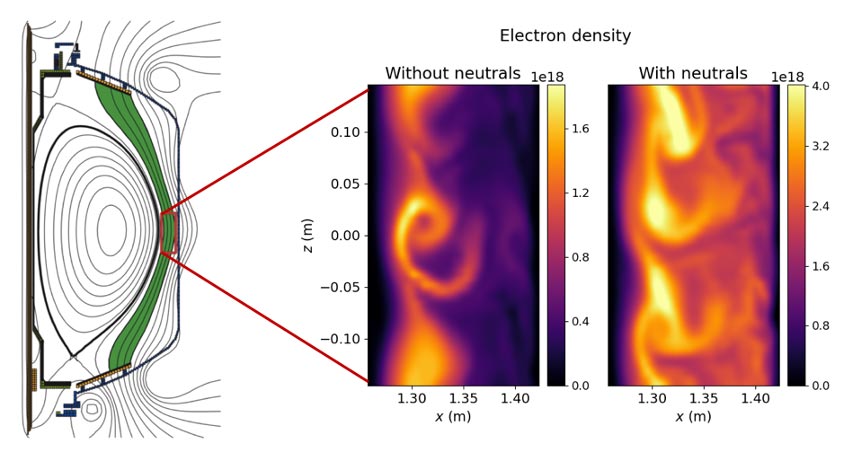
Large amounts of heat and particles, however, eventually need to be exhausted from the edge of the tokamak (Figure 1), and conditions in the exhaust region can impact the effectiveness of plasma confinement. Predicting plasma movement in this region is difficult due to the presence of turbulent structures called “blobs.” These are localized areas of higher pressure that can move heat and particles across magnetic field lines to material walls.
Neutral Particles Hold the Key to Plasma Behavior
Recent work using the computational plasma framework Gkeyll has revealed an important insight—that including chargeless neutral particles has a key impact on plasma behavior.
“Understanding and controlling plasma turbulence and transport in this region is very important since it impacts the lifetime of wall materials,” said Dr. Tess Bernard, who led the study in collaboration with scientists from General Atomics and the Princeton Plasma Physics Laboratory (PPPL). “This challenge is further complicated by the fact that neutral atoms in this region interact with plasma particles, and the effect of neutrals on plasma blob behavior is not well understood.”
The results with neutrals have significant differences in important plasma parameters—density, temperature, and flow levels. This can clearly be seen in Figure 1, where a comparison of plasma simulations near the wall of the National Spherical Torus Experiment (NSTX) at PPPL with and without neutral particles are shown. The inclusion of neutral particles also leads to reduced plasma fluctuations and slower blob motion.
Bridging Fluid and Kinetic Plasma Models
This result required a first-of-its-kind coupling between existing methods of simulating plasmas. Historically, a range of simulation tools based on theoretical models have been used to understand experimental observations in the tokamak and make predictions for current and future plasma devices. For example, kinetic models that track particles’ location and velocity are more accurate but also more computationally demanding. Fluid models, which track bulk properties such as density, flow and temperature, are generally less demanding but make assumptions that are not valid for all tokamak scenarios.
To be self-consistent, codes should contain models for both plasma and neutral dynamics. Comprehensive kinetic models for each, however, can be difficult to couple together due to prohibitive computational demands. Foreseeing this challenge, Gkeyll was developed with efficient algorithms that have facilitated the recent coupling of a gyrokinetic model for plasma dynamics to a kinetic model for neutral atoms. A gyrokinetic model relies on the fact that charged particles orbit quickly around magnetic field lines. This model averages this fast motion, modeling particles as charged rings and reducing the complexity of the problem.
Work is ongoing to verify this model with experimental data, and it will be a useful tool for benchmarking other codes. This work is important both in terms of informing future work to minimize the impact of disruptive blobs on fusion power plants, and as an example of the powerful plasma code that was used.
Meeting: 63rd Annual Meeting of the APS Division of Plasma Physics
TI02.00004: Effects of neutral transport on plasma scrape-off layer turbulence in gyrokinetic simulations
This material is based upon work supported by the U.S. Department of Energy, Office of Science, Office of Fusion Energy Sciences, Theory Program, under Award No. DE-FG02-95ER54309.
Never miss a breakthrough: Join the SciTechDaily newsletter.
Follow us on Google and Google News.