
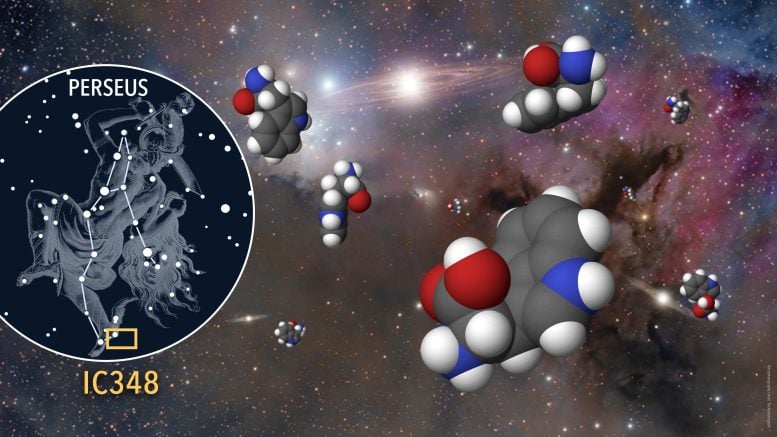
Scientists have detected tryptophan in space for the first time, suggesting that amino acids may be common in star-forming regions, potentially fostering life on exoplanets.
Tryptophan is among the 20 vital amino acids necessary for protein synthesis, crucial for life’s evolution on Earth. This amino acid has many spectral features in the infrared, as had been previously characterized by Susana Iglesias Groth, an IAC researcher.
Utilizing data from the Spitzer Space Observatory, she identified over 10 emission bands for this molecule, the strongest according to her laboratory measurements.
“Given the spectral coverage in the infrared, and the large spectroscopic database from the Spitzer telescope this amino acid was the obvious candidate to search for in space” explains the astrophysicist.
Searching for Amino Acids in Star-Forming Regions
The study took into account data from many regions of star and planet formation, but it was in one of the nearest and best-known regions, the molecular cloud complex in Perseus, and in particular in the stellar system IC 348 where the combination of all the spectroscopic data from the satellite has allowed us to attain the máximum sensitivity and to identify lines which tryptophan produces in the laboratory,
“IC 348 is an exceptional star formation region and an extraordinary chemical laboratory; thanks to its proximity to Earthy we can carry out some of the most sensitive searches for molecules in the interstellar medium” notes Iglesias-Groth, who has recently detected in the same region evidence for other molecules such as water (H20), carbon dioxide (CO2), hydrogen cyanide (HCN), acetylene (C2H), benzene (C6H6), policyclic aromatic hidrocarbons, and fullerenes, among others.
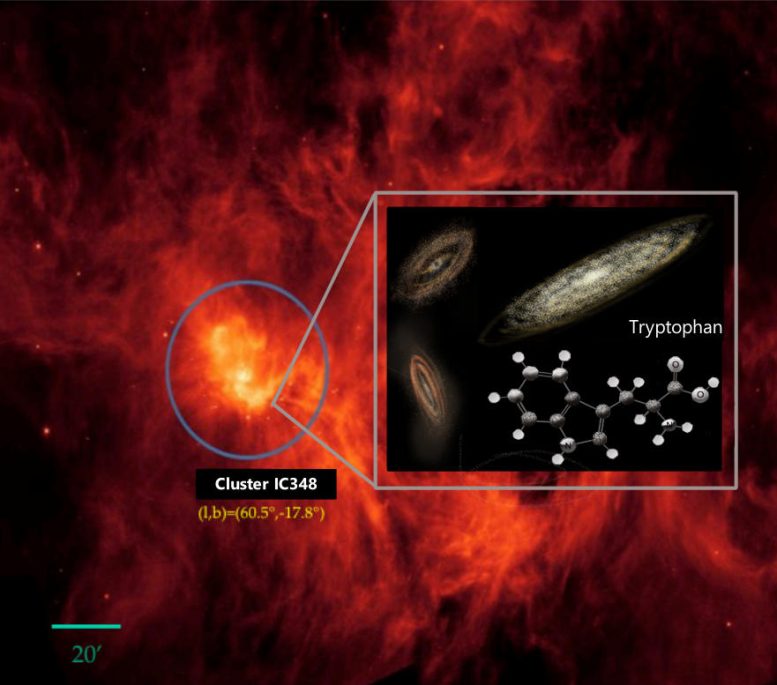
First Detection of Tryptophan in the Interstellar Medium
“The novelty of this work is that tryptophan has never before been detected in the interstellar medium, and furthermore, in spite of decades of research, there has been no confirmed detection of other amino acids in any other star formation region” emphasizes the researcher.
The study presents evidence that tryptophan-associated emission lines may also be present in other star-forming regions and suggests that its presence, and possibly that of other amino acids, is common in the gas from which stars and planets form. “It is likely that amino acids, the building blocks of proteins, may be enriching the gas in the protoplanetary discs and atmospheres of young, newly formed exoplanets and perhaps accelerating the emergence of life there,” says Iglesias-Groth.
The analysis of the emission bands of this molecule has also allowed us to estimate the temperature at which it is found in the gas of this cloud: about 280 Kelvin, i.e. close to zero degrees Celsius, a temperature very similar to that measured for molecular hydrogen and water in the interstellar medium of IC 348 in previous studies published by Iglesias-Groth. The new work also presents an estimate of the abundance of tryptophan in the same region: about ten billion times less abundant than molecular hydrogen.
Amino Acids and the Possibility of Life Beyond Earth
“It is well known that amino acids are part of meteorites and may have been present as early as the formation of the Solar System” explains Iglesias-Groth. “The discovery of tryptophan and, hopefully, of other amino acids in the future, could indicate that protein-building agents, which are key to the development of living organisms, exist naturally in the regions where stars and planetary systems form, and that life may be more common in our Galaxy than we could have predicted” she concludes.
Reference: “A search for tryptophan in the gas of the IC 348 star cluster of the Perseus molecular cloud” by Susana Iglesias-Groth, 22 May 2023, Monthly Notices of the Royal Astronomical Society.
DOI: 10.1093/mnras/stad1535
Never miss a breakthrough: Join the SciTechDaily newsletter.
Follow us on Google and Google News.