
Close Menu
    Facebook X (Twitter) Instagram
    SciTechDaily
    • Biology
    • Chemistry
    • Earth
    • Health
    • Physics
    • Science
    • Space
    • Technology
    Facebook X (Twitter) Pinterest YouTube RSS
    SciTechDaily
    Home»Space»Scientists Discover Amino Acid Essential for Life in Interstellar Space
    Space

    Scientists Discover Amino Acid Essential for Life in Interstellar Space

    By Royal Astronomical SocietySeptember 10, 20234 Comments3 Mins Read
    Facebook Twitter Pinterest Telegram LinkedIn WhatsApp Email Reddit
    Share
    Facebook Twitter LinkedIn Pinterest Telegram Email Reddit
    Space Nebula Concept
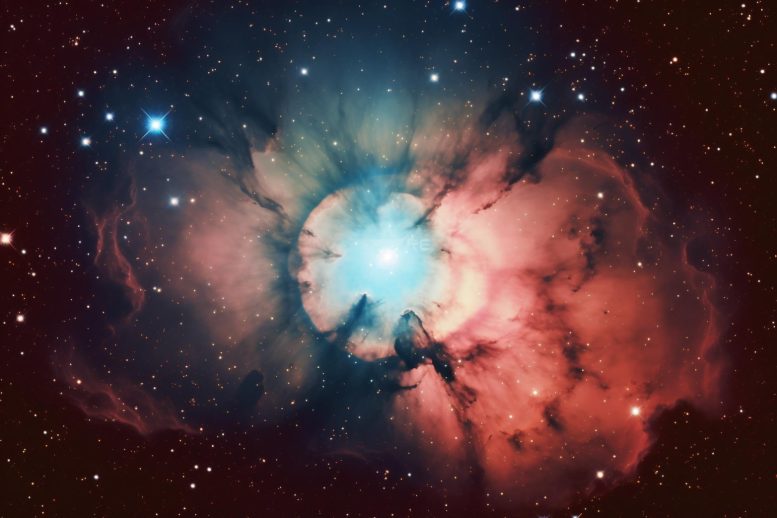
    Researchers discovered evidence of the amino acid tryptophan in the interstellar material of the IC348 star system using data from the Spitzer Space Observatory. This finding suggests that protein-building amino acids are prevalent in areas where stars and planets develop, hinting at the potential for life in exoplanetary systems.

    The discovery of tryptophan in a distant star-forming region hints that amino acids, crucial for life, may be widespread in space.

    Dr. Susana Iglesias-Groth from The Instituto de Astrofísica de Canarias (IAC) has used Spitzer space observatory data to uncover signs of the amino acid tryptophan in the interstellar material in a nearby star-forming region. The research was recently published in the journal Monthly Notices of the Royal Astronomical Society.

    High amounts of tryptophan were detected in the Perseus Molecular Complex, specifically in the IC348 star system, a star-forming region that lies 1000 light years away from Earth — relatively close in astronomical terms. The region is generally invisible to the naked eye, but shines brightly when viewed in infrared wavelengths.

    Tryptophan is one of the 20 amino acids essential for the formation of key proteins for life on Earth and produces one of the richest patterns of spectral lines in the infrared. It was therefore an obvious candidate to be explored using the extensive spectroscopic database of the Spitzer satellite, a space-based infrared telescope.
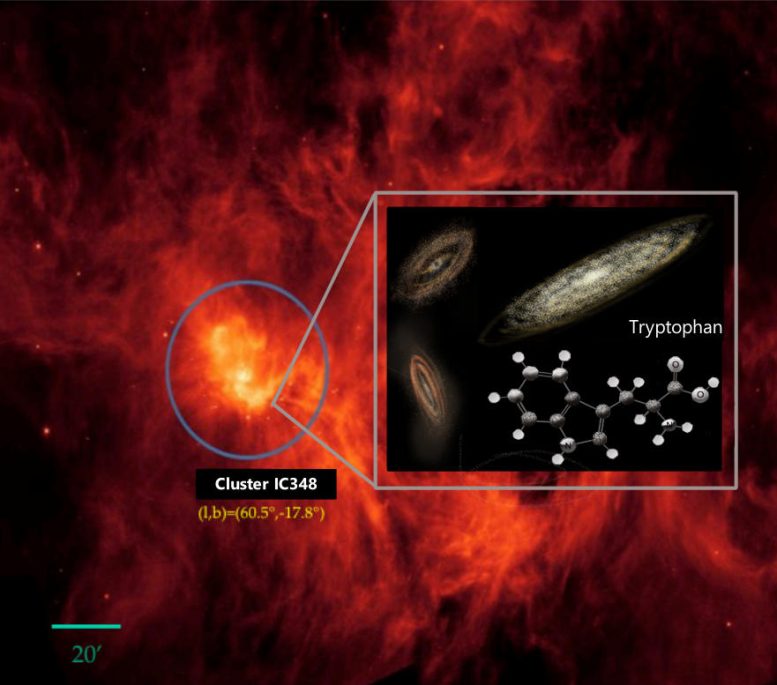
    Tryptophan Found in Space
    Tryptophan has been detected in space. Credit: Jorge Rebolo-Iglesias. Background image: NASA/Spitzer Space Telescope

    The analysis of the infrared light emitted from the region revealed 20 emission lines of the molecule tryptophan. The temperature of the tryptophan is about 280 Kelvin, or 7 degrees Celsius. Iglesias-Groth has previously found water and hydrogen at the same temperatures in IC348.

    The study suggests that the emission lines associated with tryptophan may also be present in other star-forming regions and that their presence is common in the gas and dust from which stars and planets form.

    Amino acids are commonly found in meteorites and were present during the formation of our Solar System.  This new work could indicate that these protein-building agents — that are key to the development of life — exist naturally in the regions where stars and planetary systems form, and may contribute to the early chemistry of planetary systems around other stars.

    Dr. Iglesias-Groth says, “The evidence for tryptophan in the Perseus molecular complex should encourage additional effort to identify other amino acids in this region and in other star-forming regions. It is a very exciting possibility that the building blocks of proteins are widely present in the gas from which stars and planets form — it may be key for the development of life in exoplanetary systems.”

    Reference: “A search for tryptophan in the gas of the IC 348 star cluster of the Perseus molecular cloud” by Susana Iglesias-Groth, 22 May 2023, Monthly Notices of the Royal Astronomical Society.
    DOI: 10.1093/mnras/stad1535

    Never miss a breakthrough: Join the SciTechDaily newsletter.
    Follow us on Google and Google News.

    Amino Acid Astrobiology Astronomy Popular Royal Astronomical Society Space Telescope
    Share. Facebook Twitter Pinterest LinkedIn Email Reddit

    Related Articles

    “Project Hail Mary” – These 45 Exoplanets Could Be Home to Alien Life, Scientists Say

    Unexplained Gases on Venus: Could They Be the Sign of Alien Life?

    Never Before Detected – Organic Molecule Essential for Life Found in Interstellar Space

    Habitable Planets With Earth-Like Biospheres May Be Much Rarer Than Thought

    Stellar Flares With a Chance of Radio Bursts: Space Weather Discovery Puts “Habitable Planets” at Risk

    Astronomers Discover New Way to “See” Elusive Dark Matter Halos

    NASA Planet-Hunter Data Reveals That 50% of Sun-Like Stars Could Host Potentially Habitable Planets

    Acidic Fluids: Finding Evidence of Life on Mars Just Got Harder

    Signs of Life on Venus? What This Means for Earthlings

    4 Comments

    1. Kevin S Maloney on September 10, 2023 7:15 pm

      Does this mean that these aliens are sleeping on their lazy boy recliners after their Thanksgiving Turkey Dinner like we Earthlings do?

      Reply
    2. Kevin S Maloney on September 10, 2023 7:17 pm

      FYI. Tryptophan is the chemical in Turkey that makes us sleepy.

      Reply
    3. dlsamg on September 11, 2023 8:40 am

      Science finds silicon. Could lead to computers.

      Reply
    4. Jeanne on November 23, 2023 8:22 am

      Aw, so it’s Not an amino acid we could ingest to live in outer space? I was pretty excited when I read the headline. Happy Tryptophan Day, everyone! 🦃

      Reply
    Leave A Reply Cancel Reply

    • Facebook
    • Twitter
    • Pinterest
    • YouTube

    Don't Miss a Discovery

    Subscribe for the Latest in Science & Tech!

    Trending News

    Scientists Discover Game-Changing New Way To Treat High Cholesterol

    This Small Change to Your Exercise Routine Could Be the Secret to Living Longer

    Scientists Discover 430,000-Year-Old Wooden Tools, Rewriting Human History

    AI Could Detect Early Signs of Alzheimer’s in Under a Minute – Far Before Traditional Tests

    What if Dark Matter Has Two Forms? Bold New Hypothesis Could Explain a Cosmic Mystery

    This Metal Melts in Your Hand – and Scientists Just Discovered Something Strange

    Beef vs. Chicken: Surprising Results From New Prediabetes Study

    Alzheimer’s Breakthrough: Scientists Discover Key Protein May Prevent Toxic Protein Clumps in the Brain

    Follow SciTechDaily
    • Facebook
    • Twitter
    • YouTube
    • Pinterest
    • Newsletter
    • RSS
    SciTech News
    • Biology News
    • Chemistry News
    • Earth News
    • Health News
    • Physics News
    • Science News
    • Space News
    • Technology News
    Recent Posts
    • Revolutionary Imaging Technique Unlocks Secrets of Matter at Extreme Speeds
    • Where Does Mass Come From? Scientists Find Evidence of a New Exotic Nuclear State
    • Quantum Breakthrough: Unhackable Keys Sent Over 120 km Using Quantum Dots
    • Researchers Discover Unknown Beetle Species Just Steps From Their Lab
    • Jellyfish Caught Feasting on Exploding Sea Worms for the First Time
    Copyright © 1998 - 2026 SciTechDaily. All Rights Reserved.
    • Science News
    • About
    • Contact
    • Editorial Board
    • Privacy Policy
    • Terms of Use

    Type above and press Enter to search. Press Esc to cancel.