
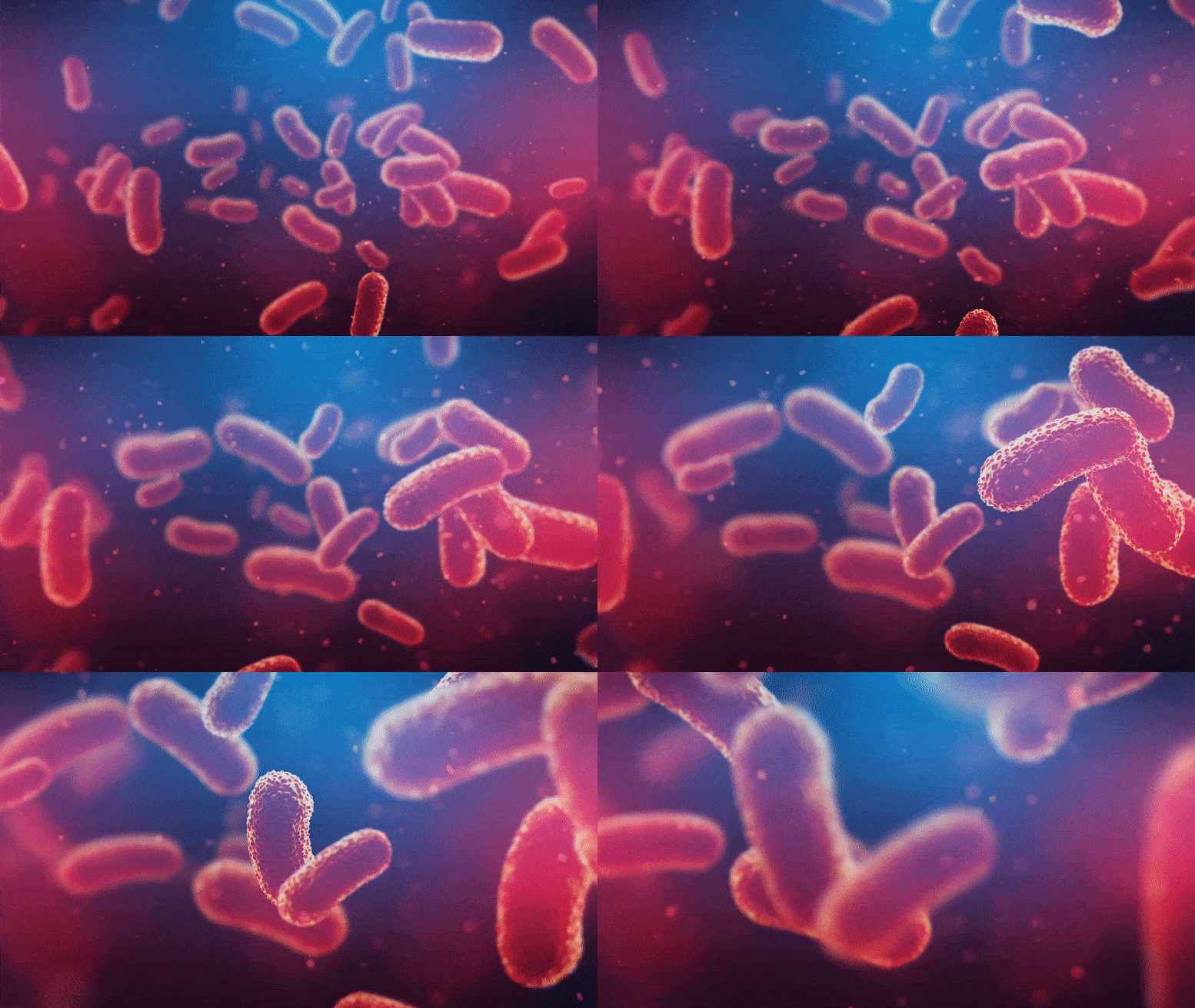
A New Antibiotic That Can Fight Against Resistant Bacteria
Antibiotics were long thought to be a miracle cure for bacterial infections. However, many pathogens have evolved to withstand antibiotics over time and thus the quest for new drugs is becoming more urgent. Researchers from the University of Basel were part of an international team that used computational analysis to identify a new antibiotic and deciphered its mode of action. Their research is an important step in the creation of new, powerful drugs.
The WHO refers to the steadily increasing number of bacteria that are resistant to antibiotics as a “silent pandemic.” The situation is made worse by the fact that there haven’t been many new drugs introduced to the market in recent decades. Even now, not all infections can be properly treated, and patients still run the risk of harm from routine interventions.
New active substances are urgently required to stop the spread of antibiotic-resistant bacteria. A significant finding has recently been made by a team headed by researchers from Northeastern University in Boston and Professor Sebastian Hiller from the University of Basel’s Biozentrum. The results of this research, which was a component of the National Center of Competence in Research (NCCR) “AntiResist” project, have recently been published in Nature Microbiology.
Tough Opponents
The researchers discovered the new antibiotic Dynobactin by a computational screening approach. This compound kills Gram-negative bacteria, which include many dangerous and resistant pathogens. “The search for antibiotics against this group of bacteria is far from trivial,” says Hiller. “They are well protected by their double membrane and therefore offer little opportunity for attack. And in the millions of years of their evolution, the bacteria have found numerous ways to render antibiotics harmless.”
Only last year, Hiller’s team deciphered the mode of action of the recently discovered peptide antibiotic Darobactin. The knowledge gained was integrated into the screening process for new compounds. The researchers made use of the fact that many bacteria produce antibiotic peptides to fight each other. And that these peptides, in contrast to natural substances, are encoded in the bacterial genome.
Fatal Effect
“The genes for such peptide antibiotics share a characteristic feature,” explains co-first author Dr. Seyed M. Modaresi. “According to this feature, the computer systematically screened the entire genome of those bacteria that produce such peptides. That’s how we identified Dynobactin.” In their study, the authors have demonstrated that this new compound is extremely effective. Mice with life-threatening sepsis caused by resistant bacteria survived the severe infection through the administration of Dynobactin.
By combining different methods, the researchers have been able to resolve the structure as well as the mechanism of action of Dynobactin. This peptide blocks the bacterial membrane protein BamA, which plays an important role in the formation and maintenance of the outer-protective bacterial envelope. “Dynobactin sticks in BamA from the outside like a plug and prevents it from doing its job. So, the bacteria die,” says Modaresi. “Although Dynobactin has hardly any chemical similarities with the already known Darobactin, nevertheless it has the same target on the bacterial surface. This, we didn’t expect at the beginning.”
A Boost for Antibiotics Research
On the molecular level, however, the scientists have discovered that Dynobactin interacts differently with BamA than Darobactin. By combining certain chemical features of the two, potential drugs could be further improved and optimized. This is an important step on the way to an effective drug. “The computer-based screening will give a new boost to the identification of urgently needed antibiotics,” says Hiller. “In the future, we want to broaden our search and investigate more peptides in terms of their suitability as antimicrobial drugs.”
Reference: “Computational identification of a systemic antibiotic for Gram-negative bacteria” by Ryan D. Miller, Akira Iinishi, Seyed Majed Modaresi, Byung-Kuk Yoo, Thomas D. Curtis, Patrick J. Lariviere, Libang Liang, Sangkeun Son, Samantha Nicolau, Rachel Bargabos, Madeleine Morrissette, Michael F. Gates, Norman Pitt, Roman P. Jakob, Parthasarathi Rath, Timm Maier, Andrey G. Malyutin, Jens T. Kaiser, Samantha Niles, Blake Karavas, Meghan Ghiglieri, Sarah E. J. Bowman, Douglas C. Rees, Sebastian Hiller and Kim Lewis, 26 September 2022, Nature Microbiology.
DOI: 10.1038/s41564-022-01227-4
Never miss a breakthrough: Join the SciTechDaily newsletter.
Follow us on Google and Google News.
4 Comments
It also kills off the microbiome.
Of all the negligent and dangerous practises that doctors undertake, is when they give their patients antibiotics, and offer no probiotic at the end of the course of antibiotics, to restore the good gut bacteria that is vital for long-term health.
Peter is correct. Astute providers should recommend or give probiotics to restore gut health. Knowing this, we use yogurt vs sour cream to support our belly processes.
Thank u peter n others. Didn’t know about the probiotics. So when is best time to start them?
@A Shaw…
If you’re asking me, if you’re eating a poor diet and take medication, you should be taking probiotics all the time.
Seek out a holistic practitioner or Naturopath for more advice.