
Next Step in Simulating the Universe
Researchers led by the University of Tsukuba devise a new approach to show how ghost-like neutrinos helped shape the Universe.
Computer simulations have struggled to capture the impact of elusive particles called neutrinos on the formation and growth of the large-scale structure of the Universe. But now, a research team from Japan has developed a method that overcomes this hurdle.
In a study published recently in The Astrophysical Journal, researchers led by the University of Tsukuba present simulations that accurately depict the role of neutrinos in the evolution of the Universe.
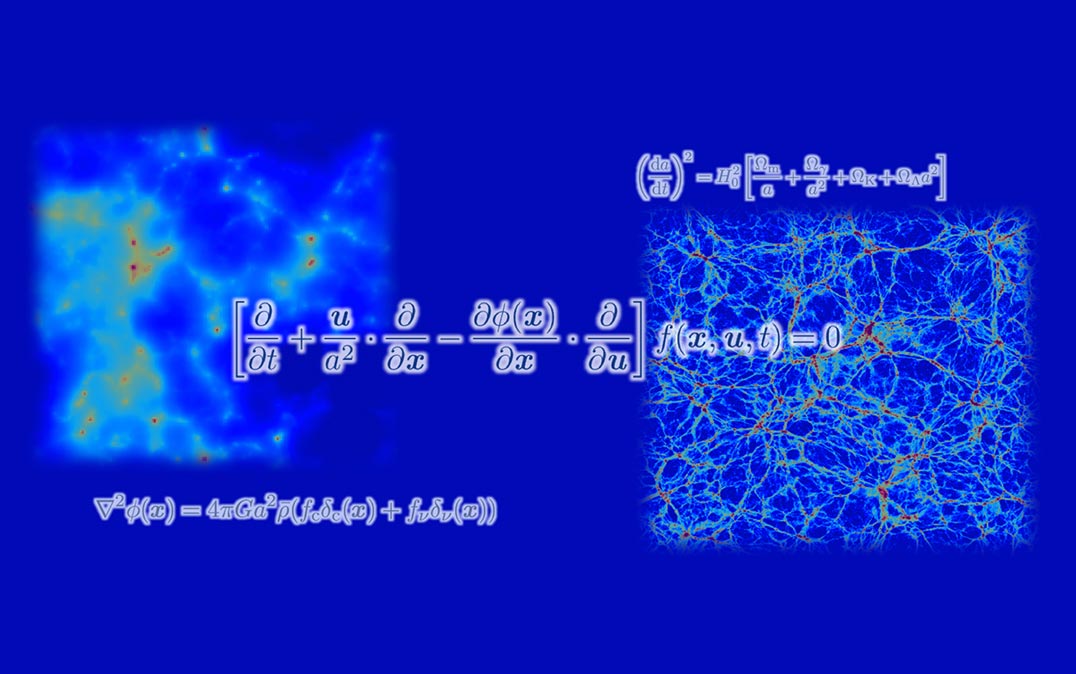
Why are these simulations important? One key reason is that they can set constraints on a currently unknown quantity: the neutrino mass. If this quantity is set to a particular value in the simulations and the simulation results differ from observations, that value can be ruled out. However, the constraints can be trusted only if the simulations are accurate, which was not guaranteed in previous work. The team behind this latest research aimed to address this limitation.
“Earlier simulations used certain approximations that might not be valid,” says lead author of the study Lecturer Kohji Yoshikawa. “In our work, we avoided these approximations by employing a technique that accurately represents the velocity distribution function of the neutrinos and follows its time evolution.”
To do this, the research team directly solved a system of equations known as the Vlasov–Poisson equations, which describe how particles move in the Universe. They then carried out simulations for different values of the neutrino mass and systemically examined the effects of neutrinos on the large-scale structure of the Universe.
The simulation results demonstrate, for example, that neutrinos suppress the clustering of dark matter—the ‘missing’ mass in the Universe—and in turn galaxies. They also show that neutrino-rich regions are strongly correlated with massive galaxy clusters and that the effective temperature of the neutrinos varies substantially depending on the neutrino mass.
“Overall, our findings suggest that neutrinos considerably affect the large-scale structure formation, and that our simulations provide an accurate account for the important effect of neutrinos,” explains Lecturer Yoshikawa. “It is also reassuring that our new results are consistent with those from entirely different simulation approaches.”
This work represents a milestone in simulating the Universe and paves the way for further exploration of how neutrinos influence the formation and growth of the large-scale structure. For instance, the new simulation approach could be used to study the dynamics of neutrinos and unconventional types of dark matter. Ultimately, it might lead to a determination of the neutrino mass.
Read Solving a Cosmological Ghost Particle Mystery: Theory That Neutrinos Shape the Universe Validated for more on this research.
Reference: “Cosmological Vlasov–Poisson Simulations of Structure Formation with Relic Neutrinos: Nonlinear Clustering and the Neutrino Mass” by Kohji Yoshikawa, Satoshi Tanaka, Naoki Yoshida and Shun Saito, 30 November 2020, The Astrophysical Journal.
DOI: 10.3847/1538-4357/abbd46
Never miss a breakthrough: Join the SciTechDaily newsletter.
Follow us on Google and Google News.
3 Comments
…. ∉ ♦ ,,,
The second figure illustrates nicely how neutrinos is < 0.2 % of the total dark matter budget.
That figure also seems to imply that one can extract the dark matter particle mass from the estimated neutrino masses. But for that they didn't use the Vlasov-Possion flow but the usual N-body simulation with dark matter proxies that aren't very sensitive to mass. E.g. they use a few massive particles that can effectively represent the many real dark matter particles.
The additional physics tests the current cosmology well, since the outcome is not significantly different. The cosmic mean neutrino temperature is used in current cosmological models, while here the "effective local neutrino "temperature" around massive galaxy clusters varies by several percent with respect to the cosmic mean; the neutrinos in clusters can be hotter or colder depending on the neutrino mass."
It is a judgement call if "several percent" of difference in neutrino temperatures "considerably affect the large-scale structure formation", but that bit looks – at least superficially – as an oversell. But it is an improvement on cosmology and on neutrino physics both!
… We, kind of live on the third rock left of the Sun, also known as the Earth.
The most lucky gift to keep us, down to the Earth, are our limitations to understand, all of the information, that we perceive, at one.
Usually, we strive for more. However, less is actually more. Our imperfections, are the building blocks, that we need in order to carry along the path, called life.
Due to the limitations of a human thought, it is, just, so puzzling, how far humans, as a kind have reached out, and if we add on top of that the inherited limitation of scientific method, too.
Folksonomies, aren’t good material for a reasonable discussion, any way…
… It would lead to “legitimate” questions like:
– physics vs philosophy,
– physics vs theology,
etc…
… I just prefer to back track from a dead end, however some prefer to get stuck in a moment, that yield no progress at all…