
Close Menu
    Facebook X (Twitter) Instagram
    SciTechDaily
    • Biology
    • Chemistry
    • Earth
    • Health
    • Physics
    • Science
    • Space
    • Technology
    Facebook X (Twitter) Pinterest YouTube RSS
    SciTechDaily
    Home»Space»New Cassini Images of Saturn’s Moon Dione
    Space

    New Cassini Images of Saturn’s Moon Dione

    By Elizabeth Landau / Preston Dyches, Jet Propulsion LaboratoryJune 19, 2015No Comments2 Mins Read
    Facebook Twitter Pinterest Telegram LinkedIn WhatsApp Email Reddit
    Share
    Facebook Twitter LinkedIn Pinterest Telegram Email Reddit
    Cassini Views of Saturn's Moon Dione
    This was Cassini’s fourth targeted flyby of Dione and the spacecraft had a close approach altitude of 321 miles (516 kilometers) from Dione’s surface. The bright rings of Saturn can be seen at left, in the background of the image. North on Dione is up and rotated 44 degrees to the left. The image was taken in visible light with the Cassini spacecraft narrow-angle camera on June 16, 2015. The view was acquired at a distance of approximately 48,000 miles (77,000 kilometers) from Dione and at a sun-Dione-spacecraft, or phase, angle of 128 degrees. Image scale is 1,519 feet (463 meters) per pixel. Credit: NASA/JPL-Caltech/Space Science Institute

    NASA’s Cassini Spacecraft reveals it latest flyby images of Saturn’s moon Dione.

    The rugged landscape of Saturn’s fracture-faced moon Dione is revealed in images sent back by NASA’s Cassini spacecraft from its latest flyby. Cassini buzzed past Dione on June 16, coming within 321 miles (516 kilometers) of the moon’s surface.

    Raw, unprocessed images from the flyby are available via the Cassini mission website at:http://saturn.jpl.nasa.gov/photos/raw
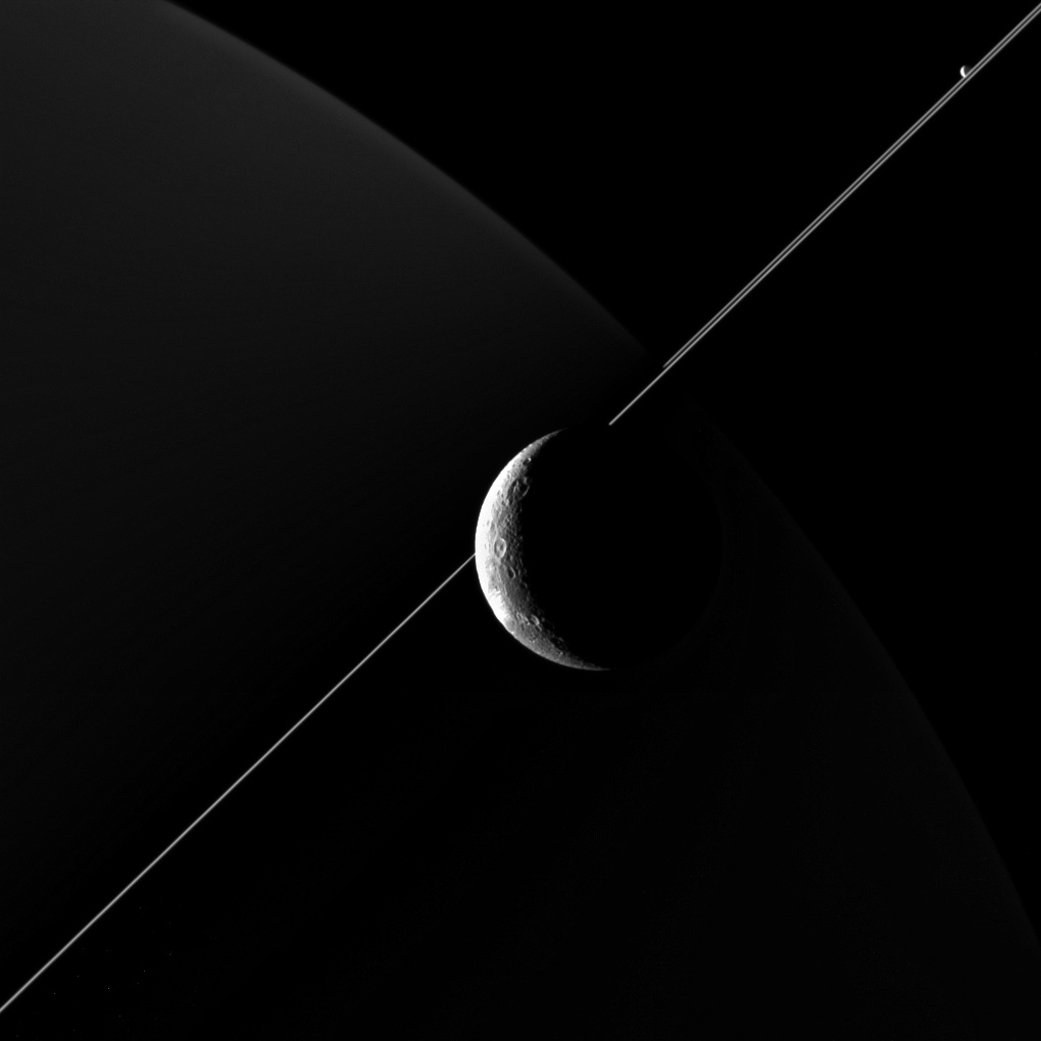
    New Image of Dione
    The view was acquired at a distance of approximately 48,000 miles (77,000 kilometers) from Dione and at a sun-Dione-spacecraft, or phase, angle of 128 degrees. Image scale is 3 miles (5 kilometers) per pixel. Credit: NASA/JPL-Caltech/Space Science Institute

    On August 17, the spacecraft will make its final flyby of Dione, diving to within 295 miles (474 kilometers) of the surface. The final Dione encounter will be Cassini’s second-closest brush with the icy moon. A December 2011 flyby saw the spacecraft reach an altitude of just 60 miles (100 kilometers) above Dione.

    The Cassini-Huygens mission is a cooperative project of NASA, ESA (European Space Agency) and the Italian Space Agency. NASA’s Jet Propulsion Laboratory in Pasadena, California, manages the mission for the agency’s Science Mission Directorate in Washington. JPL is a division of the California Institute of Technology in Pasadena. The Cassini imaging operations center is based at the Space Science Institute in Boulder, Colorado.

    Never miss a breakthrough: Join the SciTechDaily newsletter.
    Follow us on Google and Google News.

    Astronomy Cassini-Huygens Mission Dione Planetary Science
    Share. Facebook Twitter Pinterest LinkedIn Email Reddit

    Related Articles

    A Striking View of Saturn’s Moon Dione

    Cassini Image Shows Saturn’s Rings with Dione and Epimetheus

    Cassini Views Crater Duo on Saturn’s Moon Dione

    Dione Divided – Dione Appears Cut in Two By Saturn’s Rings

    New Cassini Image – Dione Before the Rings

    Cassini Views Dione and Enceladus

    NASA’s Cassini Spacecraft Views Dione for the Last Time

    Cassini Spacecraft Will Make Last Close Flyby of Dione in August

    Cassini Spots a Nile Like River Valley on Titan

    Leave A Reply Cancel Reply

    • Facebook
    • Twitter
    • Pinterest
    • YouTube

    Don't Miss a Discovery

    Subscribe for the Latest in Science & Tech!

    Trending News

    Mezcal “Worm” in a Bottle Mystery: DNA Testing Reveals a Surprise

    New Research Reveals That Your Morning Coffee Activates an Ancient Longevity Switch

    This Is What Makes You Irresistible to Mosquitoes

    Shockingly Powerful Giant Octopuses Ruled the Seas 100 Million Years Ago

    Scientists Stunned by New Organic Molecules Found on Mars

    Rewriting Dinosaur Evolution: Scientists Unearth Remarkable 150-Million-Year-Old Stegosaur Skull

    Omega-3 Supplements Linked to Cognitive Decline in Surprising New Study

    First-of-Its-Kind Discovery: Homer’s Iliad Found Embedded in a 1,600-Year-Old Egyptian Mummy

    Follow SciTechDaily
    • Facebook
    • Twitter
    • YouTube
    • Pinterest
    • Newsletter
    • RSS
    SciTech News
    • Biology News
    • Chemistry News
    • Earth News
    • Health News
    • Physics News
    • Science News
    • Space News
    • Technology News
    Recent Posts
    • This New Chip Could Make GPUs Far More Efficient
    • This Tiny World in the Outer Solar System Should Be Airless, but It Has an Atmosphere
    • NASA’s Webb Space Telescope Reveals a Dark Airless Super-Earth That Looks Like Mercury
    • These Simple Daily Habits Can Quickly Improve Blood Pressure and Heart Risk Factors
    • A Common Nutrient May Play a Surprising Role in Anxiety
    Copyright © 1998 - 2026 SciTechDaily. All Rights Reserved.
    • Science News
    • About
    • Contact
    • Editorial Board
    • Privacy Policy
    • Terms of Use

    Type above and press Enter to search. Press Esc to cancel.